

Automated glossary generation works best when definitions are grounded in your own approved documents, reviewed by a subject expert before publishing, and paired with visible author names, update dates, and source citations. Search engines and AI systems are more likely to cite glossary pages that have stable URLs and clear attribution, so skipping the review step risks creating pages that neither humans nor AI will trust. Start with an audit of your existing content before automating, and plan to review glossaries quarterly—or monthly for regulated or fast-changing terms.
Make Glossary Pages AI Citable: Audit First Automation for UK SEO

An AI glossary generator extracts key terms from your content and drafts definitions automatically, usually by scanning existing pages or a supplied document set. We recommend automation when it is paired with source grounding and a human review gate, because unreviewed output risks factual drift. Done well, the approach builds topical authority quickly; done without oversight, it produces pages search engines and AI systems have no reason to trust.
***
TL;DR: >- Ground every definition in approved first party documents, attach a source citation, and require a named subject expert to verify accuracy before publication.- Review most glossaries quarterly, but check regulated or fast changing terms monthly and trigger another review whenever an underlying source document changes.- Robots.txt cannot distinguish ordinary search indexing from AI training or answer generation, so set and test crawler permissions separately for each content class.- Publish stable canonical URLs, author names, update dates, and primary references; missing attribution or accidental crawler blocks can keep glossary pages from being cited.
***
Table of Contents
- What is an AI glossary generator?
- How AI glossary generation works
- Why glossary pages matter for SEO and AI visibility
- A practical automation workflow for citable glossary pages
- Technical controls and legal considerations that affect AI access
- Tools and embedding options for your glossary
- Our audit-first playbook for citable glossary pages
- Automation is the easy part, review is what earns citations
- Get a free AI audit before you automate
- FAQ
- Sources
What is an AI glossary generator?
An AI glossary generator is software that identifies terminology in a body of content and produces draft definitions, often alongside metadata such as source references and related terms. Inputs typically include a website's existing pages, a product document set, or an uploaded corpus of industry material. Outputs range from a simple term and definition pair to a fully structured entry with citations, last-updated dates and internal links.
Three deployment categories dominate the market:
- CMS plugins or widgets that scan a WordPress or Shopify site and generate entries inside the existing page structure.
- Standalone SaaS generators that ingest a document set and export glossary content for manual placement.
- Custom retrieval-augmented generation (RAG) pipelines built by technical teams who want control over source documents and review workflow.
Each entry, regardless of the tool, should carry the same core structure: a term, a definition, a source reference, and metadata recording who approved it and when.
How AI glossary generation works
Most pipelines follow a consistent technical sequence, whether delivered through a plugin or a custom build.
- Term discovery. The system scans content using frequency analysis, named-entity recognition and semantic clustering to surface candidate terms worth defining.
- Definition generation. The tool retrieves relevant passages from approved source documents and drafts a definition grounded in that material, rather than relying on the model's general training data.
- Quality control. Each draft carries a confidence score, and entries below a set threshold route to a human reviewer before publication.
- Integration. Approved entries publish into the CMS and connect to site search, so a glossary term surfaces in both the A to Z index and relevant on-page search results.
The grounding step matters most. Retrieval-augmented generation helps reduce hallucinations by giving a model current, approved material at the point of generation, rather than letting it draft from memory alone. For a glossary, that means feeding the system your own product documentation, style guides or technical specifications, not leaving it to infer definitions unassisted.
Pro Tip: Require a source citation on every generated definition before it reaches the review queue, so reviewers can check grounding instead of researching from scratch.
Why glossary pages matter for SEO and AI visibility
Glossary pages earn their keep through long-tail search traffic and topical authority, and they are increasingly a route into AI-generated answers. A well-structured glossary signals depth across a subject area, which search engines and AI systems both use as a trust indicator when deciding what to cite.
Several factors increase citation likelihood:
- Stable URLs that do not change or redirect, so a citation remains valid over time.
- Visible authorship and update dates, which give an AI system a reason to treat the page as current and accountable.
- Primary source references embedded in each definition, rather than unsupported assertions.
Visible metadata, including author, update date and primary reference, is a low-effort trust signal that improves downstream identifiability, a point the Publisher CR final decision makes in the context of publisher attribution and control.
There is a trade-off worth naming early: making a glossary page easy for AI systems to crawl and cite also makes it easy to reuse without permission. We return to that tension in the technical controls section below.
A practical automation workflow for citable glossary pages
Treat glossary production as a pipeline with a fixed review gate, not a one-click export.
- Ingest the corpus. Pull in approved first-party documents: product pages, technical specs, support content.
- Generate candidate terms. Run term discovery across the corpus and rank candidates by search demand and content gaps.
- Run retrieval-augmented generation. Draft each definition against retrieved passages from the approved corpus, with a citation attached.
- Route to subject-expert review. A named reviewer checks accuracy, tone and citation validity before anything publishes.
- Publish with full metadata. Every live entry carries an author, an update date, a canonical URL and a source reference.
Pro Tip: Set a re-review trigger whenever a source document changes, rather than relying solely on a calendar cadence, so outdated definitions do not linger after an underlying policy or spec shifts.
A quarterly review cadence suits most glossaries, though regulated or fast-moving terminology (data protection, AI policy, financial rules) merits a monthly check instead.
Technical controls and legal considerations that affect AI access
Robots.txt cannot reliably separate "allow search indexing" from "allow AI training" or "allow generative-AI use at query time". That is the core limitation UK guidance identifies, and it changes how you should think about glossary access.
Robots.txt does not provide granular control over whether content is used for ordinary search, AI training, or generative AI responses.
That finding comes from the impact assessment on copyright and artificial intelligence, and it has a direct consequence for glossary pages specifically: a blanket block protects content from reuse but also removes it from the pool AI systems might otherwise cite.
Practical steps that follow from this:
- Decide per content class, not site-wide. A glossary you want cited should carry different permissions from a paywalled or proprietary page.
- Test crawler permissions against your visibility objective before committing changes across the whole site. Our guide to robots.txt for AI covers copyable policy patterns for this.
- Verify which crawlers are actually reaching your pages using our AI crawler user agent guidance, or a reference list such as identifying Googlebot, Bingbot and AI crawlers.
- Document and publish your access policy, including a plain-language explanation of what you allow and why, so the choice is transparent to both readers and auditors.
Tools and embedding options for your glossary
Choosing an implementation route depends less on budget and more on how much editorial control you need over the output.
The main categories are CMS plugins and widgets for teams who want speed, SaaS generators for teams who want a document-in, content-out workflow, and custom RAG pipelines for teams with in-house technical resource and strict source requirements. Embedding patterns include a searchable widget, hover-style inline definitions, a traditional A to Z index, and automated term linking that connects glossary entries to mentions elsewhere on the site.
Before committing to a route, check:
- Review workflow: does the tool support a mandatory human approval step, or does it publish automatically?
- Data residency: where does the corpus and generated content live, and does that match your compliance requirements?
- Maintenance cost: who re-reviews entries when source documents change?
- Accessibility: do hover definitions and widgets work with screen readers and keyboard navigation?
Our audit-first playbook for citable glossary pages
We check six dimensions of AI citability in every free audit, and glossary pages touch most of them directly: technical health, schema markup, source grounding, authority signals, platform coverage and access policy. A glossary that scores poorly usually has the same three gaps: no visible author or update date, no source reference per entry, and a robots.txt or meta-tag configuration that accidentally blocks the AI platforms it is meant to reach.
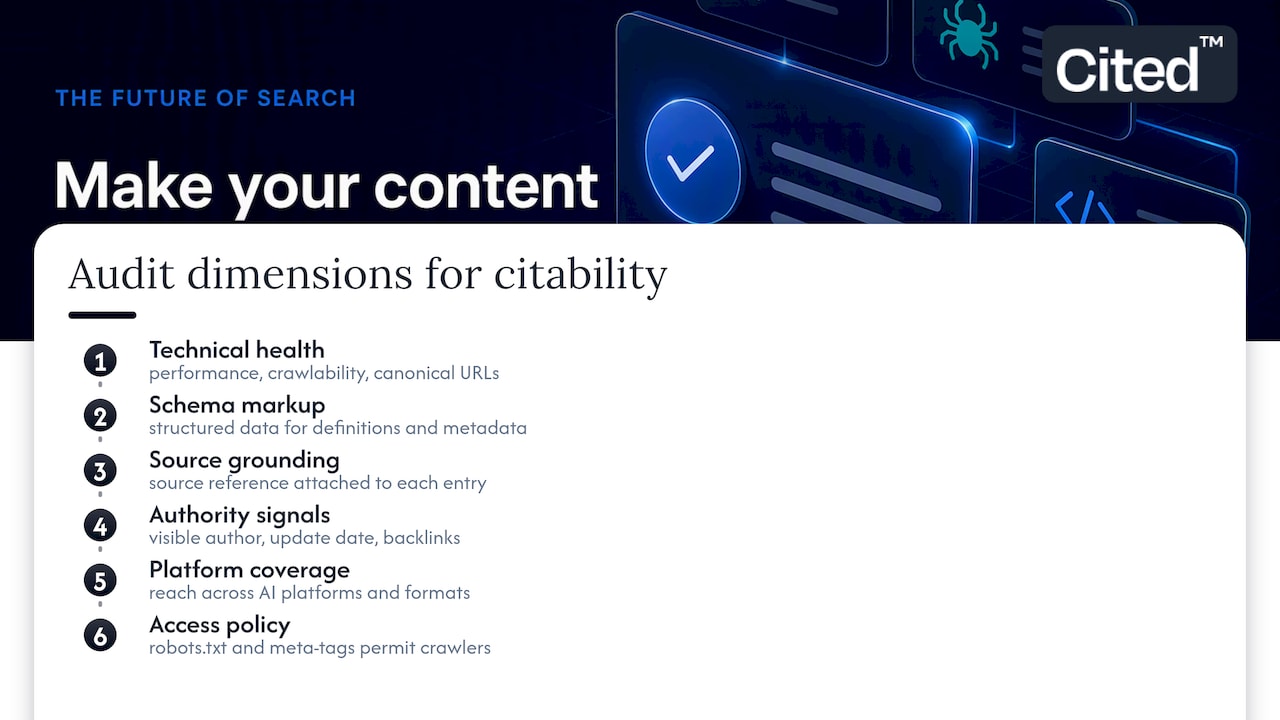
The fixes are rarely complicated. Adding stable canonical URLs, attaching a source reference to each definition, and correcting crawler permissions at the page level typically moves a glossary from invisible to citable within one implementation pass, built on the technical SEO practices that make any page easier for an AI system to source.
Automation is the easy part, review is what earns citations
The received wisdom on AI glossary tools treats automation as the whole story: generate a few hundred entries overnight, publish, and wait for traffic. That misses the point. Term extraction and draft generation are commodity capabilities now. What separates a glossary that gets cited from one that gets ignored is the review layer: a named person checking each definition against a real source before it goes live.
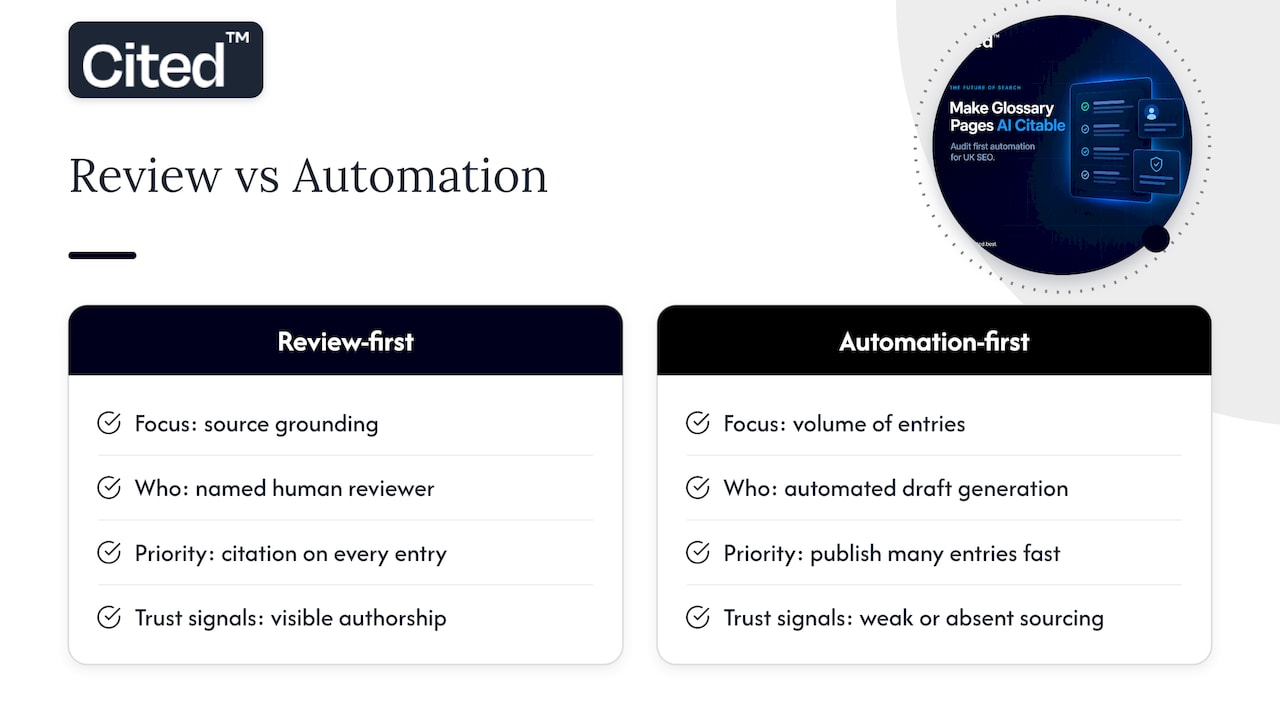
We think most teams under-invest in that step because it is the least exciting part of the project. It is also the part that determines whether an AI system treats your glossary as a reliable source or skips it in favour of a competitor's page with clearer attribution. If you can only do one thing well, make it the citation on every entry, not the volume of entries you publish.
Prioritise source grounding and a human reviewer before you prioritise coverage. A smaller glossary with verified definitions and visible authorship will outperform a larger one built on unreviewed output, because the trust signals that matter to AI systems are the same ones that matter to readers.
— Tom Heaton
Get a free AI audit before you automate
We offer a free AI visibility audit that checks whether your glossary pages, and the rest of your site, are structured for AI citation before you invest in automation.
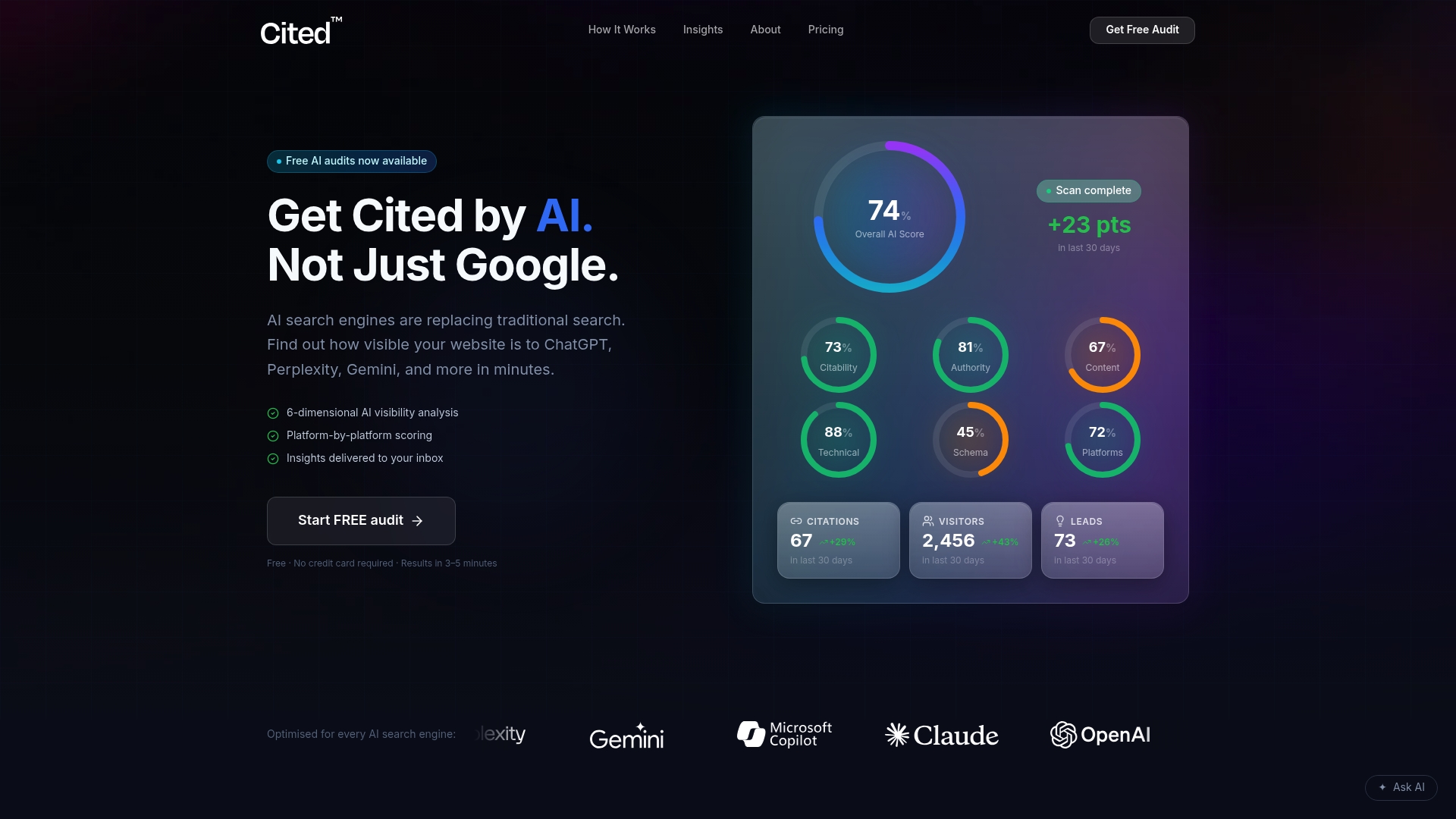
The audit flags missing authorship, weak source grounding and crawler permissions that block the platforms you actually want to reach. From there:
- Run the free audit at Cited, no card or account required.
- Request a prioritised fixes plan if the audit surfaces glossary or metadata gaps.
- Move to Technical Fixes from £495 one-off, or the AI Optimised plan from £995 per month, for ongoing implementation.
FAQ
What is a glossary page?
A glossary page is a single destination listing key terms and their definitions for a specific subject or industry. It helps readers find quick explanations without searching through full articles, and it signals topical depth to search engines.
What is a glossary page on a website?
On a website, a glossary page typically sits as its own URL or section, often organised alphabetically with internal links back to related content. Well-built versions include source references, author attribution and update dates, which strengthen both reader trust and AI citation likelihood.
What is an example of a glossary?
A software company's glossary might define terms like "API", "latency" or "retrieval-augmented generation", each with a plain-language explanation and a link to deeper technical documentation. The structure stays consistent: term, definition, source, and a date showing when it was last checked.
Which AI is best for vocabulary?
There is no single verified ranking of AI tools for vocabulary or glossary generation, since capability depends on the source material you feed the system and the review process around it. A tool grounded in retrieval-augmented generation against your own approved documents, with a mandatory human review step, consistently outperforms one that drafts from general training data alone.
How often should an AI-generated glossary be reviewed?
Most glossaries benefit from a quarterly review cycle, with an additional trigger whenever an underlying source document changes. Fast-moving or regulated terminology, such as AI policy or data protection terms, often needs a monthly check instead.
Sources
- Report on copyright and artificial intelligence
- Report and impact assessment on copyright and artificial intelligence
- Publisher CR final decision
Recommended
Ready for your AI score?
See how visible your site is to ChatGPT, Perplexity & Gemini.
Start FREE auditResults in minutes · 100% free