
To get your content cited by AI systems, you need four key elements: a visible Sources section with links and explanations, a source pack mapping each claim to approved evidence, clear author credentials and dates, and proper schema markup like Article and FAQ JSON-LD. Structure matters just as much—AI models cite content more often when it uses question-based headings, answer-first paragraphs, and short isolated sentences they can extract cleanly. The fastest win is adding a visible Sources section paired with schema markup, which signals to AI that your claims are verifiable and trustworthy.
Source Lists Page Audit: 4 Elements That Make It AI Citation Ready for SEOs and Devs
A source lists page lists the human-readable sources a piece of content relies on, alongside machine-readable metadata so AI models can verify and cite it. The single change that moves the needle fastest: add a visible Sources section with a link and a one-line rationale for each entry, then wire up Article and FAQ JSON-LD so the same claims are machine-readable too.
***
TL;DR: >- Adding a visible Sources section with clear links and rationales significantly improves the likelihood of AI citation, especially when paired with proper schema markup.- Ensuring each factual claim is mapped to an approved, verifiable source and avoiding unsupported vendor claims prevents credibility drops and strengthens content trustworthiness.- Structuring content with answer-first sections, question-based headings, short paragraphs, and up-to-date tables enhances AI extractability and accuracy in generated answers.- Monitoring citations at multiple intervals ensures early detection of issues, with schema validation and indexing checks being critical in the first 48 hours after publishing.- Fixing missing or hidden sources quickly boosts citation chances and can be supported by professional services offering audits, schema implementation, and ongoing monitoring.
***
Table of Contents
- What must a source lists page include?
- Which structural patterns make content extractable by AI?
- How do you write the Sources section and build a source pack?
- Which schema and metadata signals should you add?
- How do you monitor whether a page is actually getting cited?
- Practitioner perspective: lessons from Cited and Tom Heaton
- Get a free AI visibility audit from Cited
- Useful sources and validators to read next
- Sources
- FAQ
What must a source lists page include?
A citation-ready page needs four load-bearing elements, and skipping any one of them weakens the whole structure. AI models are checking whether a claim can be traced back to something verifiable, and a page that fails that check quietly drops out of consideration.
- A visible Sources section. Every source gets a link and one sentence explaining why it backs the claim above it, not a dumped list of URLs at the bottom.
- A claim inventory or source pack. This maps each factual claim in the article to a single approved source, so nothing gets published without evidence behind it. The source pack framework from Gregory Shevchenko sets out exactly what that artefact should contain: primary prompt, approved sources, rejected evidence, and a source-to-section map.
- A visible author byline with credentials, plus publish and update dates. Google's own guidance treats crawlability and clear authorship signals as baseline requirements for eligibility in AI-generated features.
- Primary-over-secondary sourcing rules. Government data, peer-reviewed research, and named studies rank above blog summaries of those same studies, and vendor claims with no supporting evidence get rejected outright.
Which structural patterns make content extractable by AI?
Structure decides whether a model can lift a clean, quotable answer out of your page or has to guess at one. Pages built with clear H2 and H3 headings and bullet structures are cited substantially more often than pages written as unbroken prose, because the model can locate the answer without reconstructing it from context.
- Answer first, detail second. Open every section with a direct one or two sentence answer, then support it. Opening paragraphs that answer the query upfront get cited 67% more often in some tested cases.
- Write headings as questions. "How does X work?" extracts more cleanly than "Understanding X," because it mirrors how people actually search and how models frame retrieved answers.
- Add a TL;DR to any section running past 200 words. Long sections without a summary line force the model to compress your argument itself, and compression introduces errors you don't control.
- Keep paragraphs short and isolate your best sentence. A single standalone sentence with no supporting clause attached is easier to lift whole than one buried in a longer paragraph.
- Use tables for comparisons and keep the numbers current. A stale figure in a table is worse than no table at all. A model has no way to flag it as outdated.
Pro Tip: Take your single most quotable sentence per section, strip it of any dependent clause, and give it its own paragraph. Tag it as the "answer snippet" in your source pack so anyone editing the page later knows not to bury it again.
How do you write the Sources section and build a source pack?
Write each entry as link, one-line rationale, and the claims it supports, not as an unannotated pile of URLs. Practical templates for AI-cited content consistently favour two well-chosen annotated links over ten bare ones, because the rationale is what tells a model (and a human reader) why that source earns its place.
Element | What it contains | Why it matters |
|---|---|---|
Link | The primary or best available secondary source | Gives AI something to verify against |
Rationale | One sentence on why this source supports the claim | Turns a bibliography into evidence |
Claims supported | The specific sentence or stat it backs | Prevents one source being stretched to cover unrelated claims |
Building the source pack behind that section follows a fixed sequence:
- List every factual claim in the draft before publishing, not after.
- Map each claim to one approved source; if no source clears the bar, cut the claim or soften it to a qualitative statement.
- Log rejected evidence too, including vendor claims with no data behind them and any AI-generated screenshot offered as "proof."
- Keep the Sources section visible on the page itself. A hidden or footnoted version defeats the purpose: it stops being an evidence boundary and starts being decoration.
Which schema and metadata signals should you add?
Article and FAQPage schema are the two structured data types doing the most work for citation eligibility. Structured data is not strictly required for Google's generative features, but it materially helps eligibility when paired with a technically sound, crawlable page.
- Article or BlogPosting schema, carrying author,
datePublished,dateModified, publisher, headline, and description fields filled in accurately, not left as placeholder text. - FAQPage schema matching the FAQ questions actually on the page, word for word, since mismatched schema and visible content undermines trust in both.
- DefinedTerm or HowTo schema where the content genuinely defines a concept or walks through steps. Structured content types like these raise citation probability specifically for definitional and procedural queries.
- Organization and author markup, linking the byline to a real, checkable identity rather than a generic "team" credit.
Place JSON-LD in the page head, validate it with a structured-data testing tool before publishing, and update dateModified every time you revise a claim. A practical schema implementation guide walks through the field-level detail if you're doing this for the first time.
How do you monitor whether a page is actually getting cited?
Check citation presence at four fixed points: 24 to 48 hours after publishing, then day 7, day 14, and day 30. Each check answers a slightly different question, and skipping straight to day 30 means you miss the errors that are cheapest to fix early.
- 24 to 48 hours: confirm the page is indexed and crawlable, and that schema validates cleanly with no errors.
- Day 7: query your target engines directly with questions the page answers, and note which ones surface it at all.
- Day 14: check citation accuracy, not just presence. Did the engine attribute the claim to you correctly, or paraphrase it into something slightly wrong?
- Day 30: tally share of voice against the sources cited alongside yours, then feed anything you find back into the claim inventory.
Engines don't behave the same way here. Monitoring across engines shows real spread in citation frequency, with Gemini citing sources far less often than some conversational competitors, so a page with zero Gemini citations may still be performing well elsewhere. Set your monitoring cadence against the specific engines you actually care about, not one blended average.
Practitioner perspective: lessons from Cited and Tom Heaton
Free audits often turn up the same fault first: sources buried in footnotes or missing entirely, with no rationale attached even where a link exists. That single gap does more damage to citation odds than any schema error we see. Fixing it is quick: move sources into a visible section, write one sentence per link, and the citation score shifts within the first monitoring cycle. Cited's implementation guides in Insights cover the schema side in more depth.
— Tom Heaton
Get a free AI visibility audit from Cited
This service offers a direct route to fixing everything covered above, without you having to build a source pack, audit your schema, and set a monitoring cadence from scratch. The free audit checks your site across six dimensions, technical health, schema markup, authority signals, and platform coverage, then hands you a prioritised list of what to fix first.
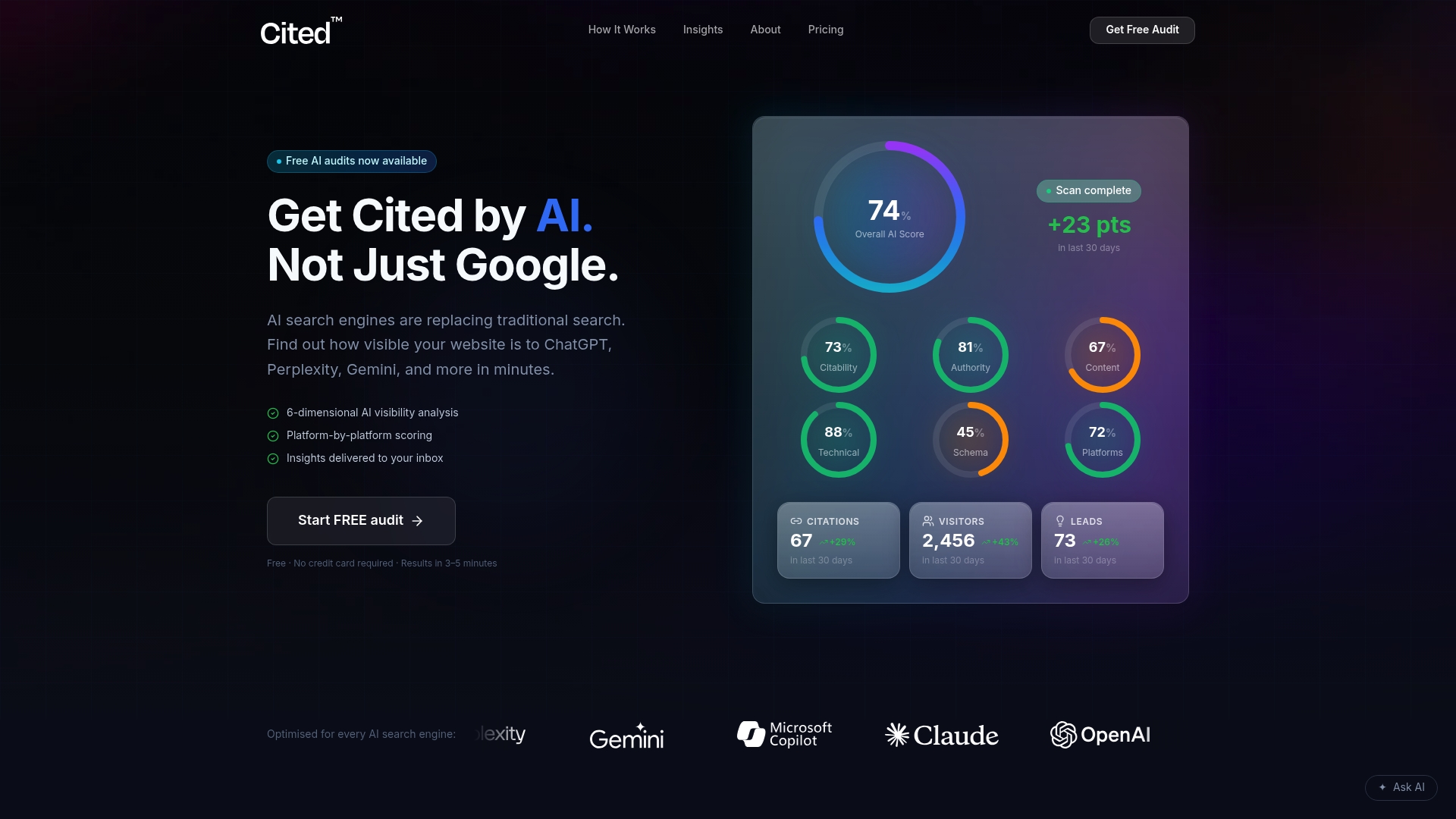
There is no guaranteed citation outcome from any single fix, and no reputable service should promise one. This service offers a clear, ranked view of where pages are losing citation eligibility, plus the option to have the fixes actually implemented rather than left as a to-do list. One-off Technical Fixes start at a fixed price, and ongoing managed services run a monthly fee for teams that want the monitoring cadence managed on their behalf. Enterprise pricing is custom for larger platforms. Run the free audit now, or book a call if you'd rather talk through the findings first.
Useful sources and validators to read next
- Google's AI optimisation guide sets out the technical crawlability baseline every citation-ready page needs to clear first.
- TLDL's guide to writing sources AI engines cite is the clearest practical template for the link-plus-rationale format used above.
- Gregory Shevchenko's source pack framework is the fullest write-up of the claim-inventory approach.
- Search Engine Land's step-by-step guide to AI search optimisation covers the structural and answer-first patterns in more depth.
Sources
Both work together: visible sources build the human trust signal, while Article and FAQPage schema give AI systems a structured, machine-readable version of the same information.
- How to optimize content for AI search engines: A step-by-step guide
- AI optimisation guide, Google Developers
- How to Write Sources That AI Answer Engines Will Cite | TLDL
- How to Build a Source Pack for AI Search Content | Gregory Shevchenko
FAQ
What is the difference between a source lists page and a bibliography?
A bibliography is a static list of references; a source lists page pairs a visible, annotated Sources section with machine-readable schema so AI systems can verify and cite the content programmatically.
How often should I check whether my content is being cited?
Check at 24 to 48 hours, day 7, day 14, and day 30 after publishing, since citation accuracy and presence tend to shift as engines re-crawl and re-index the page.
Can Cited help implement these fixes, not just identify them?
Yes. Cited's free audit at cited.best/audit identifies the gaps, and the Technical Fixes and AI Optimised services implement the schema, sourcing, and monitoring changes on your behalf.
Why do some AI engines cite my page and others don't?
Engines differ significantly in how often they cite external sources at all, with some citing far less frequently than others, so absence on one engine doesn't mean the page has failed everywhere.
Recommended
Ready for your AI score?
See how visible your site is to ChatGPT, Perplexity & Gemini.
Start FREE auditResults in minutes · 100% free