
AI systems use your URL structure, anchor text, and internal link hierarchy as metadata signals before they even read your page content. Clean, readable URLs with descriptive slugs and shallow folder depth make it easier for AI retrieval systems to understand what your page is about and cite it in answers. Fixing your link structure is one of the fastest ways to increase citation likelihood without rewriting your content.
SEO friendly links: boost AI citation likelihood
An SEO-friendly link is a readable, secure, hierarchically placed URL and anchor text combination that signals precise topical scope to AI retrieval systems before they parse your page content. URL path segments act as a secondary content layer, helping AI systems infer category and specificity. Get this right and your pages become easier to cite. Get it wrong and even well-written content gets passed over.
The core elements of an optimised hyperlink structure are:
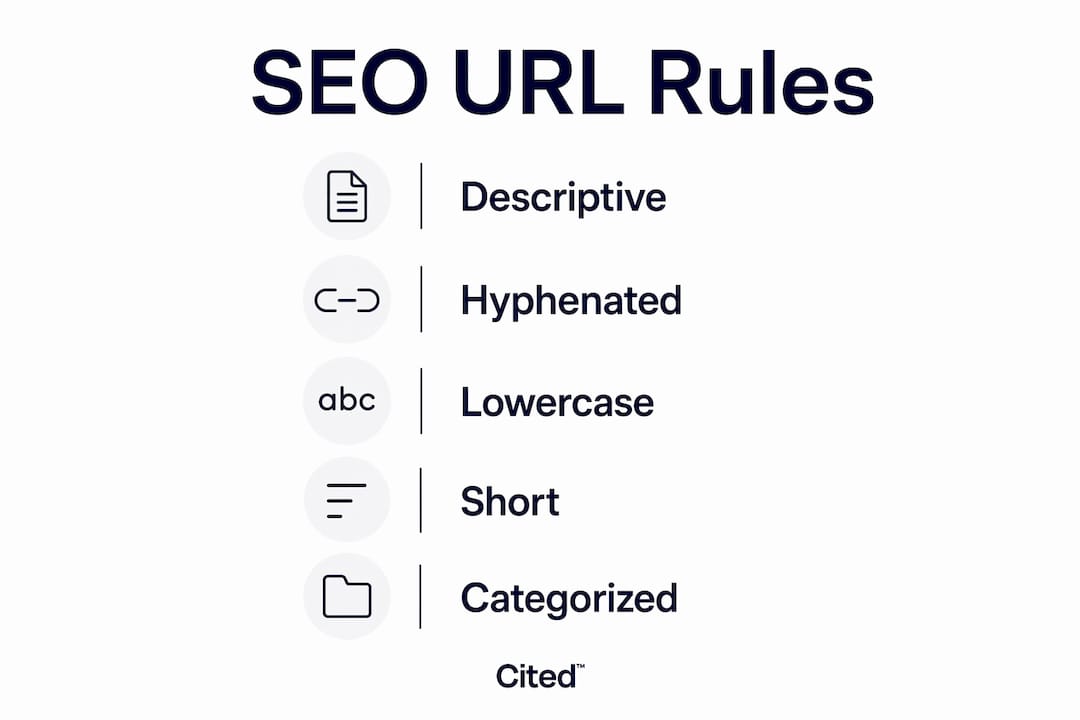
- Readable URL slug: short, lowercase, hyphenated, keyword-aligned
- Shallow hierarchy: no more than three path levels for most pages
- HTTPS protocol: a baseline requirement, not a bonus
- Clean parameters: session IDs and tracking strings removed or canonicalised
- Descriptive anchor text: matches user intent, avoids "click here"
- Correct rel attributes: nofollow, sponsored, or ugc applied where appropriate
- Canonical tags: one authoritative URL per piece of content
- Consistent category naming: stable folder names that reflect topical structure
- Crawlable internal links: surfaced in the sitemap, not buried behind JavaScript
***
Table of Contents
- Ten immediate actions to make links SEO friendly for AI
- Why do URLs, anchors and internal links affect AI citation likelihood?
- What URL structure rules actually improve AI readability?
- How should you write anchor text and internal links for AI systems?
- How do outgoing links and citation formats affect your own citation likelihood?
- Which technical link signals do AI crawlers check first?
- How do you audit links for AI visibility and what should you measure?
- What effort and timeline should you expect when fixing link issues?
- Key takeaways
- Why URL structure is the most underrated part of AI visibility work
- How Cited can help you improve AI citation likelihood
- Useful sources for UK technical teams
- FAQ
Ten immediate actions to make links SEO friendly for AI
Apply these in order. The first five carry low risk. The last five need redirect planning before you touch a live indexed URL.
- Edit new slugs before publishing to be short, lowercase, and hyphenated.
- Confirm HTTPS is active and that HTTP requests redirect cleanly to the HTTPS version.
- Remove session IDs and tracking parameters from internal links; use canonical tags to point to the clean URL.
- Replace underscores with hyphens in any new slugs. Google recommends hyphens to separate words in URLs.
- Force lowercase on all URL paths at server level to prevent duplicate indexing.
- Strip publication dates from evergreen content slugs. Dates force a redirect later and reduce long-term shareability.
- Set canonical tags on paginated, filtered, and parameter-heavy pages to point to the primary URL.
- Flatten deep nesting: any page more than three clicks from the homepage needs restructuring or stronger internal links.
- Update internal links to point to the canonical URL, not a redirect chain.
- Submit an updated XML sitemap that includes only the pages you want crawled and cited.
Pro Tip: Prioritise your highest-traffic and most topically relevant pages first. Changing a low-value URL that nobody links to carries almost no risk. Changing a URL with hundreds of backlinks and strong rankings requires careful 301 redirect planning and internal link updates before you make the switch.
***
Why do URLs, anchors and internal links affect AI citation likelihood?
AI retrieval systems treat URL paths as metadata. They check the path before parsing body content, using it to scope relevance for long-tail and question-based queries. A slug like /email-marketing-best-practices-b2b signals precise topical fit to a retrieval model in a way that /page?id=4821 cannot.

Readable, descriptive URLs also improve click-through rates and user trust, which matters when your link appears inside an AI-generated answer. A user who sees a clean, recognisable path is more likely to click through, and that engagement signal feeds back into citation value over time.
The practical business outcomes are direct: higher citation frequency in AI answers, better referral traffic from those citations, and increased authority when AI systems map your site's topical structure. A clear URL hierarchy helps AI systems understand site topical structure, assisting both retrieval and recommendation models.
44.2% of AI citations come from the first 30% of an article. Structuring your URLs and anchors to signal relevance early, at both page and site level, directly increases the probability of being selected as a source.
***
What URL structure rules actually improve AI readability?
Descriptive URLs that signal category and subtopic increase the chance an AI retrieval system will surface a page for precise queries. The rules below apply to any page type.
Rule | Why it matters to AI retrieval | Example |
|---|---|---|
Shallow hierarchy (max 3 levels) | Reduces crawl depth; signals page importance | |
Hyphenated, lowercase slug | Matches tokenisation used by language models | |
One keyword per segment | Prevents dilution; aids topical scoping | |
No dates in evergreen slugs | Keeps URLs stable; avoids redirect debt | |
No stop words | Shorter, cleaner signal | |
HTTPS | Trust signal; required for modern crawlers | |
Before and after examples:
/blog/post?id=1042&cat=3→/insights/seo-friendly-urls//products/item.php?sku=XJ99→/products/standing-desk-oak//2019/03/how-to-build-links/→/insights/link-building-practices/
Pro Tip: Avoid changing any URL that is already indexed and receiving traffic unless you have a confirmed 301 redirect in place and have updated all internal links. The SEO risk of a broken redirect chain outweighs the benefit of a cleaner slug on a page that is already performing.
***
How should you write anchor text and internal links for AI systems?
Descriptive, context-aware anchors and consistent internal link pathways raise citation probability. AI systems use anchor text as a secondary label for the destination page, much as they use the URL slug. Generic anchors like "click here" or "read more" provide no topical signal.
Rules for anchor text:
- Match the anchor to the destination page's primary topic, not the surrounding sentence's convenience
- Prefer longer, intent-matching phrases: "internal linking strategies for AI visibility" over "linking guide"
- Vary anchor phrasing across different linking pages to avoid over-optimisation signals
- Never use the same exact anchor text on every internal link pointing to one page
For internal linking structure, a hub-and-spoke model works well: one authoritative pillar page per topic cluster, supported by several related pages that each link back to the hub. Breadcrumb navigation reinforces this hierarchy and gives AI crawlers a clear parent-child path to follow.
Workflow for updating internal links sitewide during an audit:
- Export a full crawl of all internal links using a tool such as Screaming Frog or Sitebulb.
- Identify pages with zero or one internal link (orphan or near-orphan pages).
- Map each orphan to its closest topical cluster and add two to three contextual links from related pages.
- Replace any anchor text that reads as generic ("here", "this page") with descriptive phrases.
- Confirm that no internal link points to a redirect rather than the final canonical URL.
***
How do outgoing links and citation formats affect your own citation likelihood?
Clear outbound citations and contextual links increase perceived quality and help AI systems map provenance. A page that cites authoritative sources signals to retrieval models that its claims are grounded, which correlates with higher citation selection rates.
Best practices for outgoing links:
- Link to primary sources (government bodies, academic publications, official documentation) where they support a specific claim
- Use descriptive anchor text on outbound links, not bare URLs
- Apply
rel="nofollow"to paid or sponsored links; userel="sponsored"for commercial partnerships andrel="ugc"for user-generated content - Label resource links clearly so AI systems can match them to the claims they support
Pro Tip: Linking out to authoritative sources does not push users away from your site if your content answers the question more fully. Place outbound links at the end of a section or in a dedicated sources list, so readers complete your content before following an external reference.
***
Which technical link signals do AI crawlers check first?
Correct rel tags, canonical tags, and minimal redirect chains make the preferred URL unambiguous to both crawlers and AI retrievers. Clean, normalised URL structures help AI crawlers deduplicate content and identify the canonical source for a concept.
Technical checklist:
- Canonical tags: every page with a parameter variant or duplicate must carry a
rel="canonical"pointing to the primary URL - Redirect chains: resolve any chain longer than one hop; a 301 should go directly to the final destination
- rel="nofollow": applied to untrusted or paid links, not used as a blanket policy on all outbound links
- hreflang: set correctly for multi-regional UK sites to prevent duplicate indexing across language variants
- robots.txt: block parameter-generated URLs, faceted navigation variants, and internal search results from crawl
Workflow for crawlability and sitemap hygiene:
- Run a full crawl and export all 3xx redirect chains.
- Resolve chains to single-hop 301s and update internal links to point directly to the final URL.
- Audit canonical tags: confirm each points to the correct primary URL, not a redirect.
- Review the XML sitemap: remove redirected, noindexed, and low-value URLs.
- Check that the sitemap is referenced in
robots.txtand, where applicable, inllms.txtfor AI crawler instructions.
***
How do you audit links for AI visibility and what should you measure?
Prioritise pages by AI-relevance score, citation frequency potential, and existing traffic before touching any URL. Changing every URL on a site is unnecessary and risky; selective prioritisation reduces risk while improving the pages that most affect citation likelihood.
Step-by-step audit workflow:
- Inventory all URLs via a site crawl; flag those with parameters, uppercase characters, underscores, or depth greater than four levels.
- Check canonical status on all flagged URLs.
- Score URL readability: does the slug describe the page topic in plain language?
- Map internal link counts per page; identify orphans and pages with fewer than two inbound internal links.
- Record the AI visibility score for priority pages before making changes, using Cited's six-dimension audit methodology.
- Implement fixes in order of impact, then re-measure.
Metric | What to record | Why it matters |
|---|---|---|
URL readability score | Human-readable slug: yes/no, keyword present | Predicts AI retrieval selection |
Canonical status | Canonical set, correct target URL | Prevents duplicate indexing |
Internal link count | Number of inbound internal links per page | Signals page importance to crawlers |
Crawl depth | Number of clicks from homepage | Deep pages get crawled less frequently |
AI visibility score | Before and after Cited audit | Measures citation likelihood change |
Cited measures AI visibility across six dimensions, including technical health, schema markup, and authority signals. Running simulated prompts in ChatGPT, Perplexity, and Gemini before and after implementation gives a direct before-and-after citation sampling result. For a full explanation of how to measure AI search visibility, Cited's Insights section covers the testing methodology in detail.
***
What effort and timeline should you expect when fixing link issues?
Low-effort changes carry minimal risk and can be completed in hours to days. Large structural changes need months of planning and a monitoring window of at least 90 days after implementation.
Change type | Effort | Timeline | Risk level |
|---|---|---|---|
Fix anchor text on internal links | Low | Hours to 1 day | Minimal |
Add canonical tags to parameter URLs | Low | 1–2 days | Low |
Update XML sitemap | Low | Half a day | Minimal |
Resolve redirect chains | Medium | 1–2 weeks | Medium |
Restructure URL hierarchy (new slugs) | High | 4 weeks | High |
Full site URL migration | High | 3–6 months | Very high |
Common risks and mitigations:
- Broken internal links after a slug change: run a post-migration crawl within 24 hours and fix all 404s
- Lost link equity from redirect chains: resolve chains to single-hop 301s before launch
- Canonical conflicts: audit canonical tags after any CMS update, as plugins can overwrite them
For internal teams, low-effort fixes are straightforward. URL restructures and migrations benefit from an external specialist or a managed service like Cited, where implementation is handled alongside the audit to reduce the risk of errors that cost rankings.
***
Key takeaways
SEO-friendly links require readable URLs, descriptive anchors, correct technical attributes, and consistent internal link pathways to maximise citation likelihood in AI search engines.
Point | Details |
|---|---|
URL as metadata | AI systems read URL slugs before content; descriptive, hyphenated paths signal topical fit directly. |
Anchor text precision | Use intent-matching, long-tail anchor phrases; avoid generic labels that carry no topical signal. |
Technical hygiene | Canonical tags, single-hop 301s, and clean sitemaps prevent duplicate indexing and wasted crawl budget. |
Audit by priority | Focus on high-traffic, high-relevance pages first; changing every URL carries unnecessary risk. |
Cited audit | Cited's six-dimension audit measures AI visibility before and after implementation, giving measurable citation lift. |
***
Why URL structure is the most underrated part of AI visibility work
Most technical SEO checklists treat URL structure as a one-time setup task. Fix the slugs at launch, move on. That framing misses what has changed with AI retrieval. When a language model decides whether to cite your page, it is not just reading your H1 and introduction. It is reading the path. A URL like /insights/geo-vs-seo-whats-the-difference/ tells the model something about category, audience, and intent before a single word of body content is processed. That is a meaningful advantage, and most sites are not using it.
The second thing most guides miss: internal link anchor text is a citation signal, not just a navigation aid. When you link from a pillar page to a supporting article using a precise, intent-matching phrase, you are effectively labelling that destination for every crawler and retrieval system that follows the link. Generic anchors waste that opportunity on every page of your site, at scale.
The practical implication for UK businesses is that GEO and SEO are not separate programmes. The same URL and anchor decisions that help Google crawl your site efficiently also increase your citation probability in ChatGPT, Perplexity, and Gemini. The audit work is the same; the measurement framework needs to extend to AI retrieval outcomes.
***
How Cited can help you improve AI citation likelihood
Cited audits your website across six dimensions of AI citability, including URL structure, internal linking, technical health, and schema markup, then implements the fixes for you.
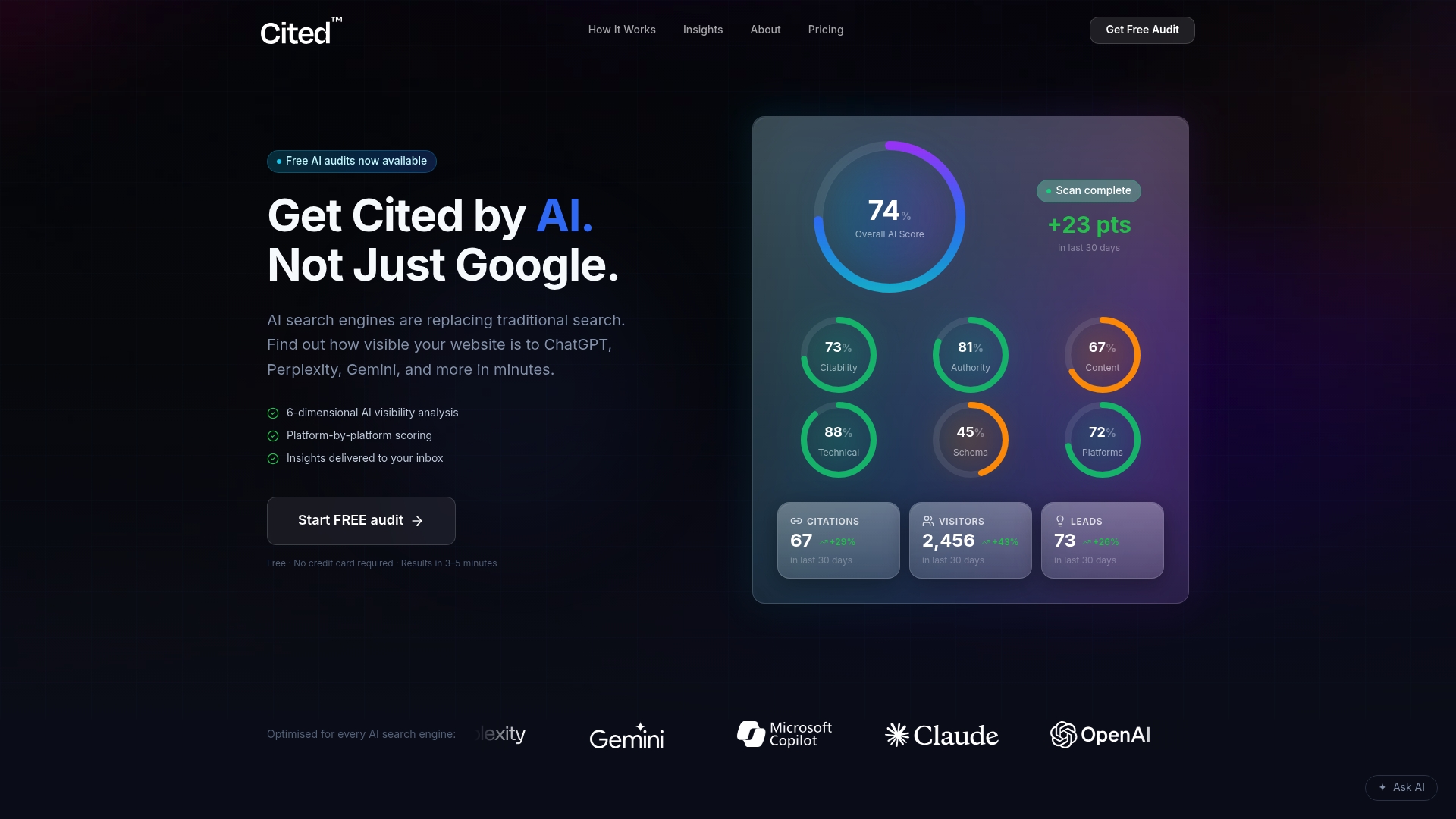
The free AI visibility audit identifies which URL and link issues are suppressing your citation rate across ChatGPT, Perplexity, Gemini, Claude, and Copilot. You receive a scored report with prioritised fixes, not a generic checklist. For teams ready to act, Cited handles implementation directly, so your technical team does not need to manage the rollout. Read the Cited methodology to see how the six-dimension scoring works, or book a call to discuss your site's current AI visibility score and where the highest-impact fixes are.
***
Useful sources for UK technical teams
- Google Search Central: URL structure best practices — the primary reference for crawlable URL requirements, hyphen usage, and parameter handling
- Search Engine Journal: URL structures for AI retrieval — covers how AI systems use URL paths as metadata before content parsing
- Search Engine Land: AI crawler optimisation guide — technical guidance on canonicalisation, sitemap hygiene, and internal linking for AI crawlers
- Cited Insights — articles on GEO, llms.txt, AI citation heuristics, and measurement methodology for UK businesses
- Screaming Frog SEO Spider — crawl tool for URL inventory, redirect chain analysis, and canonical audits
- Sitebulb — visual crawl reporting with internal link mapping and crawl depth analysis
***
FAQ
What makes a URL SEO friendly for AI search engines?
A URL is SEO friendly for AI when it uses a short, lowercase, hyphenated slug that describes the page topic, sits within a shallow folder hierarchy, and avoids session IDs or unnecessary parameters. AI retrieval systems read URL paths as metadata before parsing content, so a descriptive path directly increases citation likelihood.
Should you change existing URLs to make them more SEO friendly?
Only change an indexed URL if the benefit clearly outweighs the risk. Any URL change on a live page requires a 301 redirect, updated internal links, and a post-migration crawl. Low-traffic pages with poor slugs are safe to update; high-traffic pages with strong backlink profiles need careful planning.
How does anchor text affect AI citation probability?
Descriptive, intent-matching anchor text labels the destination page for AI retrieval systems, reinforcing its topical relevance. Generic anchors such as "click here" carry no topical signal and reduce the precision with which AI models can classify the linked page.
How does Cited measure AI visibility improvements from link fixes?
Cited uses a six-dimension audit that scores technical health, URL structure, internal linking, schema markup, authority, and platform coverage. Before-and-after citation sampling across ChatGPT, Perplexity, and Gemini shows measurable changes in citation frequency after implementation.
What is the fastest link fix for improving AI citation likelihood?
Adding canonical tags to parameter-heavy or duplicate URLs is typically the fastest high-impact fix, taking one to two days with low risk. It immediately clarifies the preferred URL for AI crawlers and prevents crawl budget being wasted on near-duplicate pages.
Recommended
Ready for your AI score?
See how visible your site is to ChatGPT, Perplexity & Gemini.
Start FREE auditResults in minutes · 100% free