
To get your business cited by AI engines like ChatGPT and Perplexity, you need to ensure AI crawlers can access your pages and that your content contains clear, quotable passages with verifiable facts. Start by checking your robots.txt file to confirm AI crawlers aren't blocked, then add structured data (JSON-LD schema) to help AI engines understand and cite your business accurately. The foundation of any AI citation strategy is making your business resolvable as a named entity and your pages easily quotable by AI systems.
Knowledge graph for AI: a UK business citation guide
Getting your business cited by ChatGPT, Perplexity, Gemini, Claude, or Copilot comes down to two things: your pages must be retrievable by AI crawlers, and they must contain passages an AI model can quote with confidence. The site-level work that achieves this is what practitioners mean by "knowledge graph for AI" — making your business resolvable as a named entity and your pages quotable by AI engines. The industry term for the broader discipline is entity SEO, and it sits at the foundation of every citation strategy.
Your immediate next step: check your robots.txt to confirm AI crawlers are not blocked, verify that your pages render full HTML, and add Organization schema with sameAs links to canonical identifiers. Then request Cited's free AI audit to get a scored baseline across six dimensions of citability.
Pro Tip: Run your robots.txt through Google Search Console's URL inspection tool and check it manually for any wildcard rules that might block GPTBot, PerplexityBot, or Googlebot — crawlability mistakes are the single most common preventable cause of AI invisibility.
- Fix crawler access first, before any content or schema work.
- Then create self-contained, quotable answer passages with entity-rich JSON-LD.
Table of Contents
- What does being cited by an AI knowledge graph actually look like?
- How do AI search engines decide what to retrieve and cite?
- What should your team fix this week to make pages cite-ready?
- Which JSON-LD types should you add, and where do they go?
- What content pattern do AI engines prefer?
- Which technical settings stop AI crawlers from seeing your pages?
- How do you test whether AI engines are citing your pages?
- How long does it take, and what does implementation cost?
- How does Cited help UK businesses get cited by AI engines?
- Key takeaways
- Why citation-first is the right strategy for UK businesses
- Useful sources
- How Cited gives UK businesses a measurable citation advantage
- FAQ
What does being cited by an AI knowledge graph actually look like?
A citation in an AI answer is concrete and specific. ChatGPT or Copilot quotes a concise passage from your page and appends your URL as a source. Perplexity lists your page in a numbered source panel alongside the generated answer. Gemini produces an AI Overview that summarises a fact and links directly to your site.
The page elements AI engines most often lift are: a question-style H2 heading followed immediately by a concise direct answer, a single sentence containing a named authority or a verifiable figure, and a JSON-LD entity block identifying the organisation or author. Linking Organization and Person nodes to canonical identifiers such as a Wikidata Q-ID increases the engine's confidence when resolving your entity, reducing the risk that your business is confused with another.
After successful inclusion, businesses typically see:
- Increased branded queries as users search for the business by name after encountering it in an AI answer.
- Referral sessions arriving from AI platform domains.
- Direct citation counts measurable by querying AI engines for your target phrases.
- Growth in the AI visibility score tracked through Cited's proprietary methodology.
How do AI search engines decide what to retrieve and cite?
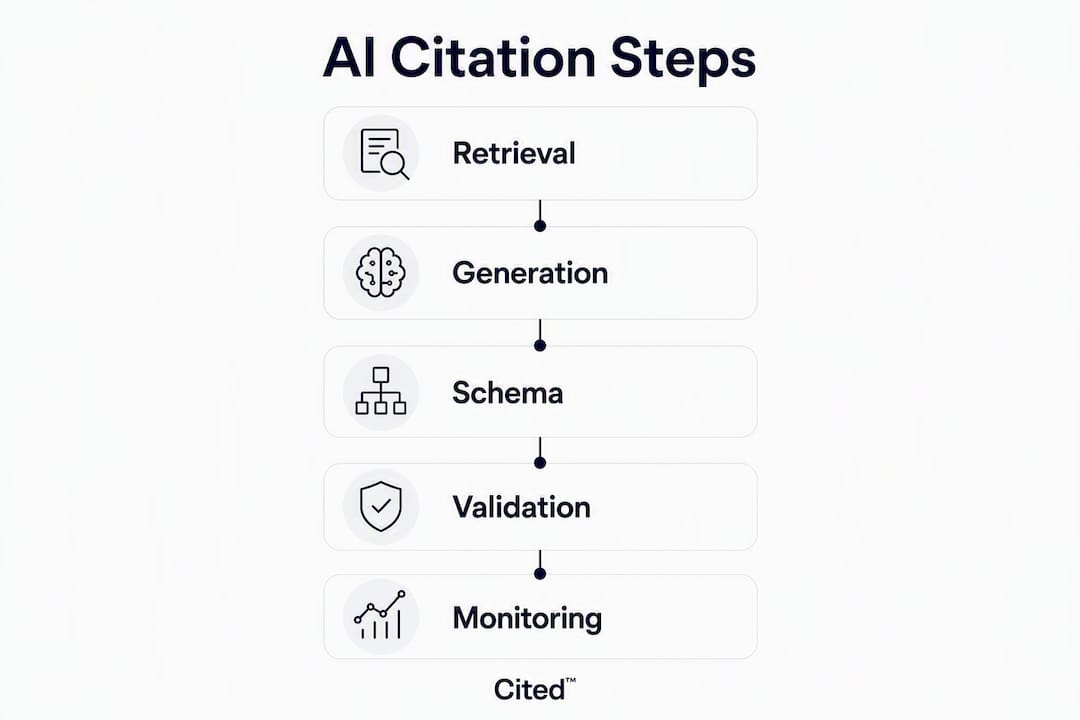
AI engines pick sources in two stages: retrieval, then generation. The same crawling and indexing infrastructure used by conventional search produces the candidate set the model reads. If your page is not indexed, it cannot be cited, regardless of how well-written it is.

In the generation stage, the large language model synthesises an answer and selects passages it can quote with confidence. It favours self-contained sentences, structured data, and verifiable specificity. Generic claims with no named source or figure are far less likely to be lifted than a sentence that states a concrete fact and attributes it. This is why AI engines favour verifiable specificity and primary source links over broad assertions.
Treat generative engine optimisation (GEO) as an extension of SEO, not a replacement. Understanding how ChatGPT decides what to cite starts with the same crawl and index fundamentals that have always governed search.
Pro Tip: Validate that your pages render full HTML before rewriting any content. A page that returns a JavaScript shell to a crawler never enters the candidate set, no matter how well-structured the content is.
What should your team fix this week to make pages cite-ready?
The three priority areas are access, structure, and entity signals, addressed in that order. Start with one or two revenue pages, measure before and after, then iterate.
- Robots.txt and bot access (Immediate, 0–7 days, Owner: Developer/Ops) — Confirm GPTBot, PerplexityBot, ClaudeBot, and Googlebot are all permitted. Check WAF and Cloudflare rules for user-agent blocks.
- HTML renderability (Immediate, 0–7 days, Owner: Developer) — Ensure server responses return full HTML, not a client-side JS shell. Test with
curl -A "Googlebot". - Organization and Person @id nodes (Immediate, 0–7 days, Owner: Developer) — Add JSON-LD with stable
@idURLs andsameAslinks to Wikidata and social profiles. - FAQPage Q&A units (Short, 1–4 weeks, Owner: Content) — Add FAQPage schema to pages targeting question queries. FAQPage schema is associated with higher citation probability for Q&A content.
- Answer blocks that are concise and direct (Short, 1–4 weeks, Owner: Content) — Rewrite key paragraphs so each opens with a direct answer to the heading's question.
- Sitemaps and canonical tags (Short, 1–4 weeks, Owner: Developer) — Submit an XML sitemap covering priority pages; add canonical tags to prevent duplicate indexing.
- Schema validation (Medium, 1–3 months, Owner: Developer/Content) — Run all schema through Google's Rich Results Test and Schema.org validator after each update.
Pro Tip: Measure your AI citation count for each target page before making changes, so you have a genuine before-and-after baseline. Screenshot the AI engine outputs on a fixed date.
Which JSON-LD types should you add, and where do they go?
Implement an interconnected @graph using Organization, WebSite, Person, and Article or BlogPosting nodes, with stable @id values and sameAs links to canonical identifiers such as Wikidata Q-IDs. A connected @graph with worksFor and authoredBy links functions as a small internal knowledge graph that AI engines can traverse.
Place the @graph block in the <head> of every page, then extend it per page type. On article pages, add datePublished, author (pointing to the Person node's @id), and about referencing the Organisation. On commercial pages, use Product or Service schema with concrete fields populated: price, availability, and a named provider.
Schema type | Page | Key fields | Validation check |
|---|---|---|---|
Organization | Homepage, all pages | | Rich Results Test |
Person | Author bio, article pages | | Schema.org validator |
Article / BlogPosting | All editorial pages | | Rich Results Test |
FAQPage | FAQ sections, Q&A pages | | Rich Results Test |
BreadcrumbList | All pages | | Rich Results Test |
Product / Service | Commercial pages | | Rich Results Test |
Schema improves entity clarity and extraction, and platforms such as Google AI Overviews and Bing Copilot have confirmed benefits, but schema alone is not sufficient. It works as part of a wider stack that includes crawlability and quotable content. For a deeper look at schema markup and AI citation effectiveness, Cited's Insights section covers the evidence in detail.
Pro Tip: Add sameAs entries pointing to your Wikidata Q-ID and a stable author profile URL. Even a minimal Wikidata entry with a few verified facts reduces entity ambiguity significantly.
What content pattern do AI engines prefer?
Phrase headings as exact user questions and follow each immediately with a concise direct answer. This pattern produces the most extractable passages for AI Overviews. The heading signals the query; the answer block gives the model a self-contained unit it can quote without modification.
Example snippet:
What is FAQPage schema?FAQPage schema is JSON-LD structured data that marks up question-and-answer pairs on a web page, making them readable by search engines and AI models. Implementing it on pages that target question queries increases the probability that an AI engine will extract and cite the answer directly, according to UK SEO practitioners.
Template for writers:
- H2: the exact user query, phrased as a question.
- Paragraph 1 (40–60 words): direct answer, self-contained, containing one verifiable fact or named authority.
- Paragraph 2 (up to three sentences): supporting context or evidence.
- Optional: a concise list or table for discrete facts.
Keep sentences self-contained. Avoid opening consecutive paragraphs with the same word or phrase. State one verifiable fact per sentence so the model can extract it cleanly. For a full guide to content optimisation for AI search, Cited's Insights section covers the UK context specifically.
Pro Tip: Read each answer block aloud. If it makes sense without the surrounding page context, it is self-contained enough for an AI engine to quote.
Which technical settings stop AI crawlers from seeing your pages?
Fix crawler access, ensure server responses return full HTML, and provide accurate sitemaps and canonical tags. These three actions determine whether AI engines can even see your candidate pages.
Site checklist by owner:
- Developer/Ops: Permit named bots (GPTBot, PerplexityBot, ClaudeBot, Bingbot) in robots.txt. Review Cloudflare and WAF rules for user-agent blocks. Confirm server returns 200 with full HTML for crawler user-agents.
- Developer: Audit for client-side-only rendering. Pages that require JavaScript execution to produce content are frequently invisible to AI crawlers. Add XML sitemaps covering all priority pages.
- Content owner: Audit for accidental
noindextags on high-value pages. Confirm canonical tags are consistent and point to the preferred URL.
On the question of emerging conventions: llms.txt can point AI tools to your canonical content pages, and adoption is early but the cost of adding it is low. No major engine guarantees support in 2026, so treat it as low-cost insurance rather than a primary signal. SEO-friendly link patterns also contribute to retrieval probability by reinforcing page authority signals.
How do you test whether AI engines are citing your pages?
Test by querying major AI engines for the exact question phrases your pages target, record citations, and track referral traffic from AI domains. Measurement should include citation counts by engine, referral traffic from AI domains, and a proprietary AI visibility score rather than keyword rank alone.
Step-by-step test protocol:
- Create a list of canonical test queries, one per target page, phrased as the exact user question the page answers.
- Run each query in ChatGPT with Search, Perplexity, Gemini, Claude, and Copilot.
- Capture a screenshot of each result, noting the quoted passage and the cited URL.
- Record results in the tracking table below.
- Repeat weekly for your top 10 pages.
Engine | Query | Quoted passage | Cited URL | Date | Screenshot |
|---|---|---|---|---|---|
ChatGPT | [query] | [passage] | [URL] | [date] | [link] |
Perplexity | [query] | [passage] | [URL] | [date] | [link] |
Gemini | [query] | [passage] | [URL] | [date] | [link] |
Claude | [query] | [passage] | [URL] | [date] | [link] |
Copilot | [query] | [passage] | [URL] | [date] | [link] |
KPIs to track: AI citation count by engine, referral sessions from AI platform domains, branded AI query growth, and AI visibility score using Cited's measurement methodology.
Pro Tip: Automate weekly checks using a simple spreadsheet with date-stamped screenshots. Content drift, such as editing a previously cited answer block, can break citation without any technical change.
How long does it take, and what does implementation cost?
Technical fixes and schema wiring typically appear in retrieval within days to weeks. Measurable citation gains usually take 4–12 weeks, depending on competition and how frequently each AI platform re-crawls your pages.
- Audit: 1 week.
- Technical fixes: 1–3 weeks.
- Content rewrites and schema implementation: 2–6 weeks.
- Measurement window: 4–12 weeks to see citation changes.
Cited's pricing: free audit at cited.best/audit, Technical Fixes at £495 one-off, AI Optimised at £995 per month, and Enterprise options available on request. For UK businesses allocating internal resource, the audit phase requires a developer for robots.txt and schema, a content editor for answer-block rewrites, and a project owner to track KPIs.
Pro Tip: Start the measurement window the day you submit technical fixes, not when you finish content rewrites. Separating the two phases lets you attribute citation changes to specific interventions.
How does Cited help UK businesses get cited by AI engines?
Cited runs a free AI visibility audit, implements the high-impact fixes, and measures citation outcomes using a proprietary six-dimension methodology. The audit covers technical health, schema markup, content structure, authority signals, entity clarity, and platform coverage.
- Free audit: scored baseline across six dimensions, delivered within days of submission at cited.best/audit.
- Technical Fixes (£495 one-off): robots.txt corrections, schema implementation, canonical and sitemap fixes.
- AI Optimised (£995/month): ongoing content pattern updates, schema maintenance, monthly citation reporting, and AI visibility score tracking.
- Enterprise: custom scope, available via book a call.
- Methodology: Cited's proprietary approach to measuring AI visibility is documented at cited.best/methodology.
Key takeaways
Getting into an AI knowledge graph requires retrievability first, then quotable content, then entity signals. Every other optimisation depends on those three foundations being in place.
Point | Details |
|---|---|
Access before content | Confirm AI crawlers can reach your pages before rewriting a single word. |
Answer blocks that are concise and direct | Structure every key page with a question H2 followed by a direct, self-contained answer. |
Entity schema is essential | Add Organization, Person, and FAQPage JSON-LD with stable @id and sameAs links to Wikidata. |
Measure with the right KPIs | Track AI citation count by engine, referrals from AI domains, and AI visibility score. |
Cited as your starting point | Request a free audit at cited.best/audit to get a scored baseline and a prioritised fix list. |
Why citation-first is the right strategy for UK businesses
The conventional wisdom in UK digital marketing still treats AI search as a future concern, something to address after the next website redesign or the next content sprint. That framing is wrong, and the cost of it is already visible in analytics: businesses that have not structured their pages for AI retrieval are simply absent from a growing share of answers their customers are reading.
Citation results compound. A page that earns a citation in Perplexity tends to accumulate authority signals that improve its probability of citation in Gemini and Copilot. Starting with two or three high-value commercial pages and measuring the before-and-after citation count is a far more productive use of a limited budget than a site-wide content refresh with no measurement framework.
The businesses that will benefit most are those that treat citation as a measurable outcome, not a vanity metric. That means tracking referral sessions from AI domains, monitoring branded query growth, and using a structured AI visibility score to prioritise the next round of fixes. The checklist in this guide is the starting point; the measurement framework is what turns it into a repeatable process.
Useful sources
Authoritative references used in this guide, plus further reading for UK businesses building an AI citation strategy:
- The Cited Methodology — Cited: proprietary six-dimension framework for measuring AI visibility and citation probability.
- Content optimisation for AI search — Cited Insights: UK-focused guide to content structure and entity signals for AI citability.
Request your free audit at cited.best/audit or book a call to discuss implementation options.
How Cited gives UK businesses a measurable citation advantage
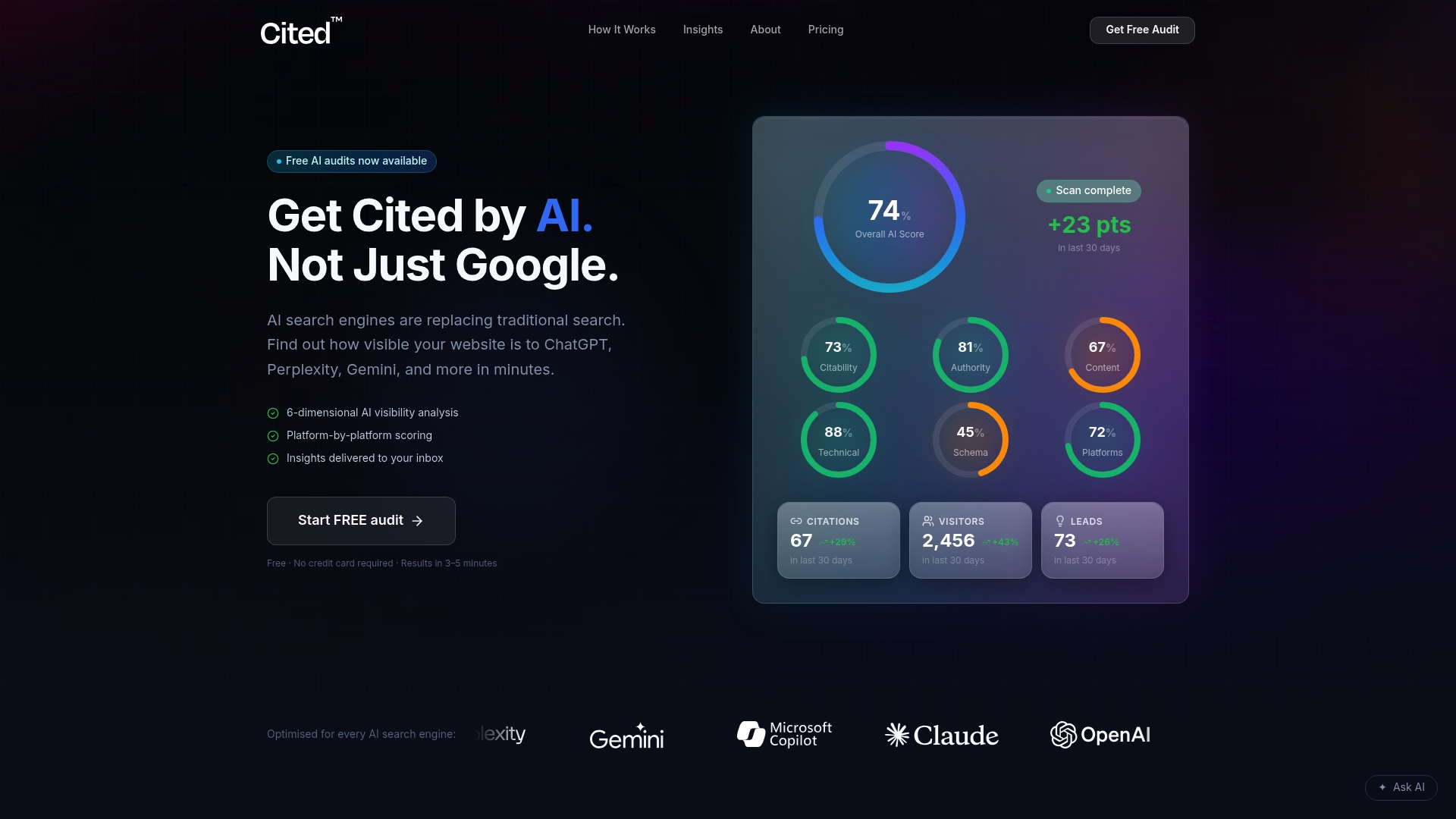
Most UK businesses approaching AI citation for the first time face the same problem: they do not know which of their pages are invisible to AI crawlers, which schema is missing, and which content blocks are too vague to quote. Cited solves that with a free audit that scores your site across six dimensions of AI citability, then implements the fixes that move the needle.
The free audit takes days, not weeks, and produces a prioritised list of technical and content changes with expected impact. From there, the Technical Fixes package at £495 handles the one-off implementation: schema wiring, robots.txt corrections, canonical tags, and sitemap submission. For businesses that want ongoing citation growth, the AI Optimised subscription at £995 per month covers monthly content updates, schema maintenance, and citation reporting against Cited's proprietary AI visibility score.
Start with the free audit at cited.best/audit, or book a call if you want to discuss scope before committing.
FAQ
What does "knowledge graph for AI" mean for a UK business?
It refers to the site-level work that makes your business recognisable as a named entity to AI engines, using schema markup, authoritative citations, and technical fixes so AI search tools cite your pages in generated answers.
Which AI engines should I prioritise for citation?
Focus on ChatGPT, Perplexity, Gemini, Claude, and Copilot, as these are the platforms UK users currently rely on most for AI-generated answers. Each uses a retrieval-then-generation pipeline, so the same technical and content fixes improve citation probability across all five.
Does schema markup alone guarantee AI citations?
No. Schema improves entity clarity and extraction, and platforms including Google AI Overviews and Bing Copilot have confirmed its benefits, but schema works as part of a wider stack that includes crawlability and self-contained answer content.
How long before I see citation results?
Technical fixes and schema changes typically appear in retrieval within days to weeks. Measurable citation gains usually take 4–12 weeks, depending on competition and each platform's crawl schedule.
How does Cited measure AI visibility?
Cited uses a proprietary six-dimension methodology covering technical health, schema markup, content structure, authority signals, entity clarity, and platform coverage. Full details are at cited.best/methodology.
Recommended
Ready for your AI score?
See how visible your site is to ChatGPT, Perplexity & Gemini.
Start FREE auditResults in minutes · 100% free