
AI search engines like ChatGPT and Perplexity select content differently than Google does—they care about whether your pages can be easily extracted and cited, not just ranked high. The fastest wins come from allowing AI crawlers access to your site, structuring answers in your opening sentences, and adding schema markup to help AI systems understand your content. Start with a free AI visibility audit to see exactly where your site stands before investing in changes.
Content optimisation for AI search: a UK business guide
Content optimisation for generative AI, known as generative engine optimisation (GEO), means structuring your pages so that AI systems like ChatGPT (OpenAI) and Perplexity can extract, trust, and cite your content in their answers. The single most valuable first step is a free AI visibility audit at cited.best/audit, which tells you exactly where your site stands before you spend a penny on fixes.
Key facts to know before you start:
- GEO is distinct from classic SEO: citation probability, not ranking position, is the goal.
- Cited audits six dimensions of AI citability and implements the fixes for you.
- ChatGPT, Perplexity, Google Gemini, Claude (Anthropic), and Copilot (Microsoft) all select sources differently, so a single-platform approach leaves visibility on the table.
Table of Contents
- How does GEO differ from classic SEO?
- What is the 8-step content optimisation checklist for AI citations?
- What are the exact technical fixes engineers need to make?
- How do you audit AI visibility across six dimensions?
- What does implementation cost and how long does it take for UK small businesses?
- What can you do in an hour, a day, and a week?
- How do you test whether AI engines are citing your site?
- How should you handle images and video for AI extraction?
- How do you avoid AI penalties from misinformation or unnatural language?
- How do engagement metrics and behavioural data improve AI trust signals?
- How should marketers and technical teams collaborate on the optimisation checklist?
- Key takeaways
- Why the audit-first approach is the only one that works
- How Cited helps UK businesses get cited by AI search engines
- Useful sources for further reading
- FAQ
How does GEO differ from classic SEO?
GEO is the practice of creating and structuring content so AI systems can understand, evaluate, retrieve, summarise, and cite it confidently. Classic SEO optimises for ranking position in a list of blue links. GEO optimises for inclusion in an AI-generated answer, where your brand is either cited or invisible.
AI engines select sources in two stages: retrieval (building a candidate set from indexed pages) then selection (extracting the most citable passage). A page can be cited without ranking first on page one, which changes the priority order entirely.
What GEO rewards, and classic SEO does not weight as heavily:
- Extractable passages with a direct answer in the first two sentences
- Explicit schema markup (Article, FAQPage, Organization)
- Consistent entity identity across title, H1, footer, and directory listings
- Visible author name and publish date on every page
A practical UK example: a Manchester marketing agency that adds a question-style H2 ("What does a marketing agency do?") with a direct answer underneath it, plus Article JSON-LD, can appear as a cited source in ChatGPT or Perplexity even if it sits on page three of Google. Many UK businesses have not yet made these changes, which creates a first-mover advantage right now.
What is the 8-step content optimisation checklist for AI citations?
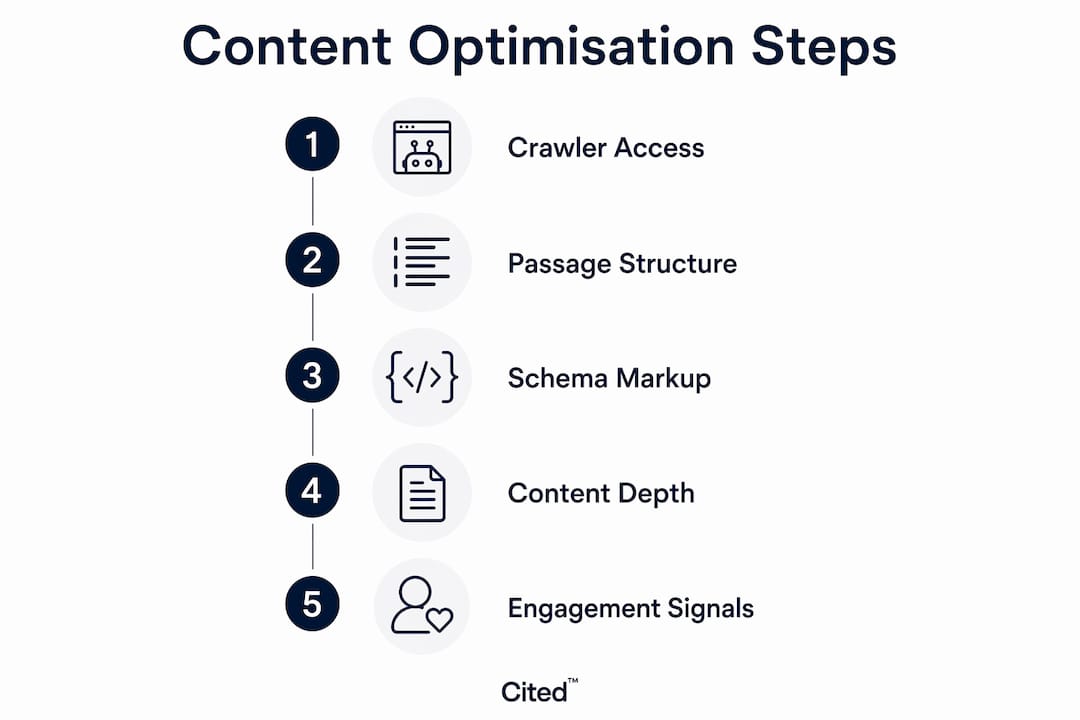
A practical GEO checklist covers access, structure, schema, entity signals, originality, and measurement, implemented in that order.
- Confirm crawler access. Check robots.txt allows OAI-SearchBot, PerplexityBot, and Bingbot. Blocking them prevents citation entirely.
- Structure pages for extraction. Answer-first opening sentences, question-style H2 headings, and short self-contained paragraphs are the highest-impact structural habits.
- Add schema markup. FAQPage, Article, and Organization schema help clarify content for AI systems.
- Clarify entity signals. Consistent entity identity across homepage title, H1, footer, and directory listings materially increases citation confidence.
- Cite authoritative sources. Link to primary sources (.gov, .edu, peer-reviewed data). Specific statistics with named sources are far more citable than vague claims.
- Use tables and short lists for comparison, pricing, or specifications. AI models extract structured formats more reliably than long narrative passages.
- Publish revision dates. Perplexity favours freshness; a visible "last updated" date is a direct trust signal.
- Measure citation frequency. Run platform-specific prompts monthly and log which sources each engine names.
Fix steps 1 and 2 first. Crawler access and passage structure deliver the fastest citation gains.
What are the exact technical fixes engineers need to make?
Technical SEO remains one of the most important drivers of AI visibility. Before any AI system can analyse your content, it must discover, crawl, and render your pages without friction.
Robots.txt: confirm these bots are not blocked.
User-agent: OAI-SearchBot/Allow: /User-agent: PerplexityBot/Allow: /User-agent: Bingbot/Allow: /User-agent: GPTBot/Allow: /
JSON-LD schema to add on every article page:
```json
{
"@context": "https://schema.org",
"@type": "Article",
"headline": "Your page title",
"author": {"@type": "Person", "name": "Author Name"},
"datePublished": "2026-01-15",
"dateModified": "2026-06-01",
"publisher": {"@type": "Organization", "name": "Your Brand"}
}
```
FAQPage and Article schema are the highest-value types for AI visibility. Add FAQPage JSON-LD wherever you have a question-and-answer block. Submit sitemaps to both Google Search Console and Bing Webmaster Tools, listing canonical URLs only.
Server and CDN checks: AI crawlers such as OAI-SearchBot and PerplexityBot operate independently from legacy bots. Cloudflare and other WAF rules can silently block them. Check server logs to confirm these bots are actually reaching your pages. Key content must be server-side rendered or pre-rendered; JavaScript-only rendering means crawlers see an empty page.
Consider adding an llms.txt file at your site root. The llms.txt convention provides a clean markdown index of your most important content for LLMs that read it. The cost of shipping it is near zero.
Pro Tip: Validate all JSON-LD with Google's Rich Results Test before publishing. A single syntax error silently disables the schema signal.
How do you audit AI visibility across six dimensions?
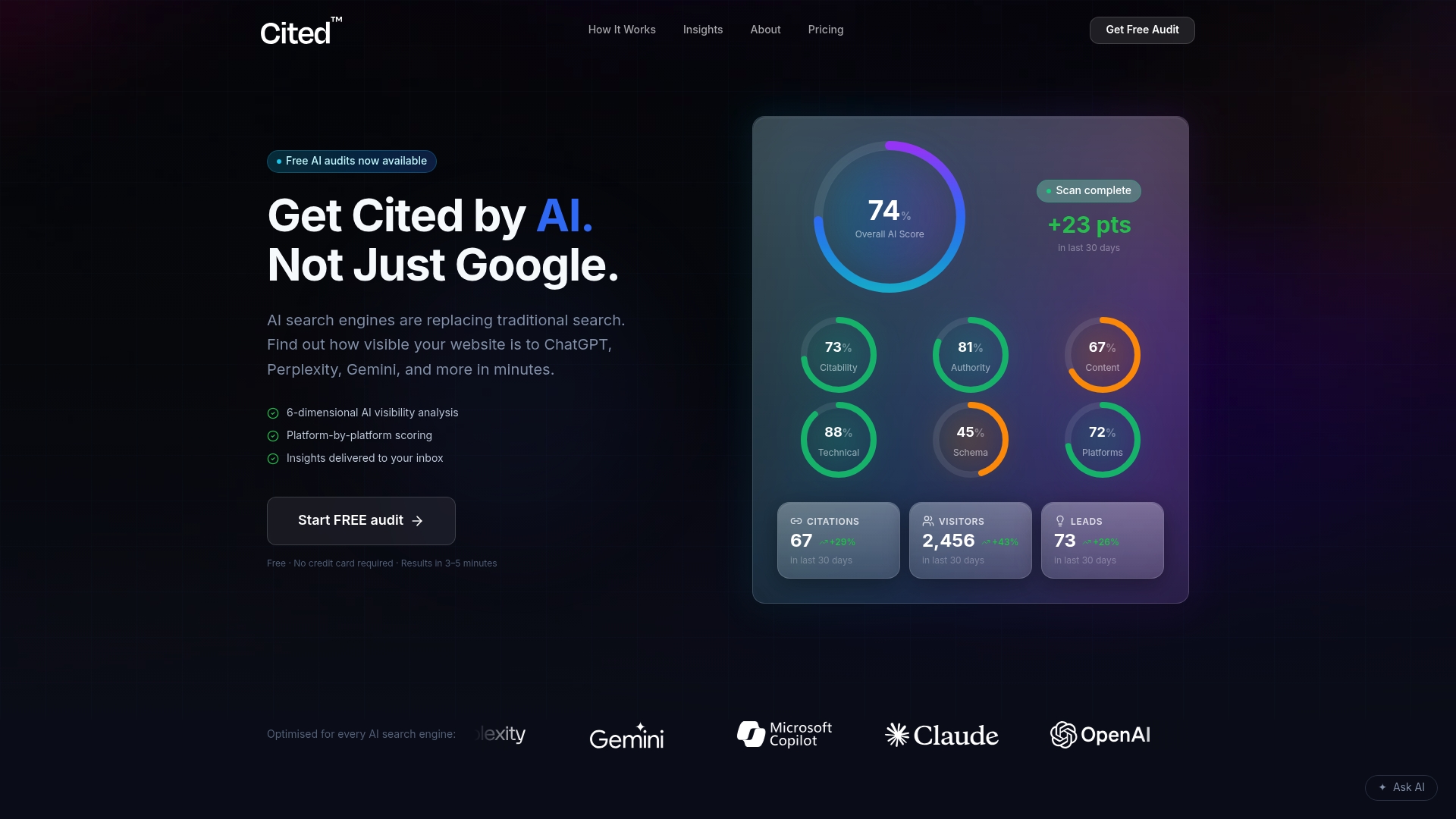
Cited's audit framework covers six dimensions: access, extractability, schema, entity clarity, authority signals, and measurement. Each dimension scores as high, medium, or low, and the combination produces an overall AI visibility score.
- Access (high/medium/low): Are AI crawlers permitted and reaching your pages?
- Extractability: Do pages lead with direct answers under question-style H2s?
- Schema: Is Article, FAQPage, and Organization JSON-LD present and valid?
- Entity clarity: Is your brand name consistent across title tags, H1s, footer, and third-party directories?
- Authority signals: Do pages cite primary sources, show author credentials, and carry visible publish dates?
- Measurement: Are you tracking citation frequency across ChatGPT, Perplexity, Gemini, Claude, and Copilot?
A low score on access or extractability overrides everything else: no amount of schema fixes a page that AI crawlers cannot reach or read. Run a free audit at cited.best/audit to get your scored report across all six dimensions.
What does implementation cost and how long does it take for UK small businesses?
Timeline and cost vary by the complexity of fixes required.
- Quick wins (hours to days): robots.txt corrections, adding visible author and date fields, and placing a 40–60 word answer under a question H2. These require minimal technical resource and can move citation rates within two to six weeks.
- Medium fixes (one to three weeks): adding or correcting Article and FAQPage JSON-LD across cornerstone pages, fixing canonical errors, and submitting updated sitemaps. Typically handled by a developer in a single sprint.
- Longer work (one to three months): building topical authority through content clusters, improving page speed, and establishing consistent entity signals across third-party directories. These compound over time, similar to classic SEO timelines.
Cited's published pricing tiers for UK businesses:
Tier | Price | What's included |
|---|---|---|
Free audit | — | Six-dimension AI visibility report |
Technical Fixes | £495 one-off | Implementation of audit findings |
AI Optimised | £995/month | Ongoing optimisation and monitoring |
Enterprise | Custom | Bespoke projects and reporting |
What can you do in an hour, a day, and a week?
Time-boxed tasks produce the fastest citation gains without requiring a full project plan.
- In one hour: open robots.txt and confirm OAI-SearchBot and PerplexityBot are allowed. Add a visible author name and publish date to your three highest-traffic pages. Write a 40–60 word direct answer under the first question-style H2 on your homepage.
- In one day: add Article and FAQPage JSON-LD to one cornerstone page. FAQ content with FAQPage schema maps user questions directly to extractable answers, making it a highly effective schema investment. Convert any comparison or pricing information into a table.
- In one week: run a six-dimension audit, fix the top three technical issues the report surfaces, update all cornerstone pages with revision dates, and add a "last reviewed" date to each.
Pro Tip: Phrase every H2 as a complete question, then open the paragraph with a sentence that answers it fully. AI engines often extract a single paragraph, so that paragraph must make sense without the surrounding context.
How do you test whether AI engines are citing your site?
Test by running platform-specific prompts and recording which sources each engine names, then repeat on a monthly cadence.
Example prompts to run across platforms:
- ChatGPT: "What does [your brand] do?" and "Who are the best [your service] providers in [your city]?"
- Perplexity: Same queries. Perplexity shows numbered sources, so note your position if cited.
- Google Gemini: "Tell me about [your brand]" and "[your service] options in the UK."
- Claude (Anthropic): "Recommend a [your service] provider in the UK."
- Copilot (Microsoft): "[Your brand] reviews" and "[your service] comparison UK."
Log results in a simple spreadsheet: date, platform, query, cited (yes/no), source position. Review monthly. For deeper tracking, measure AI search visibility using referral log analysis filtered for AI-engine domains, alongside branded query share in Google Search Console.
Monitoring checklist:
- Index status in Google Search Console and Bing Webmaster Tools
- Referral traffic from AI-engine domains in your analytics platform
- Branded query share month on month
- Periodic re-tests across all five platforms after any content update
How should you handle images and video for AI extraction?
AI systems extract text far more reliably than multimedia, so every image and video needs a text layer. Write descriptive alt text for every image, treating it as a sentence that explains what the image shows and why it matters. Captions add a second extraction point. For video, publish a full transcript on the same page as the embed; AI crawlers read the transcript, not the video file itself.

Google's guidance on high-quality images and video confirms that generative AI search features can surface relevant images and video, creating additional citation opportunities beyond web page links. Follow standard image SEO practices (descriptive filenames, compressed file sizes, structured data where applicable) and those practices carry directly into AI search.
How do you avoid AI penalties from misinformation or unnatural language?
AI systems deprioritise sources that contain factual errors, inconsistent claims, or text that reads as machine-generated filler. The practical fix is straightforward: cite primary sources for every statistic, keep claims specific rather than vague, and write for a human reader first.
Unnatural language patterns, such as keyword-stuffed sentences or paragraphs that repeat the same phrase in slightly different forms, reduce the confidence an AI system places in your content. Google's guidance is explicit: create non-commodity content that provides a unique point of view beyond what could be produced by a generative model. Outdated statistics also hurt authority; refresh data every 6–12 months and display the review date visibly.
How do engagement metrics and behavioural data improve AI trust signals?
Engagement signals, including time on page, scroll depth, and low bounce rates, indicate that human readers find content genuinely useful. AI systems that draw on web infrastructure treat these signals as indirect authority indicators. Pages with strong engagement tend to attract more backlinks and third-party citations, which in turn increase the probability of being selected as an AI source.
Practical steps: use Google Search Console to identify pages with high impressions but low click-through rates, then improve their title tags and meta descriptions to better match query intent. Pages that rank but lack clear answer blocks can sit on page one of Google and still not be cited in AI answers. Fixing the structure of those pages, rather than creating new ones, is the highest-return use of editorial time. Social amplification through platforms that AI engines monitor, such as LinkedIn and Reddit, also contributes to the external signals that build citation authority. For broader content campaign reach, AI-driven content operations can help teams scale distribution without sacrificing quality.
How should marketers and technical teams collaborate on the optimisation checklist?
Divide the checklist by skill set and set a shared cadence. Marketers own content structure, passage writing, FAQ creation, and freshness updates. Technical teams own robots.txt, JSON-LD implementation, sitemap management, server log analysis, and CDN configuration. Neither group can deliver citation gains alone.
A practical workflow: run the six-dimension audit first to produce a prioritised issue list, then assign each item to the correct owner with a deadline. Weekly check-ins between the two teams prevent the common failure mode where schema is implemented correctly but the underlying content still lacks extractable answer blocks. For teams without in-house technical resource, Cited's Technical Fixes service handles implementation directly from the audit findings.
Key takeaways
AI citation visibility compounds with content depth, technical access, and consistent entity signals. Fixing crawler access and passage structure first delivers the fastest gains.
Point | Details |
|---|---|
Fix crawler access first | Confirm OAI-SearchBot, PerplexityBot, and Bingbot are allowed in robots.txt before any other change. |
Structure pages for extraction | Lead every H2 section with a 40–60 word direct answer; AI engines often extract a single paragraph. |
Schema reduces ambiguity | FAQPage, Article, and Organization JSON-LD help AI systems attribute passages to your source with confidence. |
Test citation monthly | Run platform-specific prompts across ChatGPT, Perplexity, Gemini, Claude, and Copilot and log results. |
Cited audits and fixes | A free audit at cited.best/audit scores your site across six dimensions and identifies the highest-priority fixes. |
Why the audit-first approach is the only one that works
Most businesses approach GEO by writing more content. That is the wrong starting point. Content that AI crawlers cannot reach, or that lacks extractable structure, contributes nothing to citation probability regardless of its quality. The audit-first approach works because it identifies the specific barriers on your actual pages, rather than applying generic advice that may not apply to your site's configuration.
A typical UK client outcome: a business that fixes crawler access, adds Article and FAQPage schema to cornerstone pages, and rewrites H2 sections with direct-answer openings begins appearing as a named source in Perplexity within weeks of implementation.
How Cited helps UK businesses get cited by AI search engines
Cited gives UK businesses a clear path from invisible to citable, starting with a free six-dimension AI visibility audit that costs nothing and takes minutes to request. The audit report identifies exactly which of the six dimensions (access, extractability, schema, entity clarity, authority, measurement) are holding your site back, so you spend money only on fixes that will move your score.
From there, the Technical Fixes service (£495 one-off) implements the audit findings directly: robots.txt corrections, JSON-LD schema, canonical fixes, and passage restructuring. For businesses that want ongoing citation growth, the AI Optimised subscription (£995/month) covers continuous monitoring, content updates, and monthly citation testing across ChatGPT, Perplexity, Gemini, Claude, and Copilot. Enterprise projects are scoped and priced individually.
Start with the free audit at cited.best, or book a call to discuss your audit results and the right service tier for your business.
Useful sources for further reading
- Google Search Central, AI optimisation guide (developers.google.com): Google's own guidance on what generative AI features reward, including content structure, crawlability, and what to avoid. The authoritative primary source for Gemini-related GEO.
- HubSpot, AI content optimisation guide (blog.hubspot.com): Practical breakdown of GEO, AEO, and traditional SEO working together, with a useful content audit framework.
- Lumar, content GEO and AEO best practices (lumar.io): Technical depth on how AI systems evaluate and retrieve content, with structured data and passage-level guidance.
- Cited Insights (cited.best/insights): Platform-specific guidance on how ChatGPT decides what to cite, GEO vs SEO comparisons, and measurement methodology for UK businesses.
FAQ
What is generative engine optimisation (GEO)?
GEO is the practice of structuring content so AI systems such as ChatGPT, Perplexity, and Gemini can extract, trust, and cite it in their generated answers. It differs from classic SEO in that citation probability, not ranking position, is the primary goal.
Does ranking on page one of Google guarantee AI citations?
No. AI engines retrieve and select sources in two separate stages, so a page can be cited without ranking first, and a page-one result can be ignored if it lacks extractable structure or clear schema.
Which schema types matter most for AI visibility?
FAQPage, Article, and Organization are the highest-value schema types. Accurate JSON-LD removes ambiguity and makes your passages safer for AI systems to attribute in generated answers.
How quickly can content optimisation changes improve AI citations?
Quick wins such as robots.txt corrections, answer-first passage structure, and schema additions can start moving citation rates within two to six weeks. Compounding effects from topical authority and brand signals typically take three to twelve months to fully materialise.
How does Cited's free audit work?
Cited analyses your site across six dimensions (access, extractability, schema, entity clarity, authority, and measurement) and returns a scored report identifying the highest-priority fixes. The audit is free at cited.best/audit with no obligation to purchase implementation services.
Recommended
Ready for your AI score?
See how visible your site is to ChatGPT, Perplexity & Gemini.
Start FREE auditResults in minutes · 100% free