
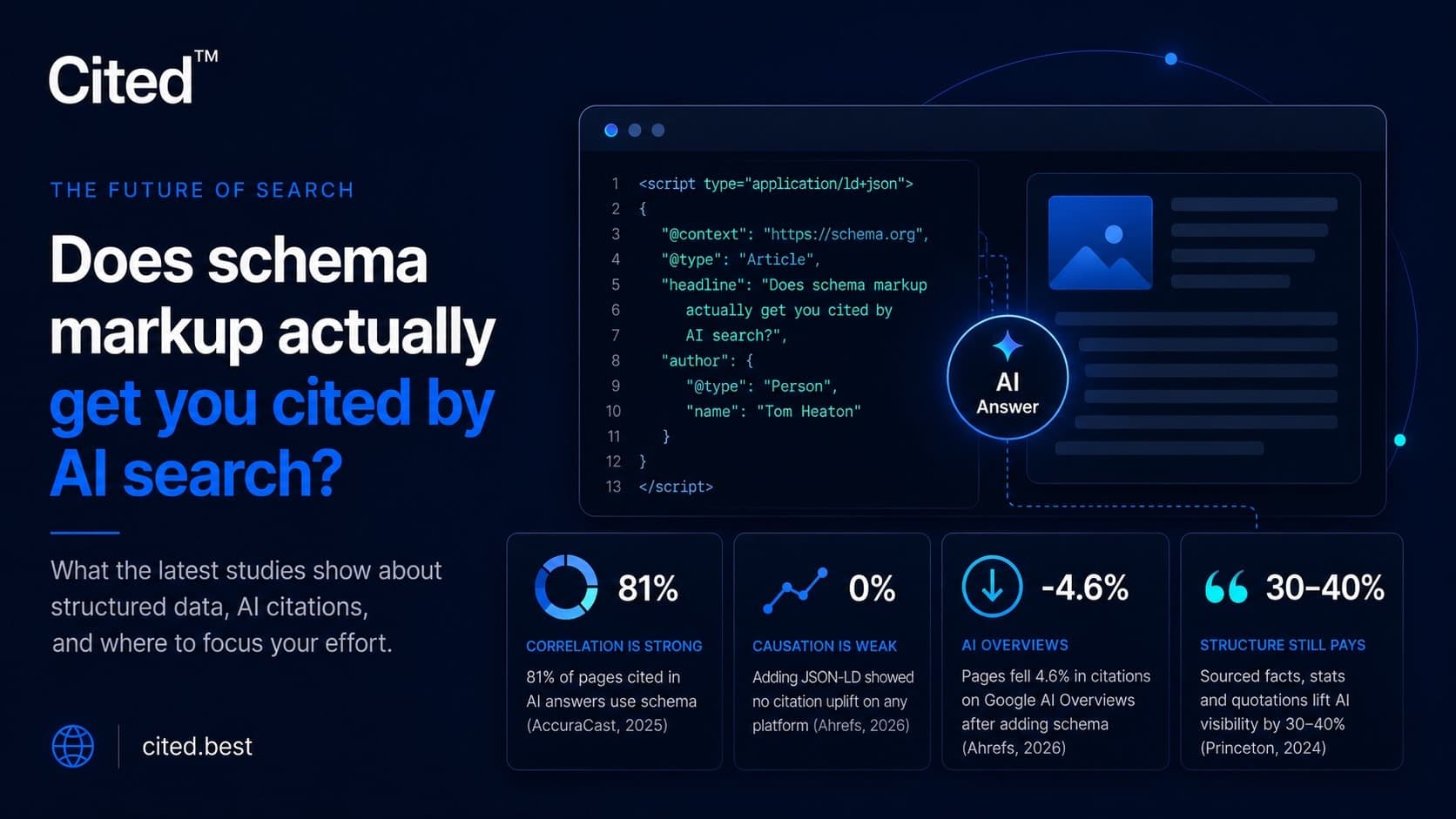
Correlation is strong: 81% of pages cited in AI answers carry schema markup, against 19% with none (AccuraCast, 2025).
Causation is weak: Ahrefs tracked 1,885 pages that added JSON-LD and found no citation uplift on any platform (Ahrefs, 2026).
On Google AI Overviews, those same pages fell 4.6% against matched controls (Ahrefs, 2026).
AI crawlers may not read it at all: in one test, five major AI systems extracted only visible HTML and ignored JSON-LD during live retrieval (searchVIU, 2025).
Structure still pays elsewhere: the Princeton GEO study found citing sources, adding quotations and adding statistics lifted AI visibility by 30 to 40% (Princeton University, 2024).
Does schema markup get you cited by AI search?
Not on its own, and not in the way the add-schema-to-win-AI advice implies. Schema markup (the JSON-LD you add to describe a page as an Article, FAQ, Product or Organization) helps search engines understand structured facts. The evidence that it directly causes more AI citations is thin, and the best controlled test we have suggests adding it to an already-visible page does close to nothing.
That does not make schema worthless. It makes it a supporting act rather than the lever, and it is worth knowing the difference before you spend a sprint on it. For the related technical file people confuse it with, see our explainer on what llms.txt is and how it works.
Why do most AI-cited pages have schema then?
Because schema travels with everything else that gets a page cited. Ahrefs analysed 6 million URLs and found AI-cited pages were almost three times more likely to carry JSON-LD than non-cited pages, and that 53% of AI-cited pages run schema (Ahrefs). AccuraCast's separate look at around 9,000 citation sources put the figure higher, at 81% (AccuraCast).
Both numbers describe the same trap. Sites that add structured data also tend to publish stronger content, build more links, maintain their pages and rank well. Schema is a marker of a well-run site, so it rides the wave of every other signal. The correlation is real; the causation is the open question.
What happened when people actually added schema?
Ahrefs ran the test that isolates cause from correlation. They tracked 1,885 pages that added JSON-LD between August 2025 and March 2026, matched each against control pages that did not, and measured the citation change.
AI source
Effect on citations vs controls
Verdict
Google AI Overviews
-4.6%
Small but statistically significant decline
Google AI Mode
+2.4%
Indistinguishable from zero
ChatGPT
+2.2%
Indistinguishable from zero
Source: Ahrefs, May 2026.
The two positive figures are small enough to be noise across thousands of URLs. The AI Overviews decline is real but tiny in absolute terms, and both treated and control pages were already sliding before schema was added, so it is not evidence that schema hurts. The honest reading is that for pages already being cited, adding JSON-LD moved nothing.
One important limit: every page in that study was already cited heavily before the test. For a page invisible to AI today, schema might still help it get crawled and parsed in the first place. The study cannot rule that out.
Want to know what is actually driving your AI visibility? Start a free AI audit at https://cited.best/audit and see the signals that matter for your pages. Results in minutes, 100% free.
Do AI crawlers even read your JSON-LD?
Often, no. searchVIU tested whether five major systems (ChatGPT, Claude, Perplexity, Gemini and Google AI Mode) used schema when fetching a page live, and found all five extracted only the visible HTML, ignoring JSON-LD, hidden Microdata and hidden RDFa (searchVIU). If the model only reads what a human reads, then a fact buried in structured data but absent from the visible text is a fact the model never sees. That single finding explains most of the schema-did-nothing results.
Which schema types still matter, and why keep it?
Schema still earns its place for reasons unrelated to AI citations: rich results in classic search, voice assistants, and feeding Google's Knowledge Graph, which shapes how engines recognise your brand as an entity. Product and Organization markup in particular do real work for how you are understood.
FAQ markup is a weaker bet than its reputation suggests. In AccuraCast's citation data, FAQPage schema appeared in only 1.8% of cited sources, so it is far from the citation driver it is often sold as (AccuraCast). Keep schema for entity clarity and rich results. Do not add it expecting a citation bump.
So where should the effort go instead?
Into the visible content the models actually read. The Princeton GEO study tested content changes across roughly 10,000 queries and found the biggest visibility gains, 30 to 40%, came from citing sources, adding direct quotations and adding statistics in the body copy (Princeton University).
Put the answer in plain HTML, high on the page, in a passage a model can lift whole. Cite and quote credible sources inside that text. Keep it current, because AI-cited URLs run 25.7% newer than organic results on average (Ahrefs). Then track whether it works, using AI visibility as its own metric rather than assuming a rich result implies a citation. Our methodology and our guide to measuring AI search visibility both set out how to do that.
The short version
Add schema for the things it demonstrably does: rich results, entity recognition, voice. Do not add it as an AI-citation tactic, because the controlled data shows no uplift and the crawlers frequently ignore it. Spend the effort on visible, well-sourced, current content, which is what the models read and cite.
Ready for your AI score?
See how visible your site is to ChatGPT, Perplexity & Gemini.
Start FREE auditResults in minutes · 100% free