
AI search engines like ChatGPT and Perplexity cite sources independently from Google's top rankings, with only about 12% overlap between the two—meaning you can't rely on Google rankings alone to get cited by AI. To capture both visibility channels, you need to combine traditional SEO fundamentals with structured, verifiable content that AI systems can easily retrieve and trust. Focus your measurement on actual outcomes like referral clicks and conversion quality rather than citation frequency, which fluctuates unpredictably.
Close the 12% AI Gap: Citations vs Rankings for UK SEO
Citations do not replace rankings, they sit alongside them as a separate visibility layer with different rules. Google's top 10 still drives organic traffic, but ChatGPT, Perplexity and Gemini now decide independently which sources they quote, often ignoring the same top 10 entirely. The practical answer is to keep core SEO fundamentals intact while adding the structured, verifiable cues that help these systems retrieve and trust your content. Cited exists to help teams do both without guessing.
***
TL;DR: >- Only about 12% of sources cited by AI search engines also appear in Google's top 10 results, with significant variation between platforms.- Building for Google rankings alone provides no automatic advantage in AI citations, requiring separate structured content and verifiable sourcing efforts.- Citation metrics are highly volatile and should be measured through stable outcomes like actual referral clicks and conversion quality, not by frequency alone.- Improving both rankings and AI citations involves technical SEO, clear content structure, and authoritative external references, with monthly audits recommended.- Citation and ranking timelines differ, with indexing often taking days to weeks, but AI citations frequently lag or appear before ranking improvements.
***
Table of Contents
- What does the data show about overlap between Google and AI citations?
- What does the citation gap mean for measurement and reporting?
- What optimisation steps help both rankings and AI citations?
- What timeline should you expect after making changes?
- What regulatory and platform guidance affects this landscape?
- How does Cited measure AI visibility and what can you check yourself?
- Where should your priorities sit right now?
- Get a free AI visibility audit from Cited
- Where can you verify these claims yourself?
- Sources
- FAQ
What does the data show about overlap between Google and AI citations?
The overlap between Google's top rankings and AI citation sources is smaller than most marketers assume, and it varies sharply by platform. A study analysing more than 18,000 queries found that only around 12% of URLs cited by AI search engines also appeared in Google's top 10 results, with wide variance between platforms.
That variance matters more than the headline number:
- ChatGPT showed the lowest overlap with Google's top 10, citing sources that rarely featured in classic organic results.
- Perplexity showed considerably higher overlap, drawing more often from pages that already ranked well in Google.
- AI Overviews blended behaviour, mixing conventional ranking signals with independent retrieval in ways that shifted from query to query.
These figures come from a single study sample, so treat them as directional rather than fixed. Query type, topic freshness and prompt phrasing all move the numbers, and no public dataset tracks this at the scale needed for a definitive industry-wide figure. The sensible takeaway is that ranking well in Google buys you nothing automatic in ChatGPT, and building for one without the other leaves a visibility gap.
What does the citation gap mean for measurement and reporting?
Citation frequency is a volatile metric, and treating it like a stable KPI will mislead your reporting. Practitioner and academic observation from the University of Exeter's web team notes that AI citation metrics are often non-reproducible: the same question with a different follow-up can pull a different source entirely, because LLMs respond to conversational context as much as to the original query.
Build your reporting around outcomes that hold steady across sampling noise:
- Grounded clicks in Search Console, where available, to see actual referral behaviour rather than inferred visibility.
- Conversion quality from AI-referred sessions, tracked against your existing goals rather than a new AI-specific metric.
- Session value, comparing AI-referred visitors against organic search visitors over a rolling period, not a single snapshot.
Pro Tip: Sample citations with a small, varied prompt set rather than one fixed question, since a single prompt tells you almost nothing about how a model behaves across real user queries.
A useful framework treats ranking KPIs as your baseline and citation observations as a qualitative overlay: track rankings as you always have, then log which AI platforms mention your brand across a rotating sample of prompts each month. For a deeper walkthrough of defensible tracking methods, see how to measure AI search visibility.
What optimisation steps help both rankings and AI citations?
The changes that help you rank in Google and get cited by ChatGPT overlap more than most teams expect, because both systems reward clarity, structure and verifiable sourcing. Google's guidance is explicit that well-structured, factual content with clear sourcing increases its chance of being used as grounding material in generative answers.
Start with the technical layer:
- Keep canonical tags consistent and avoid duplicate URLs that split authority signals across near-identical pages.
- Use schema markup to make entities, authorship and publication dates machine-readable.
- Ensure fast indexing through clean sitemaps and stable URLs that do not change after publication.
Then address content structure:
- Write concise answer blocks near the top of the page that state the core fact before the explanation.
- Add explicit source lists on key pages, since a short, single-paragraph section linking to documentation and authoritative data is disproportionately effective at improving grounding chances.
- Keep pages single-topic where possible, so retrieval systems can match a query to a clear, undiluted subject.
- Write authoritative excerpts, meaning short passages that could stand alone as a quoted answer.
External presence carries real weight too. High-quality references on documentation sites, review platforms, industry directories and trusted third-party publications all feed the same trust signals that Google's ranking systems and AI retrieval layers draw from. The technical checklist in get cited by ChatGPT and Perplexity expands on schema and indexing specifics, and the practical guide to building citation-ready source lists covers the exact structure that works. On the content side, humanising content for ranking and citation explains why human-first writing signals help both systems trust a page.
Pro Tip: Run a monthly audit against these three areas rather than a one-off fix, since indexing and model behaviour both change continuously.
Monitoring closes the loop: sample prompts across ChatGPT, Perplexity and Gemini on a fixed schedule, check Search Console's generative AI reports where your account has access, and repeat full audits quarterly rather than assuming a single fix holds indefinitely.
What timeline should you expect after making changes?
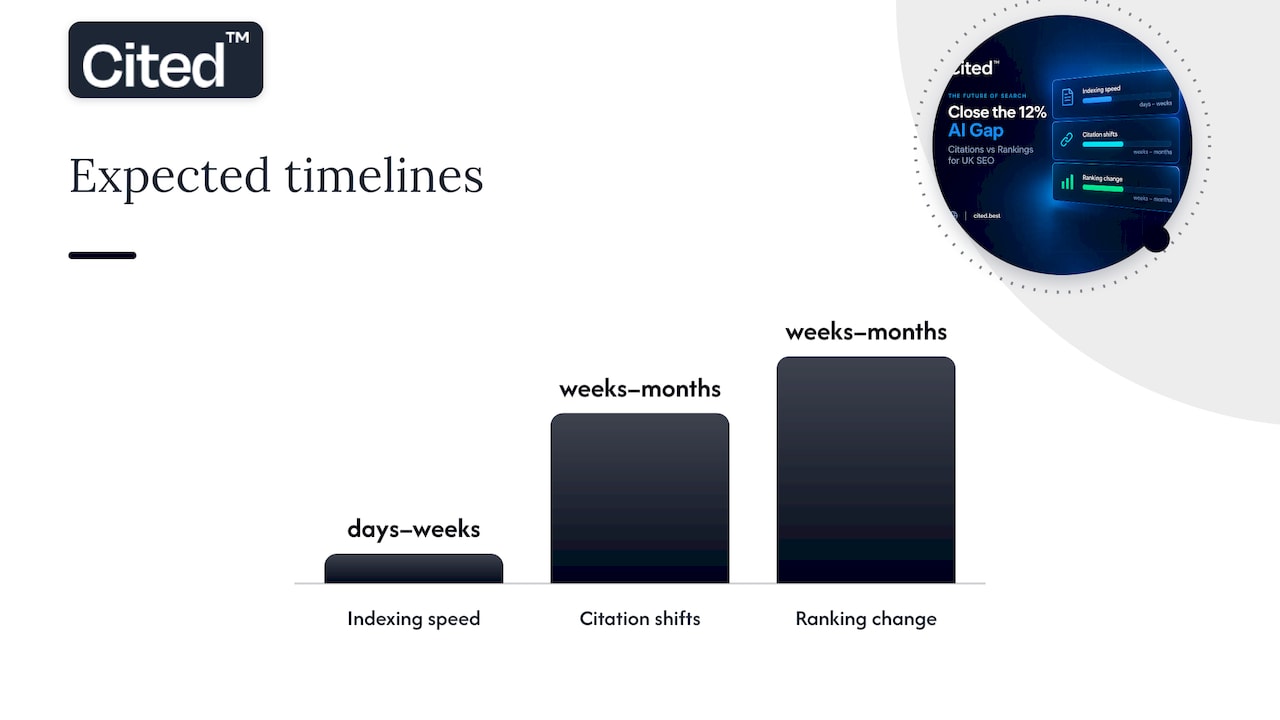
Indexing changes typically show up within days to a few weeks, but citation movement lags further behind. Google's own systems need to recrawl and re-evaluate a page before it can be surfaced in AI features, and initial citation shifts commonly take weeks to months to appear consistently across sampled prompts.
Several factors shorten or extend that window:
- Pages on domains with established authority tend to get picked up by retrieval systems faster than new or low-authority pages.
- Fresh third-party references, such as a new mention on a trusted industry site, can accelerate citation likelihood independently of your own page changes.
- Platform indexing speed varies: some AI systems refresh their retrieval index more frequently than others, so the same fix can surface at different speeds across ChatGPT, Perplexity and Gemini.
Citations sometimes lead rankings, appearing before a page climbs Google's organic results, and sometimes lag them by months. Treat both as separate timelines rather than expecting one to predict the other.
What regulatory and platform guidance affects this landscape?
The UK's Competition and Markets Authority introduced Fair Ranking conduct requirements in 2026 that require Google to rank organic results using objective, non-discriminatory criteria, with search generative AI features explicitly brought within scope. The final decision document sets out the compliance expectations and transparency requirements Google must meet under this conduct requirement.
The practical implications for practitioners:
- Expect greater transparency from Google about how AI features select and rank content, reducing the space for permanent hidden signals.
- Monitor your own visibility across both rankings and citations rather than assuming one regulatory framework covers both.
- Raise concerns through established channels if you suspect ranking or citation behaviour breaches the conduct requirement, since the CMA's remit now explicitly includes AI-driven search features.
How does Cited measure AI visibility and what can you check yourself?
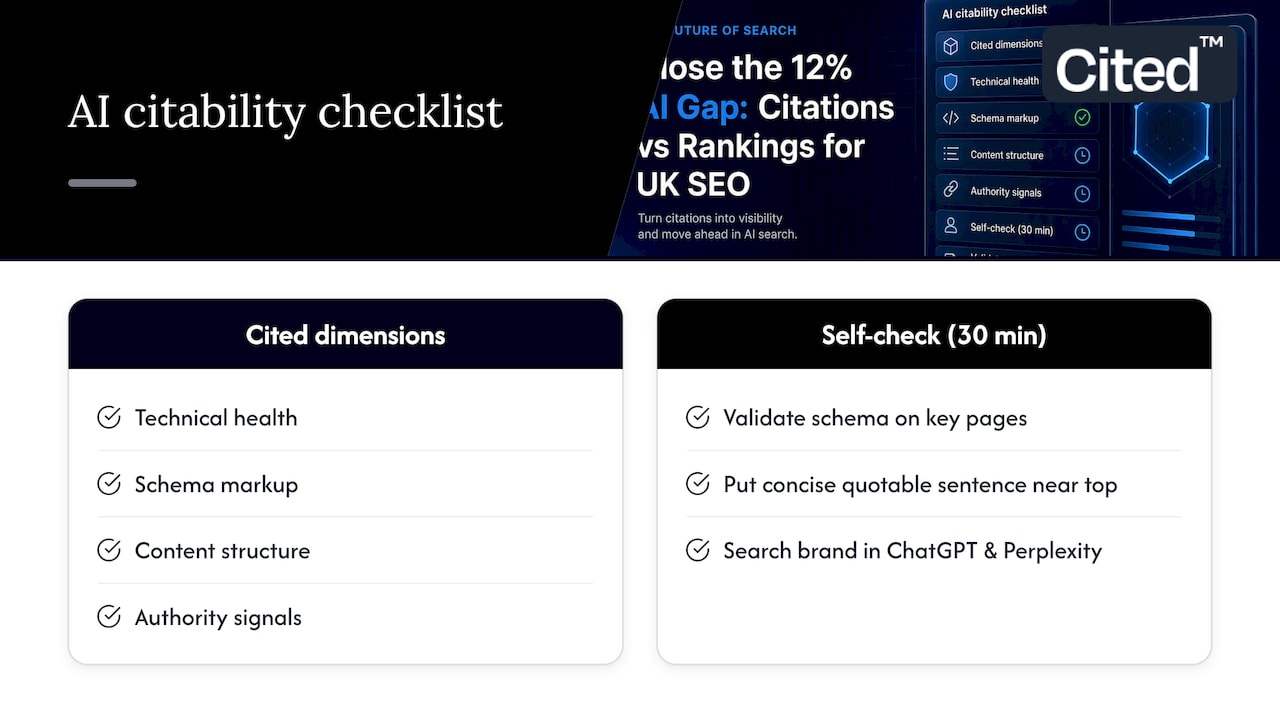
Cited scores AI citability across six dimensions: technical health, schema markup, content structure, authority signals, platform coverage and source referenceability, detailed in the Cited methodology. You can run a lighter version yourself in half an hour: check whether your key pages have valid schema, confirm your most important facts appear in a concise, quotable sentence near the top of the page, and search your brand name in ChatGPT and Perplexity to see what, if anything, gets cited back.
Where should your priorities sit right now?
Citations and rankings are complementary systems measuring different kinds of trust, and treating them as competing metrics wastes effort that should go into defensible, outcome-based reporting. The gap between the two will not close through guesswork: it closes through structured content, verifiable sourcing and consistent technical hygiene applied to both.
If you do nothing else this quarter, do three things: run an AI visibility audit, fix any gaps in your structured data, and strengthen the third-party references that point back to your key pages. Start with the free audit at Cited.
— Tom Heaton
Get a free AI visibility audit from Cited
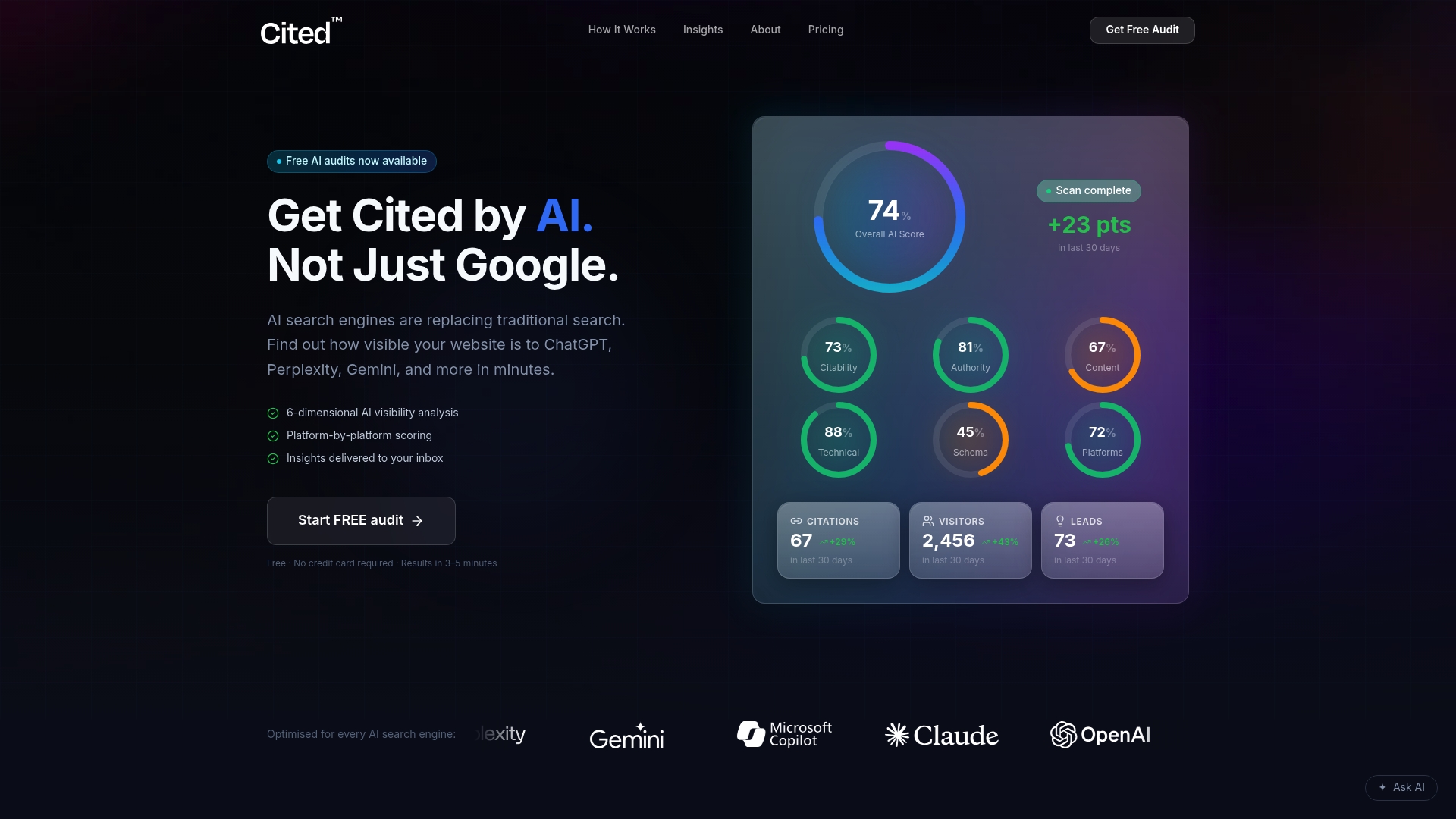
Fixing the gap between rankings and citations takes structured, prioritised work, not another dashboard to check daily. Cited's free audit reviews your site across the six dimensions above and hands you a prioritised list of what to fix first, with no credit card or account required.
From there, the path depends on what the audit finds:
- Start with the Free GEO Audit to see where your current AI visibility stands.
- Commission Technical Fixes from £495 one-off for scoped, priority issues the audit identifies.
- Move to the AI Optimised plan from £995 per month for ongoing implementation and monitoring.
- Talk to Cited about an Enterprise engagement if you need custom scope across multiple sites or brands.
Every audit reveals different priorities, and fixes are scoped and priced after that review, so there is no generic package to guess at. See how the process works before you commit to anything.
Where can you verify these claims yourself?
The claims in this article draw from named regulatory and technical sources rather than aggregated estimates.
- The CMA's Fair Ranking announcement and its final decision document set out the conduct requirement in full.
- Google's developer documentation on AI features explains retrieval-augmented generation and optimisation guidance directly from the platform.
- The University of Exeter's analysis of AI visibility tracking covers why citation metrics behave inconsistently across sampling.
Sources
AI citation systems select sources through retrieval and grounding, not through the ranking signals that decide Google's organic results. Google's own developer documentation confirms that generative AI features rely on retrieval-augmented generation, where the system fetches candidate documents relevant to a query, then uses them as grounding material for a generated answer. Retrieval and synthesis differ fundamentally from classic ranking, which sorts a fixed index by relevance and authority signals such as backlinks and page experience.
Three technical differences explain most of the divergence:
- Further CMA action to secure a fairer deal for businesses and improve Google search services in UK
- Google's guide to optimising for generative AI features on Google Search
- AI visibility tracking: SEO's dirty secret | University of Exeter Web Team
- Fair ranking CR final decision
Google states plainly that core search quality systems remain the foundation for these AI features, and warns against third-party claims of access to secret AI ranking metrics. There is no separate algorithm to reverse-engineer, only a retrieval layer sitting on top of familiar quality signals.
FAQ
Is 24 citations good for AI visibility?
There is no published benchmark that defines a good citation count, since counts vary enormously by platform, query volume and topic. Focus instead on whether your citations appear consistently across a varied prompt sample rather than chasing a specific number.
What is the difference between a citation and a reference list?
A citation, in the AI search context, is a source an AI system quotes or links to when generating an answer, chosen through retrieval and grounding. A reference list is a static set of links a page author includes, which may or may not ever be picked up as a citation by an AI system.
What are two types of citations in AI search?
Direct citations appear as explicit links or attributions within an AI-generated answer, visible to the user as the source of a claim. Grounding citations are documents an AI system retrieves and uses to inform its answer without always surfacing them visibly to the reader.
What is an example of an AI citation?
If a user asks ChatGPT about a specific product feature and the response links to a manufacturer's documentation page as the source of that fact, that link is the citation. The same query asked of Perplexity or Gemini may cite a different source entirely, reflecting each platform's own retrieval behaviour.
Are citations necessary for SEO, or only for AI visibility?
Citations are not a ranking factor for classic Google organic results, but they matter for visibility inside AI-generated answers where increasing numbers of searches now occur. Teams optimising only for traditional rankings risk missing this separate, fast-growing layer of discovery entirely.
Recommended
Ready for your AI score?
See how visible your site is to ChatGPT, Perplexity & Gemini.
Start FREE auditResults in minutes · 100% free