
A credible author page needs three core elements: a verifiable identity with a real headshot and full name, dated proof of actual work like tools used or interviews conducted, and external links that confirm the author exists and knows the subject. Author pages are one of the fastest wins in an SEO audit because they help both AI systems and search raters confidently attribute claims to a real person with genuine expertise. Missing or weak author pages force readers and algorithms to guess whether someone actually knows what they're writing about, which rarely works in a website's favor.
Five Minute Author Page Fixes: Receipts and Audit Steps for EEAT
A credible author page must show a verifiable identity, first-hand experience, and external verification paths. Everything else on the page exists to support those three signals. That means a real headshot and full name, dated proof of work such as tools used or interviews conducted, and links out to bylines, credentials, or profiles that corroborate the person exists and knows the subject.
***
TL;DR: >- Verifiable identity signals like a current headshot, full name, and contact route must be clear and consistent across the author page.- Evidence of specific, dated work receipts such as tools used, projects completed, or interviews conducted significantly strengthen the author’s credibility.- External verification links, including LinkedIn, ORCID, or published work, should be accurate, live, and directly connect to the author's credentials.- Author schema markup must precisely mirror the visible bio, with validated links and properties, to support AI attribution and search trust signals.- Incorporating a receipts section, explicit editorial responsibility, and outbound verification links are crucial for building authoritative, human-centric author pages.
***
Table of Contents
- What author pages E-E-A-T signals actually require
- What should an author bio page include to prove expertise?
- How does Person and Article schema support author pages eeat?
- What makes a strong author page worth copying?
- Where should author bios live and link to?
- How do you write a bio that sounds human, not like a CV?
- What receipts and editorial signals matter most right now?
- Author page checklist: the fields that map to E-E-A-T
- Author pages sit near the top of the audit checklist, not because they're glamorous, but because they're one of the fastest wins available to most sites. A page with no author link at all, or a byline pointing to a dead "Team" page, is a five-minute fix with a disproportionate effect on how confidently an AI system can attribute a claim to a real person.
- Get a free AI visibility audit for your author pages
- Sources
- FAQ
What author pages E-E-A-T signals actually require
Google's own guidance on people-first content says the quiet part out loud: pages should make it easy to verify who created them, and a byline linking to a proper author page is the mechanism it recommends for doing that. This is the practical core of author pages E-E-A-T work. Search Quality Raters are trained to look for signals of experience, expertise, authoritativeness, and trust, and an author page is the single densest place on a website to concentrate all four.
Think of the author page as an entity home. It is the fixed point where a person's expertise, history, and output get tied to a specific identity, and where that identity gets tied to the brand publishing the content. When that link is missing or thin, both raters and automated systems have to guess who wrote something and whether they know what they're talking about. Guessing rarely works in a website's favour.
The entity-home concept matters more as AI systems generate summaries and citations directly from web pages. A large language model pulling together an answer needs some signal that a claim came from someone credible, not just someone who typed fast. Author pages with clear credentials and receipts of work give that model something to point to.
The bar rises sharply for anything touching money, health, safety, or legal advice, commonly shortened to YMYL. It also rises for AI Overviews and similar summary features, where Google has openly stated it wants human-reviewed, expert-backed content over unreviewed AI output. Author transparency is one of the clearest ways to demonstrate that a human with relevant knowledge stood behind the page.
What raters and AI systems are actually checking for on an author page:
- A named, identifiable person rather than a generic "Team" or "Admin" byline
- Evidence the person has done the thing they're writing about, not just read about it
- A way to verify the person's claims outside the site itself
- Signs that someone reviews or updates the content over time
- Consistency between what the bio claims and what the rest of the site shows
None of this is exotic. It is closer to what a hiring manager checks on a CV than anything mysterious about algorithms, and that is precisely why so many sites still get it wrong.
What should an author bio page include to prove expertise?
An author page needs four groups of proof: visible identity fields, experience receipts, verifiable credentials, and trust signals such as a corrections policy. Miss any one group and the page reads as decorative rather than evidential.
Visible identity fields come first because they're the baseline check any reader or rater performs in seconds:
- A professional headshot, ideally the same one used consistently across the site and any linked social profiles
- Full name, written the same way everywhere it appears
- Current role and scope of coverage (what topics this person actually writes about, not a vague "content specialist")
- A contact method or corrections route, even if it's a simple mailto link or a link to a contact page
Experience receipts are where most author pages fall flat. A line claiming "10 years in SEO" is a CV-style assertion nobody can check. A receipts section that lists specific, dated activity is different. That might be a tool the author built or tested, a dataset they analysed, a case note from a client project (anonymised where needed), an interview they conducted, or a direct link to a primary output like a published study or a conference talk. This is the part of author bios that drive E-E-A-T most convincingly, because dated, specific claims are far harder to fabricate at scale than generic ones.
Credentials and external verification turn the page from self-reported to corroborated. Degrees, professional registrations, and published work all count, but only if they're linked somewhere a reader can actually check them, not just named. sameAs links to LinkedIn, an ORCID ID, a Google Scholar profile, or a professional body's member directory all serve this purpose. The link itself is the verification path; naming the credential without one is just another unchecked claim.
Trust items round out the page and matter more than most site owners assume:
- A corrections policy, even a one-line statement of how errors get reported and fixed
- Disclosure of any conflicts of interest, particularly for product reviews or comparison content
- A last-reviewed date on the bio itself, showing someone maintains it
Pro Tip: Write one sentence per credential claim that names the exact organisation, year, and link. "Chartered Marketer, CIM, 2019" with a link to the CIM directory beats "marketing professional with extensive experience" every time, for a human reader and for anything summarising the page automatically.
How does Person and Article schema support author pages eeat?
Structured data proves nothing on its own. It only works when it mirrors what a reader can already see on the page, using the Person and Article schema properties that Schema.org documents for exactly this purpose.
For Person schema, the properties worth including are name, image, url (pointing to the dedicated author page), sameAs (an array of verified external profile links), jobTitle, and worksFor. Each one should match, word for word, what's written in the visible bio. If the JSON-LD says the author's job title is "Senior Editor" but the bio text says "Contributing Writer," that mismatch does not go unnoticed by automated systems reading the markup against the page.
Article schema needs an author property that references the Person object, ideally by linking to the author's URL rather than repeating the name as a flat string. This is what actually ties a specific article to a specific, verifiable creator rather than a name that could belong to anyone.
Two figures worth keeping in mind while building this out: Google's own structured data introduction states plainly that markup must reflect the main content of the page, and mismatches between visible and structured content actively reduce trust in the eyes of automated processors reading both.
Common pitfalls worth checking before publishing:
- An
imageproperty pointing to a stock photo or an old headshot that no longer matches the visible bio photo sameAslinks that go to dead profiles, private accounts, or pages that don't actually mention the author by name- Article schema that names an author string but has no linked Person object at all
- Multiple authors sharing one schema entry because a CMS defaulted to a single "admin" user
Test every implementation with a structured-data testing tool before it goes live. Cited's own author schema audit walks through the five most common red flags found across real sites, most of which come down to exactly this kind of drift between what's coded and what's visible.
What makes a strong author page worth copying?
The strongest author pages share three transferable features regardless of site size: a documented receipts section, a clearly stated editorial role, and outbound links that let a reader leave the site to verify the person. Published examples of author bios that drive E-E-A-T consistently show these same three elements, dressed differently but structurally identical.
The receipts section matters most because it's the hardest thing for a thin content mill to fake convincingly. A page listing three named projects with dates and links reads as real in a way that "passionate about technology" never will, for a rater and for an AI system alike.
An explicit editorial role, something like "reviews all product testing methodology before publication," tells a reader exactly what this person is accountable for. It also gives search systems a specific claim to weigh, rather than a vague seniority signal.
Outbound links are counterintuitive to some site owners who worry about sending readers elsewhere, but a link to an author's LinkedIn, a published paper, or a conference recording is the single easiest way to let someone outside the site confirm the person is real and does the work claimed.
Adaptation notes by site size:
- Small blogs and solo sites: skip the elaborate schema and focus entirely on one strong paragraph plus two or three genuine receipts. A single real credential beats five vague ones.
- Mid-size publishers: standardise a bio template across all writers so every author page has the same fields in the same order, then add sameAs links as a non-negotiable field in the CMS.
- Enterprise sites: build author pages into the CMS as a required content type with mandatory fields, not an optional profile page that individual writers may or may not fill in.
Where should author bios live and link to?
The minimum requirement is a byline on every piece of content that links to a dedicated, indexable author page, not a pop-up tooltip or a name with no link at all. This single change is what Google's own guidance on people-first content specifically recommends as the mechanism for creator verification.
Beyond that minimum, the network of links matters as much as any individual page:
- The author page should link back to a reasonable selection of the person's authored posts, not just exist as an island
- The site's About page should link to individual author pages rather than duplicating bio content
- The author's name should be written identically everywhere it appears, in bylines, on the author page, and in any schema markup
- Author pages need to be indexable, not blocked by robots.txt or accidentally set to noindex by a CMS default
- Author URLs belong in the sitemap alongside regular content pages, and should use canonical tags correctly if the CMS generates duplicate paginated author archives
Getting this wrong is one of the most common technical gaps found during technical SEO audits for AI visibility: author pages exist, but they're accidentally excluded from indexing, which makes every careful bio and every schema property pointless because nothing can find the page in the first place.
How do you write a bio that sounds human, not like a CV?
Write bios that state what the person has actually done, using specific numbers and named outputs, rather than adjectives describing how good they supposedly are at their job. "Managed content strategy across 40 client accounts between 2021 and 2024" tells a reader something checkable. "Passionate strategic content leader" tells them nothing.
Short bios, the one or two lines that appear under a byline, should carry the single most relevant credential and nothing else. Long bios, on the dedicated author page, can expand into the full receipts section, credentials, and trust items covered earlier.
Choose first person or third person deliberately, not by CMS default. First person suits sites built on personal connection, a solo consultant or a niche newsletter, because it reads as the person speaking directly. Third person suits larger publishers where the bio functions more like a masthead credit, formal and consistent across dozens of writers.
- Replace vague seniority claims ("years of experience") with a specific start date or project count that a reader could, in theory, check
- Name the actual publications, tools, or clients involved wherever confidentiality allows it
- State editorial responsibility plainly: what does this person approve, fact-check, or take accountability for before publication?
Pro Tip: Read the bio back and ask whether a stranger could disprove any sentence in it. If every claim is unfalsifiable ("deeply committed to quality"), the bio is doing decoration, not verification.
What receipts and editorial signals matter most right now?
A receipts section is a short, dated list of specific things the author has done, built, tested, or published, and it is one of the hardest E-E-A-T signals for thin or AI-generated content to fake convincingly. That difficulty is precisely why it carries weight with both raters and automated citation systems.
The 2025 update to Search Quality Rater guidelines reiterates that author transparency and documented expertise raise evaluated content quality, and that AI-generated content without human review carries a higher risk of being judged low quality. Editorial signals are the practical response to that guidance: a named reviewer, a last-reviewed date, and a clear corrections route.
These matter most for YMYL-adjacent content, where the Search Quality Rater Guidelines place particular weight on demonstrable expertise and reduced risk of harm from inaccurate claims. A finance or health page without a named, credentialed reviewer is taking on risk that a simple byline update could remove.
Adding these signals without bloating the page is straightforward:
- One short "Reviewed by" line with a name, date, and link to the reviewer's own author page
- A single sentence stating the corrections policy, linked to a contact method
- Three to five bullet-pointed receipts rather than a sprawling career history
- A visible "last updated" date on the article itself, tied to the same review cycle
None of this needs a redesign. It needs a template with the right fields built in from the start, so every writer fills the same gaps rather than inventing their own format each time.
Author page checklist: the fields that map to E-E-A-T
Building an author page from scratch is easier with the requirements grouped by category rather than treated as one long list.
E-E-A-T category | What to include |
|---|---|
Experience | Dated receipts: tools used, projects completed, interviews conducted, primary outputs linked |
Expertise | Credentials with verification links, scope of coverage, relevant training or registrations |
Authoritativeness | sameAs links to LinkedIn, published work, professional directories, or citation profiles |
Trustworthiness | Corrections policy, last-reviewed date, disclosure of any conflicts of interest |
A simple page skeleton to hand to a developer or CMS template builder:
- Header: headshot, full name, job title, one-line scope statement
- Short bio: two to three sentences, specific and checkable
- Receipts section: three to five bulleted items with dates
- Credentials block: degrees, registrations, or memberships, each linked
- Verification links: sameAs array covering LinkedIn, published bylines, and any professional profiles
- Trust footer: corrections contact, last-reviewed date
For accessibility, make sure the headshot carries descriptive alt text, headings follow a logical order for screen readers, and every link has meaningful anchor text rather than "click here." WordPress sites can build most of this using the core user profile fields plus a custom fields plugin for the receipts and sameAs arrays; larger CMS platforms should make these fields mandatory at the template level, not optional extras a writer might skip.
Author pages sit near the top of the audit checklist, not because they're glamorous, but because they're one of the fastest wins available to most sites. A page with no author link at all, or a byline pointing to a dead "Team" page, is a five-minute fix with a disproportionate effect on how confidently an AI system can attribute a claim to a real person.
The pattern shows up repeatedly across audits: sites with solid content but thin or missing author pages score worse on citation likelihood than sites with average content and properly built author entities. The receipts section is usually the single biggest gap. Most writers list credentials but skip the dated, specific proof that actually distinguishes a real practitioner from a template bio.
What tends to move the needle fastest is adding sameAs links that actually resolve to live, name-matching profiles, and fixing Person schema that has drifted out of sync with the visible bio text. Neither takes long. Both compound across every page that byline touches.
Get a free AI visibility audit for your author pages
Most sites never actually check whether their author pages help or hurt their AI visibility until someone runs the numbers. A free audit can check whether bylines link to real, indexable author pages, whether Person and Article schema mirrors what's visible on the page, and whether sameAs links actually resolve to profiles that corroborate who your writers are.
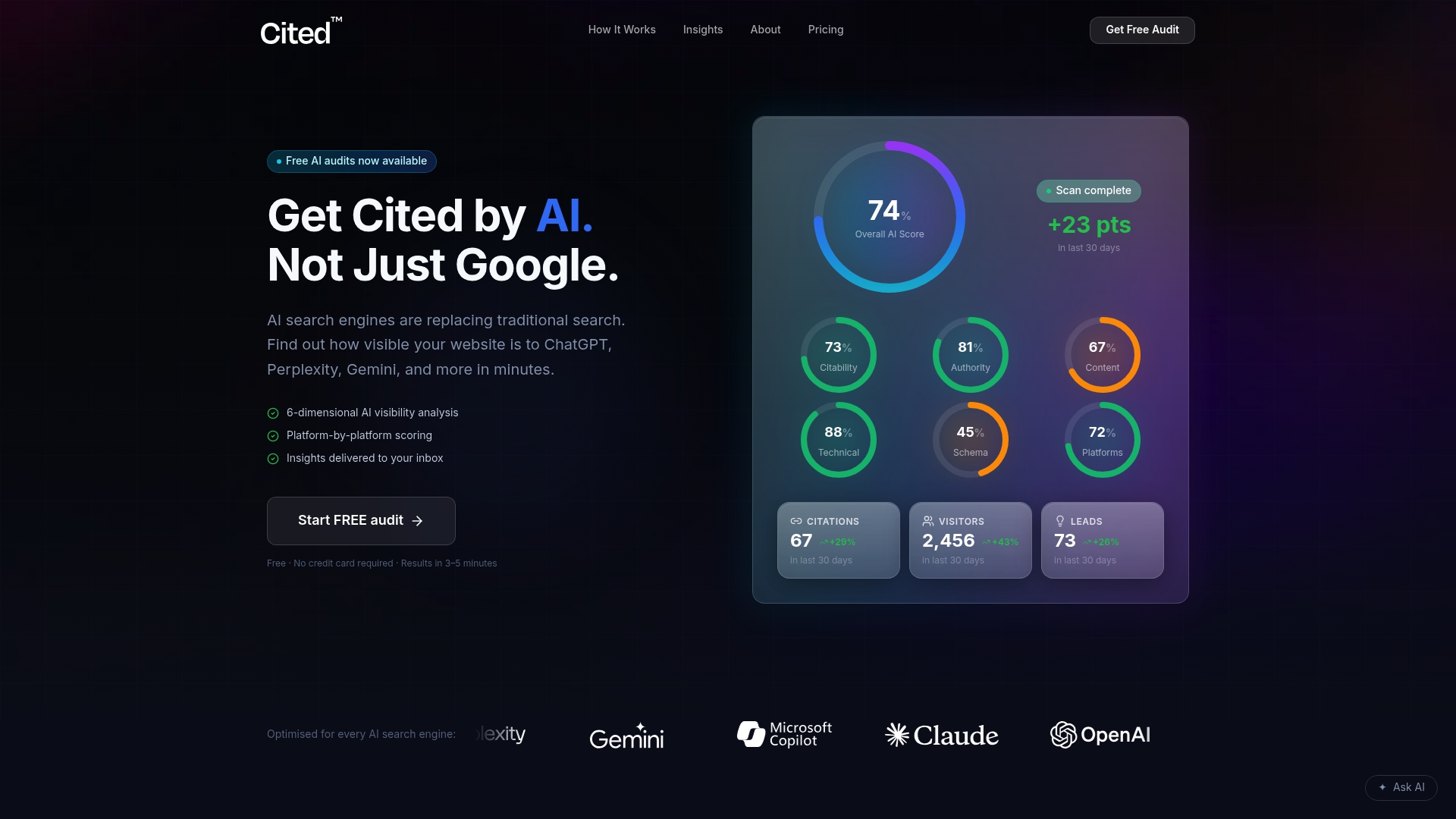
The audit covers six dimensions of AI citability altogether, including technical health, schema markup, authority signals, and platform coverage, so author pages are one part of a wider picture rather than the whole story. Where the audit finds gaps, there are options to close them with one-off technical fixes or a managed service for ongoing implementation and monitoring. Larger organisations with multiple authors and complex CMS setups can get a custom enterprise scope. You can read more about how the scoring works on the Cited methodology page.
Start with the free AI visibility audit to see exactly where your author pages currently stand, or book a call if you'd rather talk through the findings with someone directly.
Sources
Google's own documentation on people-first content remains the primary source for how author signals feed into quality evaluation, alongside the Search Quality Rater Guidelines for the fuller detail on how expertise and trust get assessed.
For implementation, Schema.org's author and Person documentation sets out the accepted properties, and Google's structured data introduction covers the testing and mirroring principles that keep markup honest. WordPress users can start from the core profile documentation before layering on custom fields for receipts and sameAs links.
Cited's own Article schema guide and the broader piece on E-E-A-T versus domain authority both go deeper into the mechanics covered here, and SemLocal's piece on search marketing and branding is worth reading for how author credibility feeds into wider brand trust.
- Creating helpful, reliable, people-first content | Google Search Central
- Schema
- 5 examples of author bios that drive E-E-A-T, Fractl
- Quality Raters Guidelines Update: What E-E-A-T, YMYL & AI now mean for your SEO
FAQ
What is E-E-A-T and why does it apply to author pages?
E-E-A-T stands for experience, expertise, authoritativeness, and trustworthiness, and author pages are where a site concentrates the clearest proof of all four in one place.
Do author pages need Person schema to help SEO?
Person schema helps when it mirrors the visible bio exactly, using properties like name, image, sameAs, and jobTitle, but it adds no value if the markup contradicts what's actually on the page.
How long should an author bio be?
A short byline bio should run one to two sentences with the single most relevant credential; the full author page can expand into a receipts section, credentials, and verification links.
What are "receipts" on an author page?
Receipts are dated, specific examples of work the author has actually done, tools used, projects completed, or interviews conducted, and they're harder to fake than generic experience claims.
Can a small blog with one writer still build a strong author page?
Yes. A solo site benefits most from one strong paragraph, two or three genuine receipts, and working sameAs links rather than elaborate schema with little behind it.
How does Cited check author pages during an audit?
Cited's free audit checks whether bylines link to indexable author pages, whether Person and Article schema match the visible bio, and whether sameAs links resolve to real profiles, as part of a wider check across six dimensions of AI citability.
Recommended
Ready for your AI score?
See how visible your site is to ChatGPT, Perplexity & Gemini.
Start FREE auditResults in minutes · 100% free