
If you want AI systems to cite your content quickly, focus on page-level trust signals like author credentials and primary source citations—these can show results in days. Domain Authority is useful for benchmarking against competitors, but it won't directly improve your AI visibility the way E-E-A-T signals do, which is why Google's AI systems prioritize specific page trustworthiness over overall domain strength.
Win AI Citations in Weeks: E E A T vs Domain Authority
E-E-A-T decides whether a specific page gets trusted and cited, especially by AI systems; Domain Authority is Moz's 0-100 estimate of a whole domain's link strength. Prioritise E-E-A-T if you want AI citations and stable rankings on sensitive topics, and use Domain Authority when you need a quick benchmark against competitors or a way to prioritise link-building targets. The tactics for both differ, and so does the timeline for seeing results.
***
TL;DR: >- Improving page-level trust signals like author credentials and primary source citations can increase AI citations within days, while boosting domain authority takes months of link-building.- Google's AI systems prioritize specific page trustworthiness over overall domain strength, making provenance and attribution more critical than backlink metrics for AI visibility.- Tools like Moz Domain Authority are useful for competitor benchmarking but do not directly influence Google rankings, which are more affected by E-E-A-T signals at the page level.- A focus on building topic clusters, adding real author bylines, and citing primary data enhances AI citability, especially on sensitive YMYL topics.- Regularly measuring page-level KPIs such as citation frequency and author visibility is essential, with weekly and monthly audits helping track immediate improvements.
***
Table of Contents
- What do E-E-A-T and domain authority actually mean?
- How do the signals differ in practice?
- Why does AI search shift the balance towards page-level signals?
- What's the right hybrid strategy for allocating your SEO effort?
- How do you measure whether this work is actually paying off?
- Which tools and resources are worth using right now?
- What we've learned applying this to client sites
- How Cited can help you close the gap
- Sources
- FAQ
What do E-E-A-T and domain authority actually mean?
E-E-A-T stands for experience, expertise, authoritativeness and trustworthiness. It comes from Google's Search Quality Rater Guidelines, where human raters use it to judge whether a page deserves to rank, particularly for topics that affect health, money, or safety. Google has been explicit that trust is the component that matters most: a page can show deep expertise and still fail if readers have no reason to believe it.
Domain Authority is a different animal entirely. Moz built it as a third-party scoring system that predicts how well a domain is likely to rank, based mostly on the quantity and quality of its backlink profile. It has nothing to do with Google's actual algorithm. Google has never used Domain Authority as a ranking input, and Moz doesn't claim otherwise. It exists to give SEOs a comparative yardstick, not a mirror of Google's internal thinking.
The scope difference matters more than most people treat it. E-E-A-T guidance operates at the page level. Quality raters assess individual URLs against the intent of that specific page, and Google's systems apply similar logic when weighing content for sensitive or "your money or your life" topics. A single domain can host a brilliantly trustworthy medical guide and a thin, unattributed blog post side by side, and Google's evaluation of each will differ sharply.
Domain Authority, by contrast, is a blunt domain-wide number. It doesn't know or care which page you're asking about; it reflects the aggregate link profile of the whole site. That's a useful proxy for competitive strength, but it tells you nothing about whether your latest article demonstrates real expertise.
Three practical distinctions worth holding onto:
- E-E-A-T is guidance for human raters and a conceptual lens for automated systems, not a single number you can check.
- Domain Authority is a calculated score you can pull from a dashboard in seconds, updated on Moz's own schedule.
- E-E-A-T is assessed per page and per topic; Domain Authority is assessed once, for the whole domain, regardless of topic.
Understanding EAT for SEO this way, as page-specific judgement rather than a site-wide badge, changes how you should be allocating effort.
How do the signals differ in practice?
E-E-A-T signals move fast and DA signals move slowly, which is the single biggest practical difference between them. Fixing an author bio or adding a case study can shift how a page reads to both raters and AI crawlers within days. Shifting Domain Authority meaningfully usually takes months of sustained, high-quality link acquisition.
The signals that feed each metric barely overlap:
- E-E-A-T signals: author credentials and bylines, first-hand experience (photos, data, direct testimony), citations to primary sources, clear ownership and contact information, and content structured around the reader's actual question.
- Domain Authority signals: the number of unique referring domains, the authority of those domains, anchor text diversity, and the age and consistency of the link profile.
- Shared ground: both benefit from consistent publishing history and a site that isn't riddled with spam or thin pages, though they measure that consistency differently.
Domain-level authority metrics from different vendors tend to agree with each other far more than they agree with Google's actual ranking behaviour. Research comparing Moz DA, Ahrefs DR and Semrush Authority Score found a correlation of roughly 0.9 between them, which tells you these tools are measuring the same underlying signal (backlink strength) even when they disagree on the exact number. That correlation is exactly why comparing EAT and authority as competing metrics misses the point: DA tools agree with each other because they're built on similar data, not because they're approximating Google's page-level judgement.
Manipulation risk splits the two cleanly. Domain Authority can be gamed, at least temporarily, through aggressive link building or manufactured PBNs, because it's a mechanical calculation of link data. E-E-A-T is much harder to fake at scale, since it depends on demonstrable expertise and trust signals that AI systems and raters are increasingly good at cross-checking against external reality.
The practitioner pattern that shows up again and again: a page with modest domain authority but strong first-hand experience and clean sourcing can outrank a page on a high-DA domain that reads like it was written to hit a word count. This happens most visibly on YMYL topics, where Google's raters (and increasingly its AI systems) are trained to penalise thin, uncredentialed content regardless of the domain's overall strength.
Pro Tip: Run the same query in Google's standard results and in AI Mode. If a low-DA competitor is being cited in the AI answer but not ranking well in classic search, that's usually a signal their page-level trust and provenance are doing more work than their link profile.
Why does AI search shift the balance towards page-level signals?
AI search engines cite sources based on provenance and trustworthiness signals, not domain-wide authority scores. Google's own AI Mode documentation describes how its systems favour sources that demonstrate clear provenance when composing an answer, which is a page-level judgement, not a domain-level one. The same logic extends to how ChatGPT, Perplexity, and Claude select which pages to surface as citations: they're reading the specific page for signals of firsthand knowledge and clear attribution, not checking a DA score first.
This matters because AI agents favour succinct, well-attributed content when they're composing an answer rather than listing ten blue links. A page buried on a low-authority domain can still get cited if it answers the question precisely and shows its sourcing. A page on a powerful domain can get skipped entirely if it reads as generic or unattributed.
Topical authority is what ties this together in practice. Building a cluster of interlinked pages around one subject, each with a clear author, first-hand detail, and links to primary sources, signals depth in a way a single standalone article never can. Entity-focused pages (a dedicated author page, a clear "about" page, consistent naming of people and organisations across the site) give AI systems something concrete to anchor citations to.
Practical shifts worth making to your content planning:
- Build topic clusters with a defined pillar page and supporting pages that link both ways, rather than isolated posts competing for the same keyword.
- Add named author bylines with real credentials to every page that touches YMYL territory.
- Cite primary sources and original data wherever possible, rather than paraphrasing another blog's summary.
- Keep entity names (people, places, organisations) consistent across the site so AI systems can match them reliably.
None of this replaces backlinks. It just means the fastest lever for AI visibility right now sits at the page level, not the domain level, and boosting website authority through links alone won't fix a page that lacks provenance.
What's the right hybrid strategy for allocating your SEO effort?
Split your effort across three timeframes rather than treating E-E-A-T and Domain Authority as a single combined score to chase. Quick technical and provenance fixes can move the needle in weeks; topical authority and digital PR take a quarter or more; brand and entity building is a multi-year investment that compounds.
Quick wins (this month):
- Add named author bylines with genuine credentials to every page, particularly YMYL content.
- Implement schema markup, especially Author and Organization schema, so both search engines and AI crawlers can parse who wrote what.
- Fix obvious technical health issues (broken links, missing alt text, slow load times) that undermine trust signals.
- Add visible review and testimonial signals where you have genuine ones to show.
- Run a technical SEO audit for AI visibility to find gaps a manual review would miss.
Mid-term (this quarter):
Build topic clusters around your core commercial subjects, with a pillar page and genuinely useful supporting content rather than filler posts written to hit a keyword count. Commission or conduct original research: a small survey, a dataset you've compiled, or a case study from real client work gives you something worth linking to and worth an AI system citing. Pursue digital PR selectively, targeting placements on sites relevant to your topic rather than any domain with a pulse, since link quality and topical relevance matter more for citation likelihood than raw volume.
Long-term (this year and beyond):
Invest in brand and entity building: consistent naming, a recognisable author roster, and a reputation that search engines and AI systems can verify externally. Build repeatable internal processes for demonstrating expertise, templates for author bios, a checklist for citing primary sources, a standard for how case studies get documented, so that trust signals don't depend on one person remembering to add them.
Resource allocation looks different depending on team size. A solo operator or small team should spend almost all their time on the quick wins and mid-term cluster building, since that's where the fastest return sits and domain-level link campaigns are expensive to run properly. A mid-sized in-house team can split roughly two-thirds towards page-level E-E-A-T work and one-third towards sustained digital PR and link earning. Enterprise teams, with dozens or hundreds of pages competing across different intents, need dedicated ownership of both tracks, since large sites are treated unevenly by Google's systems and different sections can carry very different levels of trust. Chasing a single site-wide score is a wasted exercise; target the specific pages that serve the specific intent.
How do you measure whether this work is actually paying off?
Track page-level and domain-level metrics separately, because improvement in one doesn't guarantee improvement in the other. Conflating them is the most common measurement mistake in E-E-A-T in content marketing programmes right now.
Page-level KPIs to watch: visible author credentials on YMYL pages, citation frequency in AI outputs for target queries, average time on page, and a drop in ranking volatility for pages that previously swung wildly between search updates. Domain-level indicators: Moz DA trend over time, the quality (not just quantity) of new referring domains, and how evenly organic traffic is distributed across your pages rather than concentrated on one lucky post. AI-specific metrics: your AI audit score, how often your brand or pages get cited in AI-generated answers, and your visibility inside AI Mode results specifically.
Metric | What it tracks | Typical check cadence |
|---|---|---|
AI citation frequency | How often AI tools cite your pages | Monthly |
Moz Domain Authority | Domain-wide link strength trend | Monthly |
Author credential visibility | Byline and schema presence on YMYL pages | Quarterly audit |
Query-level ranking volatility | Stability of rankings after algorithm updates | Weekly during update windows |
Organic traffic distribution | Whether traffic relies on one page or many | Quarterly |
A simple audit rhythm works well: weekly checks on ranking volatility during known update windows, monthly reviews of DA trend and AI citation frequency, and a full quarterly audit covering author credentials, schema coverage, and referring domain quality. Detailed guidance on setting this up sits in Cited's piece on how to measure AI search visibility.
Which tools and resources are worth using right now?
Start with the primary sources rather than third-party summaries of them. Google's own Search Central guidance on helpful, people-first content is the authoritative explanation of E-E-A-T, and its AI Mode page explains how provenance affects AI citations directly from Google. Moz's Domain Authority learning centre covers the methodology behind the metric and how to interpret movement in it without overreacting to small fluctuations.
For practical audits you can run today:
- Check Domain Authority ranking factors and trend for your own domain and your three closest competitors in Moz's free tools.
- Run a free AI visibility audit to see your current AI citability score across technical health, schema, and authority signals.
- Review your author pages and bylines against Google's rater guidelines checklist to spot obvious gaps.
- Read Cited's guide to content optimisation for AI search for concrete structural changes.
An editorial policy page that plainly states who writes your content and how it's checked, similar in spirit to Osellpa's editorial policy, is a quick and underused trust signal worth adding if you don't already have one.
What we've learned applying this to client sites
Cited's audits assess six dimensions of AI citability rather than a single blended score, and the pattern that comes up most is a page-level gap, not a domain-level one. Sites with respectable Domain Authority scores still lose AI citations to smaller competitors because nobody bothered to attribute the content to a real person or link to an original source.
One example from Cited's own audit work: pages with clear author attribution and cited primary data have improved their AI citability scores within weeks of a fix, well before any backlink campaign could have moved the domain's authority score. That's not a reason to ignore link building. It's a reason to fix the cheap, fast thing first and measure it. If you haven't checked where your own site stands, run the free AI audit at cited.best/audit and look at what it flags before committing budget to a longer authority campaign.
Test small changes and measure them against a real KPI rather than assuming either metric will improve on its own.
— Tom Heaton
How Cited can help you close the gap
Cited runs a free AI visibility audit that checks your site across six dimensions of AI citability: technical health, schema markup, authority signals, provenance, platform coverage, and content structure. Unlike a generic SEO crawl, it's built specifically to flag the page-level trust gaps that stop ChatGPT, Perplexity, Gemini, Claude and Copilot from citing you, even when your Domain Authority looks fine on paper.
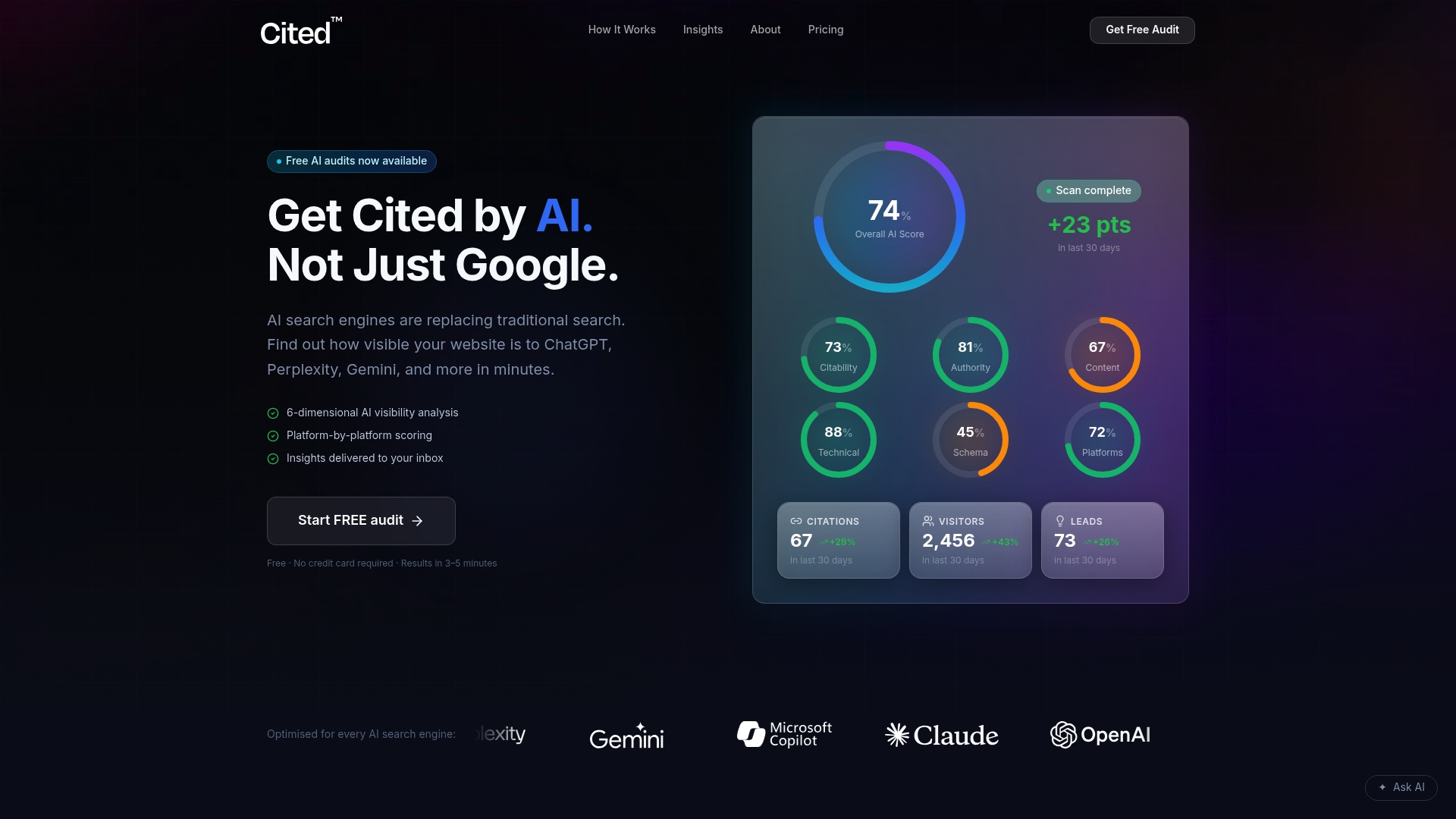
The findings map directly onto the KPIs covered earlier: missing author schema, thin provenance, weak entity consistency, and gaps in platform coverage all show up as specific, fixable items rather than a vague score. Once you have the audit results, Cited can implement the fixes directly. Technical Fixes are a one-off £495 engagement for sites that need the groundwork sorted quickly. For ongoing work, the AI Optimised plan runs £995 a month and covers continuous monitoring and implementation as AI platforms shift their citation behaviour. Larger organisations with multiple domains or complex content operations can get a custom Enterprise scope. Full detail on how the audit maps to fixes sits in Cited's methodology.
Run the free audit first, see what it flags, then book a call if you want Cited to handle the implementation.
Sources
- Creating helpful, reliable, people-first content | Google Search Central
- Domain authority (Moz)
- AI mode — Google Search
- Domain authority — Wikipedia
FAQ
What does "domain authority" mean?
Domain Authority is a Moz metric, scored 0 to 100, that estimates how likely a domain is to rank well based mostly on its backlink profile. It's a comparative tool built by Moz, not a Google ranking factor.
What is the difference between domain authority and page authority?
Domain Authority scores the ranking strength of an entire domain, while Page Authority (also a Moz metric) scores the ranking strength of a single URL using the same underlying link-based methodology. A domain can carry a high Domain Authority while individual pages on it have low Page Authority, and vice versa.
Does improving E-E-A-T raise my domain authority score?
Not directly. E-E-A-T improvements (bylines, provenance, sourcing) affect how pages are judged by raters and AI systems, while Domain Authority is calculated almost entirely from backlink data, so the two can move independently.
Can a low domain authority site still get cited by AI search tools?
Yes. AI systems tend to favour clear provenance and trustworthy sourcing on the specific page rather than the domain's overall authority score, so a well-attributed page on a smaller site can outperform a generic page on a stronger domain.
How often should I check my E-E-A-T and domain authority progress?
Check ranking volatility weekly during known update windows, review AI citation frequency and Domain Authority trend monthly, and run a full audit of author credentials and schema coverage quarterly.
Recommended
Ready for your AI score?
See how visible your site is to ChatGPT, Perplexity & Gemini.
Start FREE auditResults in minutes · 100% free