
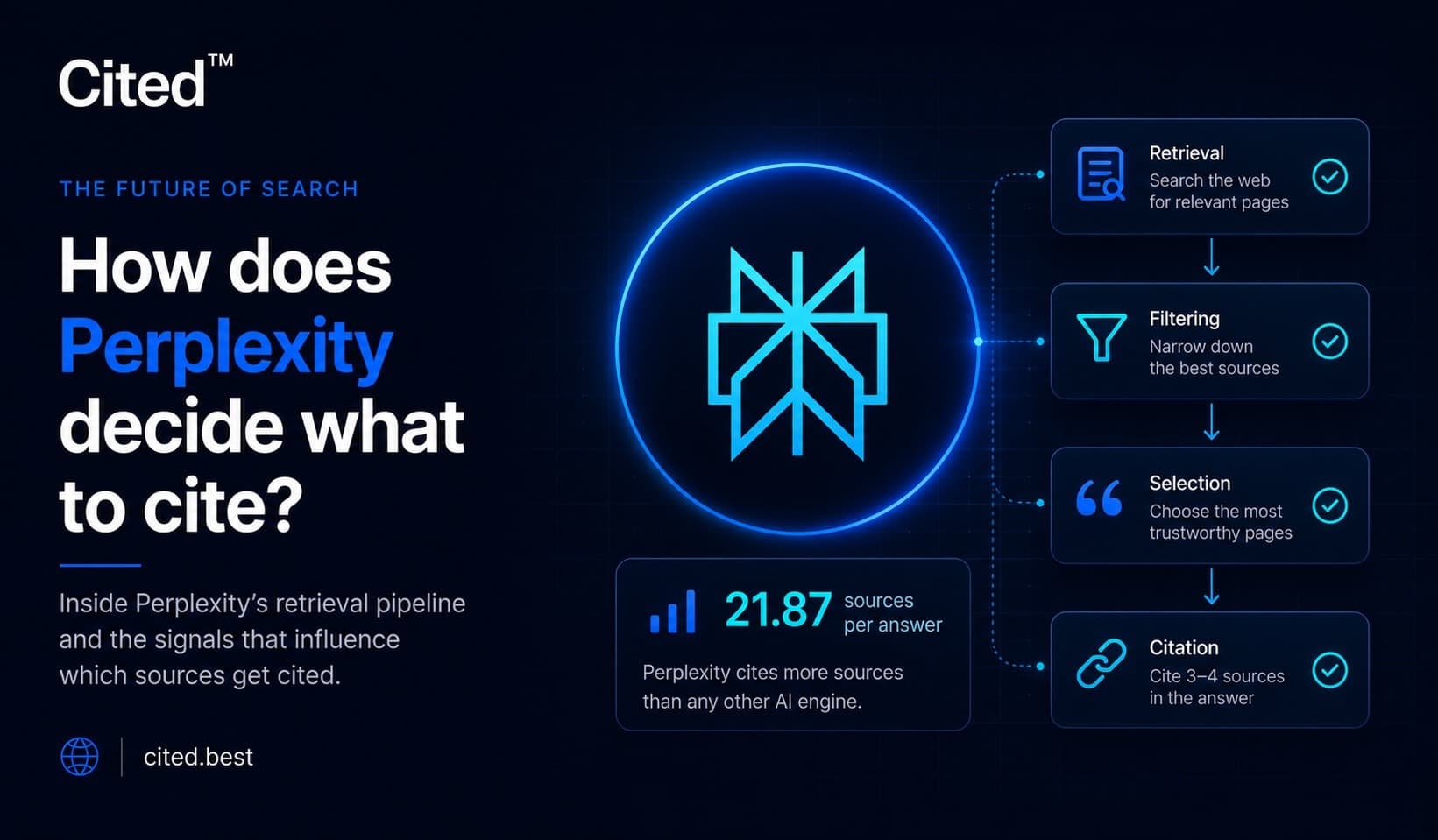
Perplexity does not cite the whole web. For each question it retrieves a small candidate set, then filters it down hard. Its retrieval pipeline visits around 10 pages per question and cites only 3 to 4 of them (ZipTie.dev). Freshness is one of the filters: B2B guides face roughly a 40% drop in citations once they go 30 days without an update (ZipTie.dev). The pages it quotes tend to answer the question in their opening lines. It also cites more sources than any other mainstream engine, an average of 21.87 per question (Qwairy analysis, via Leapd). Domain authority barely predicts citations, correlating at just r=0.18 (Wellows, 2026). Optimise for extraction: clean structure, current dates and sourced facts are what earn the citation.
Why Perplexity is worth optimising for
Perplexity handled 780 million queries in May 2025, a figure its own CEO confirmed alongside more than 20% month-on-month growth (Demandsage). Active users roughly doubled across 2025, reaching about 45 million by year end (Demandsage). A page that Perplexity trusts is put in front of a large, fast-growing audience of people who are actively researching, often with buying intent.
It also cites generously. One analysis of AI citation patterns found Perplexity averaged 21.87 sources per question, the highest of any mainstream engine (Qwairy analysis, via Leapd). More citation slots per answer means more room for your page. The question is how to fill one.
How does Perplexity actually pick its sources?
Perplexity runs a retrieval-augmented generation pipeline. For each question it does a live search, pulls a shortlist of candidate pages using hybrid search (keyword matching plus dense semantic embeddings), then filters that shortlist down to the 3 to 4 sources it actually cites (ZipTie.dev).
That shortlisting step is the whole game. Ranking first in Google gets you into the candidate pool. It does not get you cited. A page has to clear several checkpoints, semantic relevance, freshness, structure, authority and extractability, before it is quoted. We cover the same principle for the other big engine in how does ChatGPT decide what to cite, and the mechanics rhyme: retrieve, filter, quote.
Does freshness really matter that much?
Yes. Perplexity favours current material heavily. B2B guides face around a 40% drop in citations once they pass 30 days without a refresh (ZipTie.dev).
Put a real, visible date on the page. Refresh the content on a schedule and change the date when you do. Undated pages read as stale to the retrieval layer even when the information is correct.
What structure gets a page quoted?
Perplexity rewards pages it can extract cleanly. Structural quality is one of the checkpoints a page must pass before it earns a citation, alongside relevance, freshness and authority (ZipTie.dev). Valid structured data (FAQPage, HowTo, QAPage) makes a page easier to parse and quote (ZipTie.dev).
There is independent academic support for concrete, sourced content. The Princeton GEO study tested nine tactics across roughly 10,000 queries. Adding relevant statistics raised a source's visibility in generative answers by up to 41%. Citing sources and adding quotations produced similar gains in the 28 to 40% range (Princeton University, SIGKDD 2024). Attributed facts sitting next to your claims are what get pulled into an answer.
If you want to know which of these signals your own site is missing, our free AI audit checks them page by page. Start FREE audit. Results in minutes, 100% free.
How much does domain authority count?
Less than you would think. In traditional SEO, authority is close to everything. In AI citation, domain authority correlates with citation rates at only r=0.18, which explains under 4% of the variation in whether a page gets cited (Wellows, 2026). Being on a trusted domain is a prerequisite, not a guarantee.
What Perplexity does draw on is community and reference content. Across the wider AI search landscape, a small set of domains captures most citations (Semrush):
Domain
Share of AI responses citing it
40.1%
Wikipedia
26.3%
YouTube
23.5%
Presence in relevant discussions and reference pages, not just your own site, feeds the pool Perplexity draws from (Profound).
What to do this week
Put a visible date on every important page and refresh it. Answer the target question in the opening lines. Add FAQ or HowTo schema where it fits. Support each claim with a dated, attributed statistic. Then track whether it works, because you cannot improve what you do not measure. Our guide to measuring AI search visibility walks through this, and the six dimensions we score against are set out on our methodology page.
Getting cited by Perplexity is an engineering problem with known inputs. Fix the inputs and the citations follow.
See how your site scores against every signal above with a free AI audit. Start FREE audit. Results in minutes, 100% free. When you are ready to act on the findings, our pricing starts with one-off technical fixes.
Ready for your AI score?
See how visible your site is to ChatGPT, Perplexity & Gemini.
Start FREE auditResults in minutes · 100% free