
Entity optimization helps search engines and AI systems understand exactly what your brand, products, and concepts are by using structured data like Schema markup and Wikidata identifiers. This clarity makes you more likely to be cited in AI overviews and knowledge panels instead of just ranking for keywords. The most effective approach combines a clear entity map, proper schema implementation with external corroboration, and monthly tracking of your AI citation rate.
Entity optimization: a practical guide for SEO teams
Entity optimization is the practice of making your brand, products, and concepts unambiguous to AI systems, so that search engines and large language models can place your content accurately within a knowledge graph. The direct outcome is a higher probability of being cited in AI overviews, knowledge panels, and conversational search responses. Standards such as Schema and identifiers from Wikidata are the primary mechanisms that make this possible, and Search Engine Journal's Ask An SEO column confirms that the goal is to create certainty about what an entity is and how it relates to others.
Key takeaways
Entity optimization produces the largest citation gains when you combine a canonical entity map, corroborated schema identifiers, and a repeatable measurement routine.
Point | Details |
|---|---|
Start with an entity audit | Identify your primary entities, extract current signals, and set KPI baselines before making any changes. |
Schema needs corroboration | JSON-LD with |
Authority gate is real | Entity density only improves citation rate for domains that already meet the citation eligibility threshold; below that gate, focus on brand and authority signals. |
Measure three KPIs | Track AI citation rate, entity salience score (Google NLP), and embedding similarity (target above 0.70) on a monthly cadence. |
Cited audits and fixes | Cited's free AI visibility audit covers six dimensions of AI citability and delivers a prioritised fix list at Cited. |
Table of Contents
- What does entity optimization mean for your SEO team?
- Why do entity signals matter for AI citations right now?
- What are the core building blocks of entity optimisation?
- How do you implement entity optimization step by step?
- Which schema patterns should you implement first?
- Which tools fit which entity optimization tasks?
- How do you measure entity-level relevance and AI visibility?
- What mistakes undo entity optimization work?
- What should UK publishers do differently?
- How does Cited audit and fix entity optimisation issues?
- What does winning look like after 90 days?
- Cited turns entity audit findings into AI visibility gains
- Sources
- FAQ
What does entity optimization mean for your SEO team?
Entity-based SEO shifts the team's job from targeting keyword strings to clarifying, identifying, and connecting the real-world things your content is about. Where traditional SEO asks "which phrase should this page rank for?", entity SEO asks "which entity does this page represent, and how does that entity relate to others in the knowledge graph?"
AI systems and LLMs do not retrieve documents by matching query words to page words. They map concepts into vector spaces, and repeated co-occurrence of entity attributes forces a model to associate a brand with a specific entity cluster rather than a loose set of keywords. A page titled "Our Services" with no structured identifiers is invisible to that process. A page with an @id, a sameAs link to a Wikidata entry, and consistent internal references is a node in a graph the model can reason about.
The practical difference for teams shows up across three work types:
- Editorial: writers must name entities consistently, use canonical labels, and co-locate related entities on the same page rather than spreading them across thin posts.
- Technical: developers implement JSON-LD schema with
@idandsameAsfields, manage canonical URLs, and validate markup on deployment. - Data: analysts build and maintain an entity map that ties every key URL to its canonical identifier, and monitor for semantic drift over time.
Entity types your team will work with most often include organisations (your company, partners, regulators), products and services, named individuals (authors, executives), and concepts (proprietary methodologies, defined terms). Each type has a corresponding schema.org type and a natural home page on your site.
Why do entity signals matter for AI citations right now?
Entity signals feed directly into the retrieval and citation decisions AI overviews make. When a model generates a response, it does not crawl the web in real time. It retrieves candidate passages using semantic vectors, cross-references knowledge graph identifiers, and selects sources whose entities are unambiguous and corroborated. A page with a clear entity identity scores higher at every stage of that pipeline.
Gartner predicted that AI agents and virtual assistants would reduce search engine query volume, making direct citation visibility more strategically important than ranking position alone. If fewer users click through from a results page and more rely on a synthesised AI answer, the question is no longer "do we rank?" but "do we get cited?"
The citation pathway works in three stages: embeddings-based retrieval narrows the candidate set, knowledge graph signals confirm entity identity, and the synthesis layer selects the passage with the clearest, most corroborated claim. Weak entity signals cause a page to drop out at stage one or two, regardless of its backlink profile.
Pro Tip: Add a Wikidata Q-ID as a sameAs value on your Organisation schema. A single unambiguous identifier ties your entity to a node the model already knows, and that one change can move a page from "ambiguous" to "confirmed" in the retrieval stage without any content rewrite.
What are the core building blocks of entity optimisation?
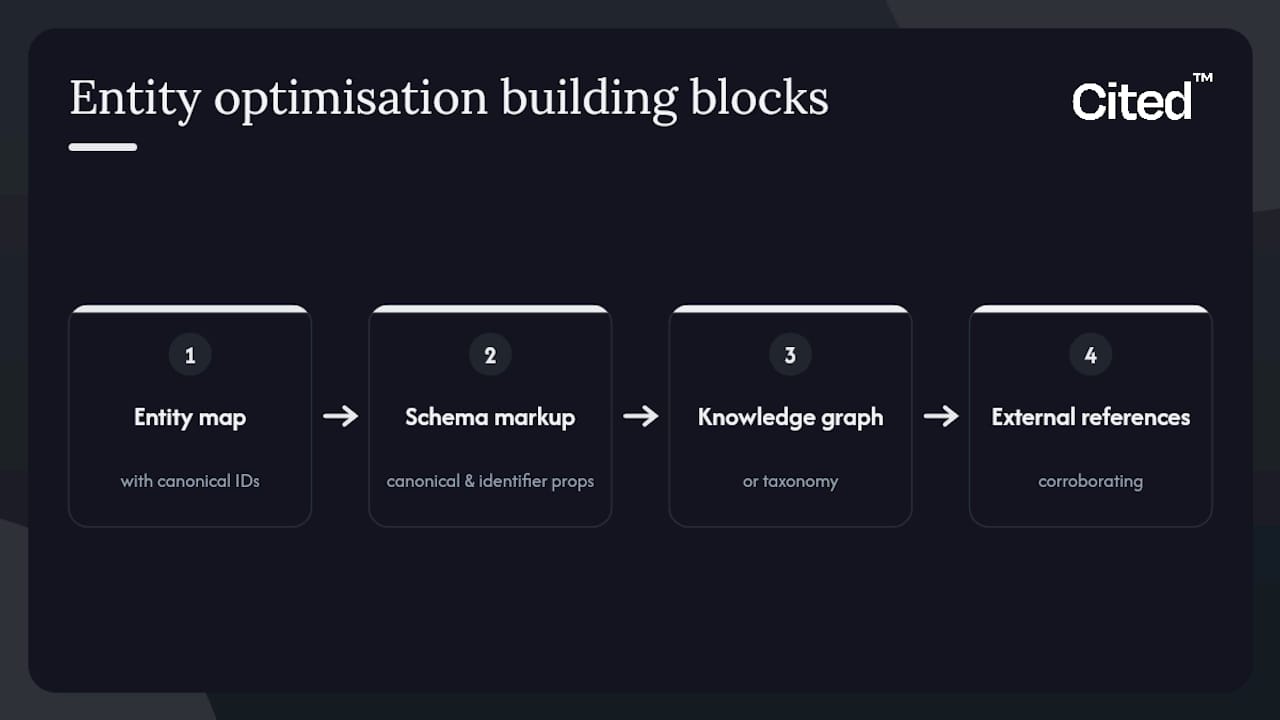
The four core building blocks are: an entity map with canonical IDs, schema markup with @id and sameAs, an internal knowledge graph or taxonomy, and corroborating external references. Every programme needs all four; missing one creates gaps the AI retrieval pipeline will exploit.
1. Entity map and canonical IDs
An entity map is a spreadsheet or database that lists every key entity your site represents, its canonical name, its home page URL, its internal @id value, and its external identifier (Wikidata Q-ID, Companies House number, ISBN, or similar). This document becomes the single source of truth for editorial, technical, and analytics teams. Without it, different writers use different names for the same thing, and the model sees multiple competing entities where there should be one.
2. Schema markup with @id and sameAs
Schema.org JSON-LD is the primary technical signal. The @id property assigns a stable, canonical URI to an entity. The sameAs property links that entity to external identifiers, reducing ambiguity across systems. mainEntityOfPage tells the model which URL is the authoritative home for that entity. These three fields together are the minimum viable schema for any entity home page.
3. Internal knowledge graph and taxonomy
Your site's internal linking structure should mirror entity relationships. If your organisation schema references a product, that product's page should link back to the organisation page and forward to related concept pages. This bidirectional linking pattern is one of the signals composite entity-matching systems weight most heavily, alongside type overlap and citation weight.
4. Corroborating external references
Schema alone is a self-assertion. AI systems treat it as a weak signal unless it is corroborated by external sources: a Wikidata entry, a Wikipedia article, a government register listing, or coverage in authoritative publications. A research-first approach recommends mapping entity relationships, validating with Wikidata Q-IDs, and measuring salience with embedding comparisons as the standard validation workflow.
Ownership summary:
- Entity map: data/analytics team owns creation; editorial team maintains naming conventions.
- Schema implementation: development team, with editorial providing canonical names and external IDs.
- Internal linking: editorial, guided by the entity map.
- External corroboration: content and PR teams, targeting Wikidata, Wikipedia, and authoritative directories.
How do you implement entity optimization step by step?
Start with an entity audit. Before writing a line of schema or editing a page, you need to know which entities your site currently signals, how consistently it signals them, and where the gaps are. That baseline determines where to spend the first sprint.
Audit steps
- Identify the ten to twenty entities most central to your business (brand, key products, key people, core concepts).
- Extract current signals: run each entity name through the Google Natural Language API to see its current salience score on your key pages.
- Check for semantic drift: compare your page's embedding against the Wikidata or Wikipedia description of the same entity using OpenAI embeddings or a similar tool. A low cosine similarity score indicates drift.
- Audit schema: confirm every entity home page has
@id,sameAs, andmainEntityOfPagefields present and valid.
Mapping steps
- Produce an entity map that ties each URL to its Wikidata Q-ID or internal
@idvalue. - Assign canonical names and record all known aliases so writers use consistent labels.
- Document entity relationships: which entities are related, and which pages represent those relationships?
Publishing steps
- Implement JSON-LD schema on every entity home page (see Section 6 for templates).
- Set canonical URLs so each entity has exactly one authoritative home.
- Build internal links that reflect entity relationships, using the entity's canonical name as anchor text where natural. Detailed guidance on internal linking for entity relationships covers anchor strategy in depth.
Monitoring steps
- Run monthly embedding similarity checks between your entity pages and authoritative external descriptions.
- Monitor AI citation rate across ChatGPT, Perplexity, and Gemini using manual spot checks or a monitoring service.
- Set drift alerts: if cosine similarity drops below your threshold, flag the page for a content review.
Pro Tip: The quickest win in most audits is adding sameAs to an existing Organisation schema block. It takes a developer under an hour and immediately corroborates your entity identity against an external reference the model already trusts.
Which schema patterns should you implement first?
For the most common entity classes, prefer these schema.org types: Organization for your brand and subsidiaries, Product for individual offerings, Person for named authors and executives, and CreativeWork (or its subtypes Article, WebPage) for content assets. Each maps to a distinct node type in the knowledge graph.
A minimal JSON-LD template for an entity home page looks like this:
```json
{
"@context": "https://schema.org",
"@type": "Organization",
"@id": "https://www.example.co.uk/#organisation",
"name": "Example Ltd",
"url": "https://www.example.co.uk",
"sameAs": [
"https://www.wikidata.org/wiki/Q12345678",
"https://find-and-update.company-information.service.gov.uk/company/12345678"
],
"mainEntityOfPage": {
"@type": "WebPage",
"@id": "https://www.example.co.uk/about/"
}
}
```
The @id value must be a stable, canonical URI, typically the page URL with a fragment identifier. Never use a URL that redirects or changes. The sameAs array should include the Wikidata Q-ID URL and, for UK organisations, the Companies House profile URL. For products, add a gtin or mpn where available.
Validation checklist
- Run every entity page through Google's Rich Results Test after deployment.
- Validate JSON-LD syntax at Validator before pushing to production.
- Document each
@idcanonical URL in the entity map so the team can reference it consistently. - Confirm
sameAsURLs resolve and point to the correct external entity record.
The schema.org sameAs property is the standard disambiguation mechanism. Use it for every external identifier you can confirm: Wikidata, Wikipedia, LinkedIn company page, government registers. Use sameAs for well-known external identifiers and @id for your own canonical URI. They serve different purposes and should both be present.
For a deeper analysis of how schema markup influences AI citations, Cited's Insights section covers the evidence in detail.
Which tools fit which entity optimization tasks?
The right tool depends on the task. NER (named entity recognition) handles extraction at scale; embedding models handle similarity measurement; Elasticsearch handles indexing and retrieval; the Google Natural Language API handles salience scoring on live pages.
- spaCy: open-source NER library, best for extracting entity mentions from large content sets at low cost. Use it to audit existing content for entity density and consistency before implementing schema. Supports custom entity types, which matters when your domain has proprietary concepts.
- Google Natural Language API: the fastest way to get an entity salience score for any URL. Paste the page content and the API returns each recognised entity with a salience score between 0 and 1. Use this to baseline your entity pages and track salience changes after edits.
- OpenAI embeddings: generate vector representations of your entity pages and compare them against authoritative descriptions (Wikidata entries, Wikipedia summaries) using cosine similarity. A score above 0.85 generally indicates strong semantic alignment; below 0.70 suggests drift worth investigating.
- Elasticsearch: the preferred tool for entity indexing and resolution at scale. Elasticsearch's entity resolution prototype uses a two-phase approach: enrich and index entities for semantic search, then extract mentions with hybrid NER for matching. The architecture separates fast retrieval from LLM-based judgement, keeping costs predictable as volume grows.
- Wikidata: the primary external identifier source for corroboration. Use it to find Q-IDs for your organisation, key people, and products, then add those Q-IDs to your
sameAsarrays. Wikidata entries also provide a ready-made authoritative description to compare against your own pages via embeddings.
For large-scale extraction, hybrid NER combining XLM-RoBERTa with pattern-based rules improves recall for role-based references ("the author of…", "the CEO of…") that pure model-based NER misses. Pipeline LLM judgement after retrieval, not before, to keep inference costs manageable.
Pro Tip: For AI tooling reviews and vendor discovery context, Selloop.ai's tool comparison content offers a useful frame for evaluating extraction and review tooling side by side.
How do you measure entity-level relevance and AI visibility?
The three core KPIs are: AI citation rate, entity salience score, and knowledge graph signals (Knowledge Panel presence, sameAs corroboration count). Each measures a different layer of the entity pipeline.
KPI | Definition | How to measure | Alert threshold |
|---|---|---|---|
AI citation rate | Percentage of tracked queries where your domain appears as a cited source | Manual spot checks across ChatGPT, Perplexity, Gemini; log weekly | Drop in volume week-on-week |
Entity salience score | Salience score (0–1) assigned to your primary entity by Google NLP on your entity home page | Google Natural Language API on page content | Score below 0.5 on primary entity |
Embedding similarity | Cosine similarity between your entity page embedding and the authoritative Wikidata/Wikipedia description | OpenAI embeddings, cosine similarity calculation | Score below 0.70 |
Knowledge graph signals | Presence of Knowledge Panel, number of confirmed | Manual Google search, Wikidata profile check | Knowledge Panel absent after 90 days of schema deployment |
Entity density correlates with citation probability within domains that already pass an authority gate, but domains below that gate see no effect from density alone. Measure entity density (recognised entities per 1,000 words) as a secondary metric, not a primary one.
Measurement routine
- Set a baseline for all four KPIs before making any changes.
- Implement schema and identifier changes on a subset of pages (A/B approach where possible).
- Re-measure after four weeks using the same tools and query sets.
- Compare embedding similarity scores before and after content edits to confirm drift has been corrected.
- Review citation rate monthly; review salience and similarity scores quarterly or after major content changes.
For a full measurement methodology, Cited's Insights piece on measuring AI search visibility covers baseline-setting and cadence in detail.
What mistakes undo entity optimization work?
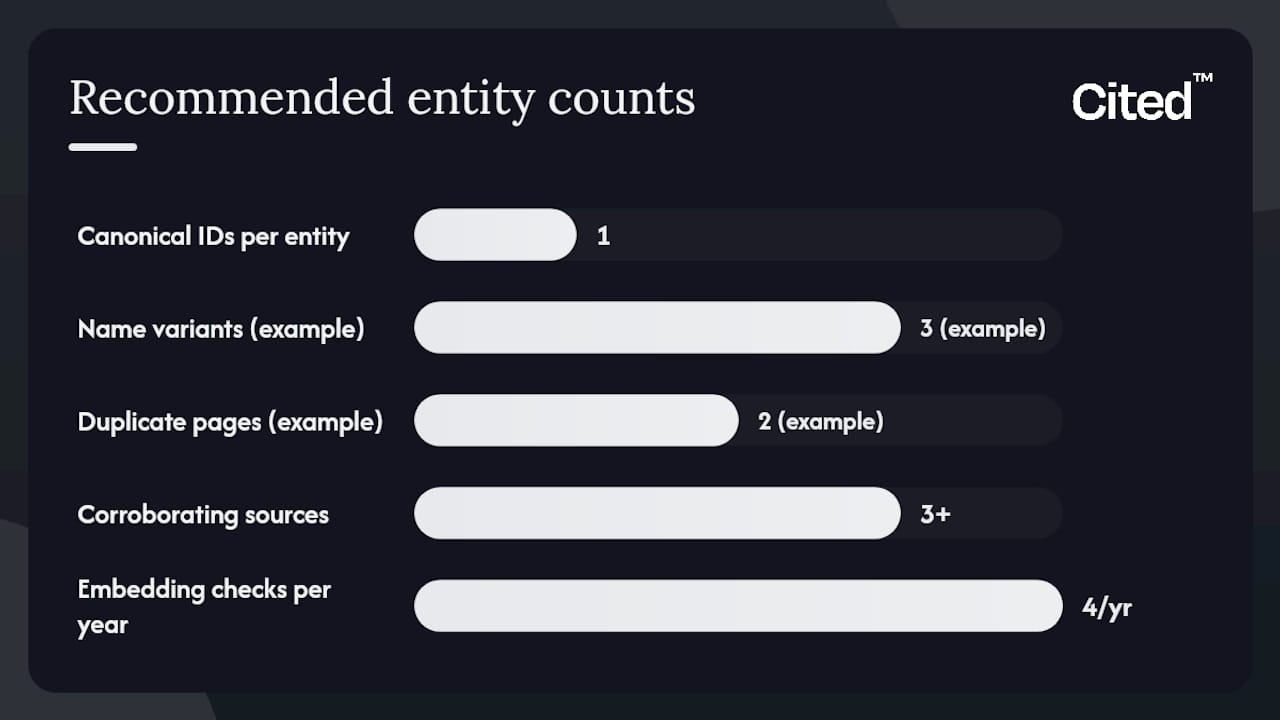
Inconsistent identifiers cause most failures. When the same organisation appears under three different @id values across a site, or when the sameAs Wikidata link on the About page points to a different Q-ID than the one on the Contact page, the model sees competing entities and defaults to ambiguity. That single error can negate months of schema work.
Common pitfalls and their fixes:
- Inconsistent
@idvalues: define one canonical@idper entity in the entity map and enforce it via a schema template. Never let individual page authors set their own@idstrings. - Conflicting external references: if your Wikidata entry says your company was founded in 2018 and your About page says 2019, the model detects a conflict and reduces confidence. Audit external references annually and correct discrepancies at source.
- Schema without corroboration: schema is a self-assertion. A page with perfect JSON-LD but no Wikidata entry, no Wikipedia coverage, and no authoritative external citations will not gain citation eligibility. Build corroboration in parallel with schema work.
- Duplicative entity pages: two pages competing to represent the same entity split the signal. Consolidate to one canonical entity home and redirect or canonicalise the duplicate.
- Semantic drift: content that evolves over time can drift away from the entity's authoritative description. Run quarterly embedding similarity checks and flag pages where cosine similarity has fallen below 0.70.
Do-not-do list for content reviews:
- Do not use different names for the same entity in the same article (e.g. "Cited" in one paragraph and "the Cited platform" in another as if they are distinct things).
- Do not create a new page for a concept that already has an entity home; add a section to the existing page instead.
- Do not remove
@idorsameAsfields during a CMS migration without updating the entity map first. - Do not rely on a single external reference; aim for three or more corroborating sources per primary entity.
What should UK publishers do differently?
UK teams should prioritise three local sources above all others: Companies House, Wikidata, and relevant government data pages. These carry strong corroboration weight for UK-based entities because AI systems trained on English-language web data have indexed them extensively.
- Companies House: add your Companies House profile URL to your Organisation schema's
sameAsarray. The URL format ishttps://find-and-update.company-information.service.gov.uk/company/[number]. This is the UK equivalent of a business registry citation and carries meaningful corroboration weight. - Wikidata: create or claim a Wikidata entry for your organisation if one does not exist. A complete entry with founding date, registered address, industry classification, and official website URL gives the model a rich, corroborated node to associate with your schema.
- Government and regulatory pages: if your business is regulated (financial services, healthcare, education), add the relevant FCA register, CQC, or Ofsted profile URL to
sameAs. Regulatory listings are among the highest-authority corroboration sources available to UK publishers. - Wikipedia: a Wikipedia article about your organisation is the strongest single corroboration signal. For smaller UK businesses that do not yet meet Wikipedia's notability threshold, focus on Wikidata (which has a lower bar) and authoritative trade press coverage instead.
Domain authority functions as a gate for AI citation. If your domain is below that gate, focus on proprietary concept creation or brand signals to become citation-eligible rather than increasing entity density on pages that will not be retrieved regardless.
Pro Tip: UK businesses with a Google Merchant Centre feed can use product GTINs and MPNs as additional sameAs identifiers in Product schema. These feed directly into Google's product knowledge graph and strengthen entity corroboration for e-commerce entities without requiring any editorial work.
How does Cited audit and fix entity optimisation issues?
Cited's free AI visibility audit assesses your site across six dimensions of AI citability: technical health, schema markup, authority signals, content structure, platform coverage, and entity clarity. The audit identifies exactly which entity signals are missing or inconsistent, and the implementation service fixes them.
The audit process covers:
- Extraction of current entity signals using NLP and schema parsing.
- Comparison of your entity pages against authoritative external descriptions to detect semantic drift.
- Schema validation across all entity home pages, checking for
@id,sameAs, andmainEntityOfPagecompleteness. - Authority gate assessment: whether your domain currently meets the citation eligibility threshold for your category.
- A prioritised fix list with effort estimates, so your team knows which changes to make first.
Cited's Insights section, including posts by Tom Heaton, covers the evidence base behind each audit dimension. The how it works page explains the methodology in full. For teams that want to understand the strategic framing before booking, the Generative Engine Optimisation (GEO) overview and the content optimisation guide for UK businesses provide the broader context.
Run your free audit at cited.best/audit or book a call to discuss a managed implementation.
What does winning look like after 90 days?
If you follow the checklist in this article, a realistic 90-day outcome is a measurable improvement in entity salience scores, at least one new Knowledge Panel signal, and a baseline citation rate you can track and improve against. The teams that see the fastest gains are those that treat the entity map as a living document and assign clear ownership from day one.
Days 1–30: run the entity audit, produce the entity map, and implement schema on the five highest-priority entity home pages. Fix the most common quick win: add sameAs to existing Organisation schema. Set baselines for all four KPIs.
Days 31–60: extend schema to all entity home pages, build or claim Wikidata entries for primary entities, and correct any conflicting external references. Run embedding similarity checks on all audited pages and address pages below 0.70. Begin monitoring citation rate weekly.
Days 61–90: review internal linking against the entity map, consolidate any duplicative entity pages, and run a second round of NLP salience checks to confirm improvement. Re-audit schema after any CMS or template changes.
After 90 days, re-audit using the same tools and query sets as the baseline. Where salience scores have improved but citation rate has not moved, the likely cause is the authority gate: the domain needs stronger external corroboration before citation eligibility opens. Redirect effort to Wikidata completeness, authoritative press coverage, and regulatory listings.
Maintenance is quarterly: embedding similarity checks, schema validation after site changes, and an annual review of external references for accuracy.
Cited turns entity audit findings into AI visibility gains
Most SEO teams know they need to improve their entity signals. The gap is implementation: auditing schema across hundreds of pages, building Wikidata entries, correcting conflicting identifiers, and monitoring citation rate all require time and technical resource that most in-house teams do not have spare.
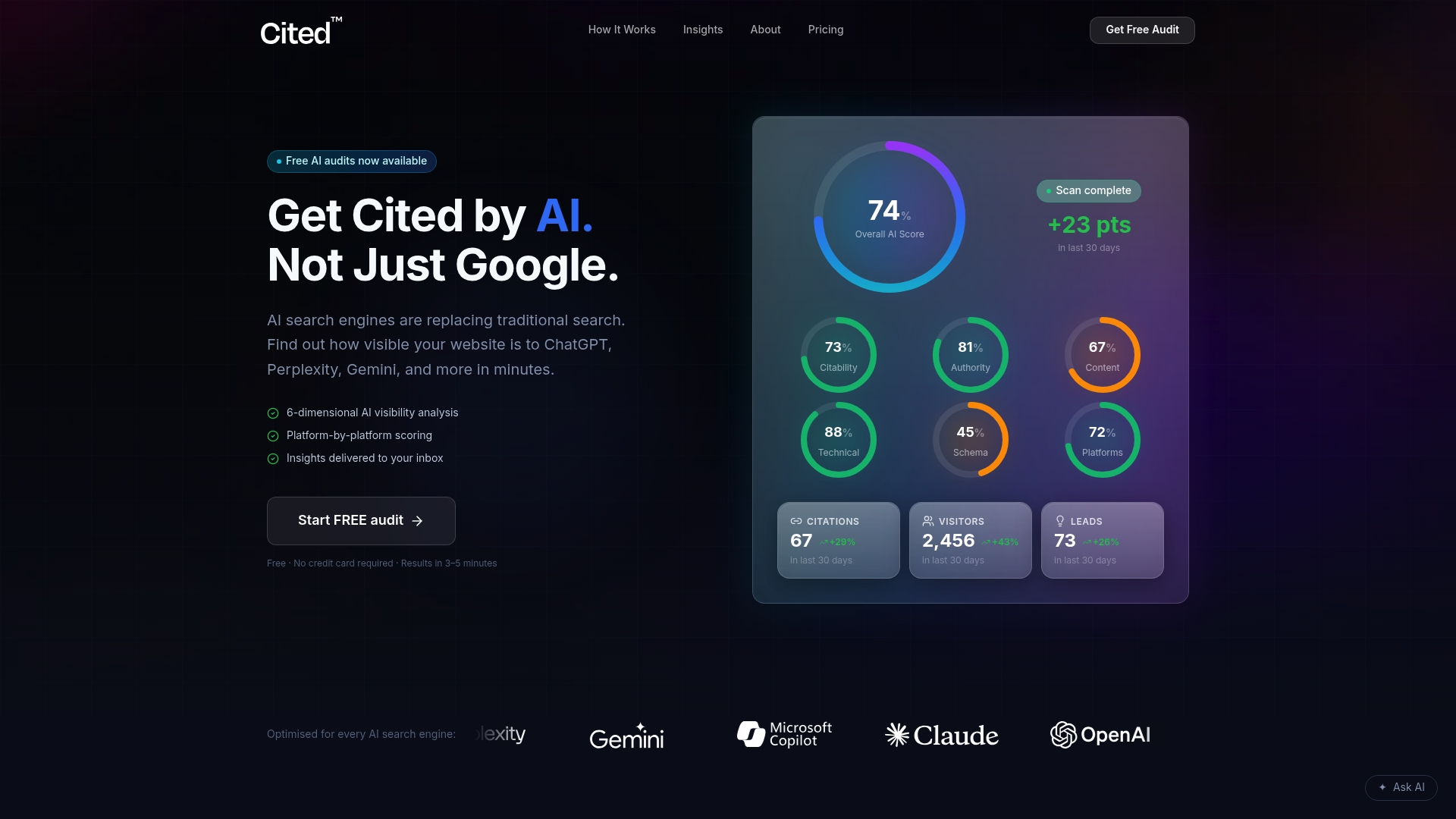
Cited's AI visibility service covers the full cycle: a free audit that scores your site across six dimensions of AI citability, followed by a Technical Fixes package (£495 one-off) that implements the highest-priority schema and identifier changes, or an AI Optimised subscription (£995/month) for ongoing optimisation and monitoring. Enterprise projects are scoped to order.
The audit takes minutes to run and delivers a prioritised fix list your team can act on immediately, whether you implement the fixes yourself or hand them to Cited. Start with the free AI visibility audit or book a call to discuss a managed programme.
Sources
Use this list to verify schema patterns, validate implementation choices, and go deeper on specific techniques. Each source covers a distinct part of the workflow.
FAQ
What is entity optimization?
Entity optimization is the process of making your brand, products, and concepts unambiguous to AI systems and search engines by implementing canonical identifiers, schema markup, and corroborating external references. The goal is to ensure AI retrieval systems can place your content accurately in a knowledge graph and select it as a citation source.
Is SEO dead, or is it evolving in 2026?
SEO is evolving, not dying. Gartner predicted reduced traditional search query volume as AI agents handle more query fulfilment, which shifts the strategic priority from ranking position to citation eligibility in AI-generated responses. Entity-based SEO is the adaptation that keeps organic visibility relevant.
What are the four types of SEO?
The four commonly recognised types are technical SEO, on-page SEO, off-page SEO, and local SEO. Entity-based SEO cuts across all four: it requires technical schema implementation, on-page entity clarity, off-page corroboration (Wikidata, press), and local identifier signals for businesses with a physical presence.
Can you do entity optimization without a developer?
Partially. Editorial teams can improve entity clarity through consistent naming, canonical labels, and internal linking without touching code. However, implementing @id, sameAs, and mainEntityOfPage in JSON-LD requires developer access to the site's template layer, and schema validation requires technical tooling. The highest-impact changes need both editorial and development involvement.
How does Cited help with entity optimization?
Cited's free AI visibility audit identifies missing or inconsistent entity signals across six dimensions, including schema completeness, sameAs corroboration, and semantic drift. The implementation service then fixes the issues the audit finds. Run your audit at cited.best/audit.
Recommended
Ready for your AI score?
See how visible your site is to ChatGPT, Perplexity & Gemini.
Start FREE auditResults in minutes · 100% free