
If you want AI search engines like ChatGPT and Perplexity to find and cite your content, you need a working RSS feed, proper identity schema (Organization and Person tags), and clear answer-first writing. Most sites miss AI discovery entirely because their feeds are broken or lack the structured data that helps AI systems understand who published what. Running a free audit at cited.best/audit takes minutes and shows you exactly what's holding you back.
RSS feeds optimised for AI discovery: a UK guide
An RSS- and schema-first approach is the fastest route to being discovered and cited by AI engines such as ChatGPT, Perplexity, Gemini, and Copilot. If your site lacks valid feed endpoints and identity schema, AI systems will either miss your content entirely or fail to attribute it correctly. Three steps you can run today:
- Check feed health: fetch your
/feed,/rss, or/feed.xmlendpoint in a browser and confirm it returns valid XML with accurate publication dates. - Add identity schema: place an
OrganizationandWebSiteJSON-LD block on your homepage, and aPersonnode on your About page, each with a stable@id. - Request a free audit: get your AI visibility score at cited.best/audit and receive a prioritised fix list within 24 hours.
Key takeaways
A valid RSS feed, identity schema wired with sameAs, and answer-first content are the three foundations that determine whether AI engines discover and cite your site.
Point | Details |
|---|---|
Feeds are the primary discovery path | Roughly 40% of AI fetch requests target feed endpoints; fix feed health before anything else. |
Identity schema comes first | Organization, WebSite, and Person nodes with stable @id and sameAs links are prerequisites for entity resolution. |
Answer-first passages drive citation | Write 40–60-word answer blocks after each heading so AI models can lift and attribute a standalone sentence. |
Consistency compounds over time | Matching entity facts across your site, Wikidata, LinkedIn, and Crunchbase builds citation reliability month by month. |
Cited audits your baseline for free | The free audit at cited.best/audit returns an AI visibility score and prioritised fix list within 24 hours. |
Table of Contents
- What does 'RSS for AI' actually mean?
- Why do feeds and structured signals improve AI discovery?
- What is the citation schema stack, and how do you build it?
- Which feeds and signals actually help AI, and what should you avoid?
- How do you run an AI visibility audit on your site?
- How do you measure AI visibility, and what timeline is realistic?
- What mistakes do most sites make with AI feeds and schema?
- Cited's free audit gives you a clear starting point
- A direct view from the Cited team
- Sources
- FAQ
What does 'RSS for AI' actually mean?
In this guide, "RSS for AI" means machine-readable feeds and discovery signals optimised so AI search engines can find, index, and cite your website. It has nothing to do with subscribing to AI news updates. The scope covers RSS/Atom/JSON Feed endpoints, sitemap.xml, robots.txt discoverability, and JSON-LD schema that connects your identity and content into a coherent, extractable graph.
The standards referenced throughout are Schema.org vocabulary (Organization, WebSite, Person, Article, FAQPage, HowTo, DefinedTerm), the W3C Feed Validation Service, and Google's structured data guidelines. Cited's AI visibility methodology maps directly to these standards.
Why do feeds and structured signals improve AI discovery?
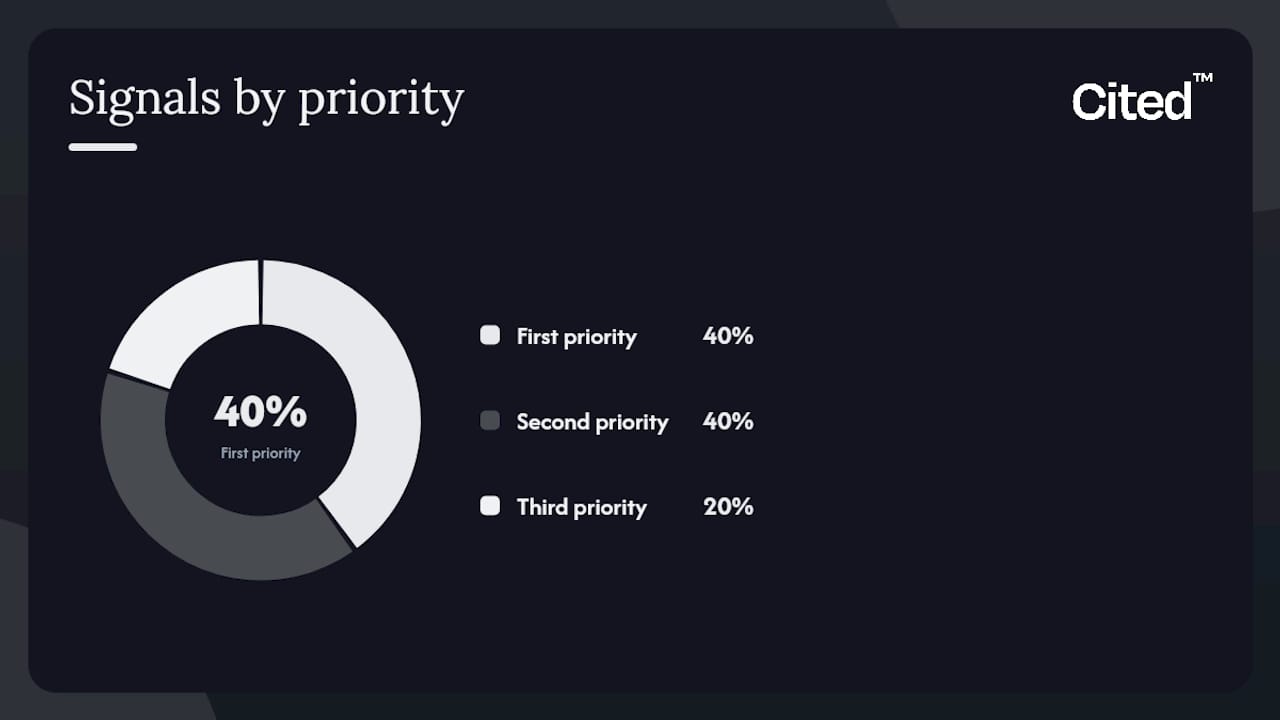
Roughly 40% of AI fetch requests target RSS and feed endpoints, making feeds the primary discovery path for many AI systems. That single figure explains why feed health is not an optional SEO nicety; it is a prerequisite for AI citation.
The practical benefits of a well-configured feed and schema stack are concrete:
- Faster discovery: AI crawlers find new content through feed endpoints before a full site crawl completes.
- Higher extraction reliability: structured data gives models a clean, parseable signal rather than requiring them to infer meaning from raw HTML.
- Clearer authorship resolution:
PersonandOrganizationnodes withsameAslinks let AI systems confirm who published a piece and whether the source is trustworthy. - Improved citation probability: pages with matched visible content and JSON-LD are more likely to be quoted and attributed correctly.
A UK publisher that adds a valid Atom feed and wires Article schema with author and publisher references typically sees AI-driven referral traffic appear in server logs within weeks, not months, because crawlers return to feed endpoints on a predictable schedule.
What is the citation schema stack, and how do you build it?
A citation schema stack, built identity-first and wired with sameAs to Wikidata, substantially increases extraction reliability and citation probability. The order of work matters: identity before content types, content types before relationship wiring.
Identity layer: Organization, WebSite, Person
Place an Organization block on your homepage and About page. Give it a stable @id (your canonical domain URL with /#organization appended), a name, url, logo, and sameAs array. Add a WebSite node with a potentialAction SearchAction. Create a Person node for each author, with @id pointing to their profile URL, and wire it to the Organization via memberOf.
Content type layer: Article, FAQPage, HowTo, DefinedTerm
Add Article JSON-LD to every post. Set author and publisher to reference the Person and Organization @id values, not inline strings. Update dateModified on every edit; stale dates signal neglect to AI crawlers. Keep FAQPage JSON-LD on Q&A pages even where Google no longer shows the visual accordion, because FAQPage schema still signals extractable Q&A to AI systems and increases extraction reliability.
Relationship wiring: @graph, @id, sameAs, about
Wire everything in a single @graph array so pages reference Person and Organization by @id rather than duplicating data. A minimal example:
```json
{
"@context": "https://schema.org",
"@graph": [
{
"@type": "Organization",
"@id": "https://example.co.uk/#organization",
"name": "Example Ltd",
"url": "https://example.co.uk",
"sameAs": [
"https://www.wikidata.org/wiki/Q12345678",
"https://www.linkedin.com/company/example-ltd",
"https://www.crunchbase.com/organization/example-ltd"
]
},
{
"@type": "Person",
"@id": "https://example.co.uk/team/jane-smith/#person",
"name": "Jane Smith",
"memberOf": { "@id": "https://example.co.uk/#organization" }
},
{
"@type": "Article",
"@id": "https://example.co.uk/blog/post-slug/#article",
"headline": "Post title",
"author": { "@id": "https://example.co.uk/team/jane-smith/#person" },
"publisher": { "@id": "https://example.co.uk/#organization" },
"dateModified": "2026-01-15"
}
]
}
```
Pro Tip: Point your sameAs values to a Wikidata Q-ID, a LinkedIn company page, and a Crunchbase profile. AI systems cross-reference these identifiers to confirm entity trustworthiness; a site with all three resolves faster as a citable source than one with none.
Schema type | Where to place it | Primary AI benefit |
|---|---|---|
Organization | Homepage, About page | Entity resolution and trust |
WebSite | Homepage | Sitelink and search action signals |
Person | Author profile pages | Authorship attribution |
Article | Every post or news page | Content extraction and dating |
FAQPage | Q&A and support pages | Direct answer extraction |
HowTo | Tutorial and guide pages | Step-by-step extraction |
Validate every block with the Schema.org validator and Google's Rich Results Test, then confirm indexing signals in Google Search Console and Bing Webmaster Tools.
Which feeds and signals actually help AI, and what should you avoid?
Perplexity and similar tools use RSS to discover new pages faster than traditional crawling; the recommended discovery files are RSS, sitemap.xml, and JSON-LD. Non-standard files such as llms.txt and content-chunking hacks offer no verified benefit. Google explicitly advises against gaming AI search with non-standard files and recommends technically accessible, people-first content with valid structured data instead.
Signal | Freshness | Bandwidth | Extractability | Priority |
|---|---|---|---|---|
RSS/Atom feed | Real-time on publish | Low | High (structured XML) | First |
JSON Feed | Real-time on publish | Low | High (structured JSON) | First |
sitemap.xml | On update | Very low | Medium (URLs only) | Second |
Inline Article JSON-LD | Per page | Per page | High | Second |
Raw HTML | On crawl | High | Low (requires parsing) | Third |
Practical rules: confirm feed endpoints return HTTP 200, list them in robots.txt as allowed paths, and check that publication dates are accurate. AI fetchers skip or deprioritise feeds with malformed XML or inaccurate dates. For Perplexity-style extractors, also read how Perplexity decides what to cite to understand its ranking signals.
How do you run an AI visibility audit on your site?
Work through this checklist in order. Assign each item to the right person, and set a realistic deadline.
- [Dev, Day 1] Validate feed endpoints. Fetch
/feed,/rss,/feed.xml, and/atom.xml. Confirm HTTP 200, valid XML or JSON, and accuratepubDateorupdatedvalues. Fix any 404s or malformed responses immediately. - [Dev, Day 1–2] Check robots.txt. Confirm feed paths and
sitemap.xmlare in allowed paths. Allow OAI-SearchBot and ChatGPT-User explicitly if you want ChatGPT citation. - [Dev, Day 2–3] Confirm server-side rendering. Fetch key pages with
curland confirm body content appears in raw HTML. Client-only rendered pages are invisible to fetchers that do not execute JavaScript. - [SEO, Week 1] Implement Organization and WebSite JSON-LD on the homepage with stable
@idandsameAsto Wikidata, LinkedIn, and Crunchbase. - [SEO, Week 1–2] Add Person nodes for all authors and wire them to
OrganizationviamemberOf. - [Editor, Week 2] Audit content for answer-first passages. Write answer-first passages of roughly 40–60 words after each heading so models can lift a standalone sentence as a citation.
- [SEO, Week 2–3] Add Article JSON-LD to every post with
author,publisher, anddateModifiedreferencing@idvalues. - [SEO, Week 3] Validate all schema with the Schema.org validator and Google's Rich Results Test. Resolve all errors before moving on.
- [Dev/SEO, Week 4–6] Submit updated sitemap to Google Search Console and Bing Webmaster Tools. Monitor index coverage weekly.
A small site can complete this checklist in three to six weeks. For a faster baseline, run the free Cited audit at cited.best/audit: it returns an AI visibility score, a prioritised fix list, and a technical fixes estimate within 24 hours.
How do you measure AI visibility, and what timeline is realistic?
Track these metrics from day one so you have a baseline before any changes take effect.
Metric | Tool | What to look for |
|---|---|---|
Feed fetch requests | Server/CDN logs filtered for AI user-agents | Monitor for increased fetches after feed activation |
Index coverage | Google Search Console, Bing Webmaster | New URLs indexed within days of sitemap submission |
AI citations | Manual search in ChatGPT, Perplexity, Gemini | Your domain appearing as a cited source |
AI visibility score | Score improvement across six dimensions over time | |
Referral quality | Analytics, UTM-tagged AI traffic | Session depth and conversion rate from AI-referred visits |
Discovery and initial feed fetch changes appear within days for sites that fix feed health first. Meaningful citation growth, where your domain appears as a named source in AI answers, typically takes weeks to months of consistent schema and content work. Google stresses that structured data must match visible page content; mismatches reset progress. For a deeper look at how ChatGPT decides what to cite, corroboration across multiple pages accelerates citation.
What mistakes do most sites make with AI feeds and schema?
Most errors are avoidable and each one compounds over time by teaching AI crawlers that your site is unreliable.
- Blocking AI fetchers in robots.txt. Add explicit
Allowrules for OAI-SearchBot, GPTBot, PerplexityBot, and similar agents; a blanketDisallow: /kills all AI discovery. - Malformed feed XML. A single unclosed tag or invalid character causes the entire feed to fail validation. Run feeds through the W3C Feed Validation Service after every CMS update.
- Client-only rendered content. If your page body appears only after JavaScript executes, most AI fetchers see a blank page. Switch to server-side rendering or static generation.
- Inconsistent entity facts. Your company name, address, and founding date must match across your website, Wikidata, LinkedIn, and Crunchbase. Discrepancies lower entity resolution confidence.
- Removing FAQPage JSON-LD after Google deprecated the visual rich result. The schema still signals extractable Q&A to AI systems; keep it.
- Stale
dateModifiedvalues. Updating content without updating the date tells crawlers the page has not changed. Always updatedateModifiedon every substantive edit.
Consistent identity wiring and accurate feed dates compound in value over months, not days. Every correct signal reinforces the others.
Cited's free audit gives you a clear starting point
Cited audits your website across six dimensions: technical health, schema markup, authority signals, feed discoverability, content extractability, and platform coverage across ChatGPT, Perplexity, Gemini, Claude, and Copilot.
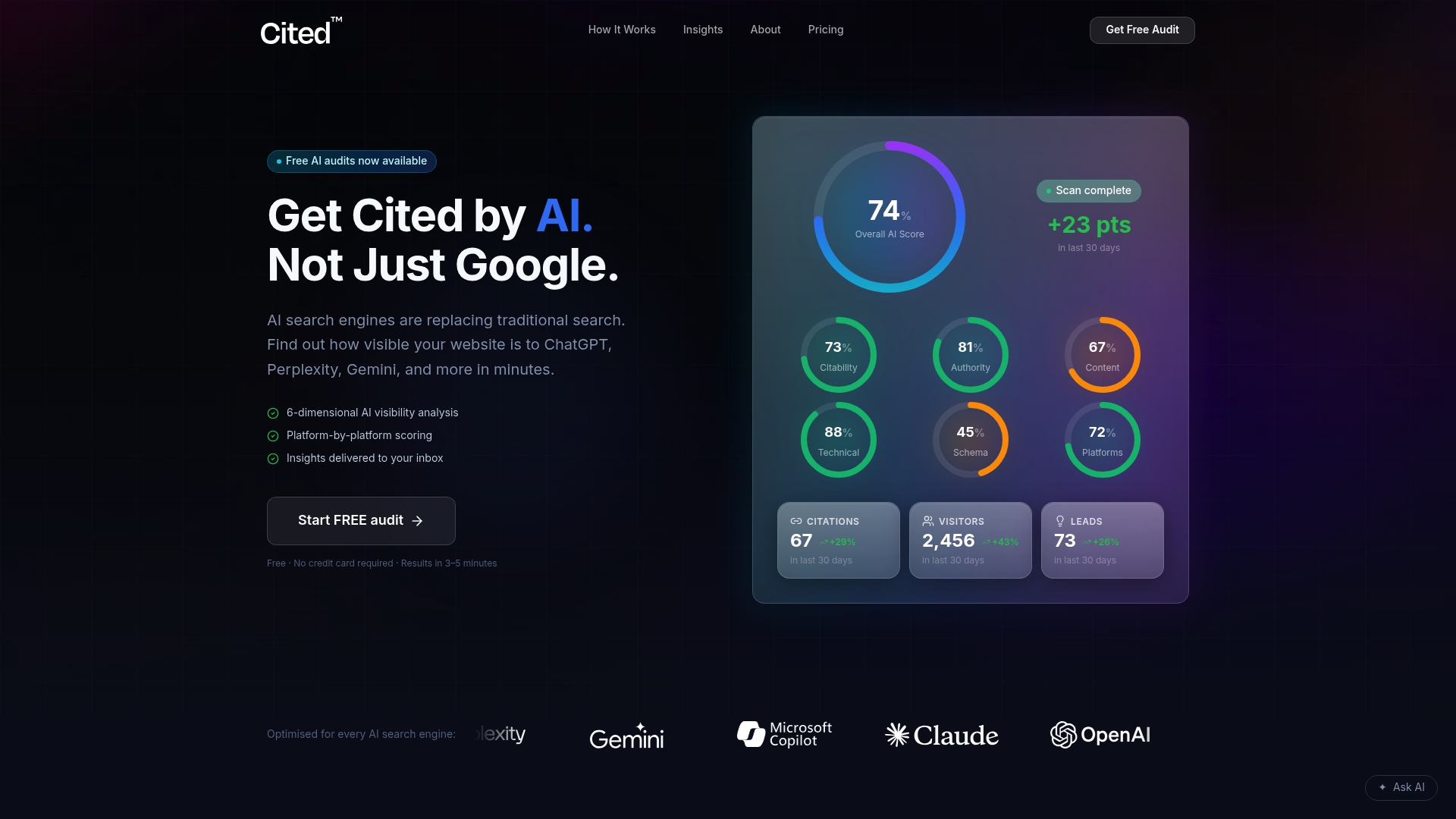
The free AI visibility audit at cited.best/audit takes minutes to request and returns your AI visibility score alongside a prioritised fix list. From there, two paid routes are available: a one-off Technical Fixes project at £495, which implements the highest-priority schema and feed corrections, or the AI Optimised monthly service at £995/month for ongoing optimisation, content structuring, and progress tracking against the Cited methodology. Enterprise projects are scoped and priced individually. To discuss your site's specific situation, book a call with the Cited team directly.
A direct view from the Cited team
The single most underestimated step in AI visibility work is identity schema, not content volume. Sites that publish frequently but skip Organization and Person nodes with sameAs links are invisible to AI systems as named entities, even when their content is excellent. AI engines cite sources they can resolve as trusted entities; without identity wiring, your content gets extracted but not attributed.
Two things worth doing this week: first, check whether your homepage returns an Organization block in its raw HTML source. Second, search for your brand name in Perplexity and note whether your domain appears as a cited source. If neither is true, the schema stack is the place to start, not more content.
For related guidance, the Cited Insights archive covers schema markup, crawler access, and content structuring in depth.
Sources
Save these as validation checkpoints during your audit:
- Schema markup for AI citation: the 2026 mark-up cheatsheet, Link Building Journal
- Succeeding in AI search, Google Search Central blog
- How to get your website cited by ChatGPT, SeoMods
FAQ
What is RSS for AI, and why does it matter for UK businesses?
RSS for AI refers to machine-readable feed endpoints and structured signals, such as RSS, Atom, JSON Feed, and JSON-LD schema, configured so AI search engines can discover and cite your site.
Which schema types matter most for AI citation?
Start with Organization, WebSite, and Person for identity, then add Article to every post and FAQPage to Q&A pages. Wire all types in a single @graph with stable @id references and sameAs links to Wikidata, LinkedIn, and Crunchbase.
Does llms.txt help AI engines find my site?

No. Google advises against non-standard files as a way to influence AI search, and there is no verified evidence that llms.txt improves discovery or citation. Focus on valid RSS feeds, sitemap.xml, and correct JSON-LD instead.
How long does it take to see AI citations after fixing feeds and schema?
Feed fetch requests typically appear in server logs within days of a feed going live. Meaningful citation growth, where your domain appears as a named source in AI answers, usually takes weeks to months of consistent schema and content work.
How does Cited measure AI visibility?
Cited scores sites across six dimensions: technical health, schema markup, authority, feed discoverability, content extractability, and platform coverage across ChatGPT, Perplexity, Gemini, Claude, and Copilot. The free audit at cited.best/audit returns this score alongside a prioritised fix list.
Recommended
Ready for your AI score?
See how visible your site is to ChatGPT, Perplexity & Gemini.
Start FREE auditResults in minutes · 100% free