
AI engines cite local businesses based on structured data on your site, mentions on other trusted sources, current information, and Q&A-formatted content. Start by running a free AI audit to identify which of these four signals you're missing, then prioritize fixes to your schema markup, Google Business Profile, and review strategy. Most schema changes show results within weeks, but building authority through independent mentions and reviews typically takes three to six months.
Test 4 AI visibility signals for UK local businesses
The fastest way to improve local business AI visibility is to fix the structured facts about your business and run a free AI audit at Cited. AI engines decide who to cite based on structured pages, third-party corroboration, recency and Q&A content, and a proper audit tells you which of those four you are failing. Once you have that list, you work through prioritised fixes rather than guessing.
***
TL;DR: >- Add the most specific supported trade subtype of LocalBusiness schema, plus Service and FAQPage markup where relevant; validate it and recheck after site updates.- Complete your Google Business Profile and keep your business name, address, and phone number identical across listings; seek genuine trade body or local press mentions.- Test your business monthly across multiple AI engines with brand, category, comparison, and customer question prompts; record cited facts and competitors, then fix specific gaps.- Schema and page edits can appear in testing within weeks, while reviews and independent mentions may take three to six months to strengthen authority.- Collect reviews transparently and never use incentives or fabricated testimonials, since fake review findings can trigger warning alerts and disabled review functions.
***
Table of Contents
- What AI engines actually look for when citing local businesses
- How do I make my pages citable with schema and structured data?
- Which off-site signals and reviews does AI visibility depend on?
- How do I test whether AI engines are citing my business?
- How long does it take to see AI citation results?
- How do I build a keyword strategy for AI search as a local business?
- How do I optimise for voice search and AI assistant visibility?
- Does page speed and mobile usability affect AI visibility?
- How does my business data reach Alexa, Google Assistant and Siri?
- Can I use AI-generated content to improve local visibility responsibly?
- How do I benchmark my AI visibility against competitors?
- What actually moves AI citation fastest for local businesses?
- Get a free AI audit and a prioritised fix list from Cited
- FAQ
- Sources
What AI engines actually look for when citing local businesses
AI engines do not crawl the web the way search engines once did. They extract facts from pages, cross-check those facts against other sources, and cite the business that gives them the clearest answer with the strongest backing. Field testing from BuiltLocal identifies four dominant signals behind local AI citations:
- Indexable structured pages: content written in plain, extractable facts rather than buried in marketing copy.
- Third-party corroboration: the same facts repeated on other sites, not just your own.
- Recency: information that looks current, not stale or contradicted by newer sources.
- Q&A-shaped content: pages that pose a direct question and answer it in a sentence or two.
A Google Business Profile, a trade directory listing and a mention in local press all serve as corroboration in exactly this way. None of this replaces classic local SEO work like reviews and NAP consistency. What changes is the weight AI engines place on structure and verification across multiple sources rather than on a single optimised page.
How do I make my pages citable with schema and structured data?
You make pages citable by adding valid JSON-LD markup and writing content in the question-answer shape AI engines extract. Start with the technical layer, then match the content format to it.
- Add
LocalBusinessschema (or the correct trade subtype, such asPlumberorDentist) to your homepage and contact page. - Mark up individual offerings with
Serviceschema, including price range and area served where relevant. - Add
FAQPageschema to any page answering common customer questions. - Use
HowToschema where you explain a process step by step, such as booking or preparation instructions. - Validate every schema block with Google's Rich Results Test before publishing.
- Rewrite page headings as direct questions, followed by a two- to three-sentence answer with concrete numbers and timeframes.
- Re-check validation after any content management system update, since plugin changes often break JSON-LD silently.
Common pitfalls include invalid JSON-LD syntax, pages blocked by robots.txt, and FAQ content that restates the question instead of answering it. Our FAQPage checklist walks through building this correctly, and our content optimisation guide covers the question-first page shape in more depth.
Pro Tip: Use the most specific trade subtype your schema vocabulary supports rather than the generic LocalBusiness type, and refresh dates and figures on key pages every few months so AI engines treat them as current.
Which off-site signals and reviews does AI visibility depend on?
AI visibility depends on a consistent footprint of facts repeated across independent sources, not just your own website. The minimum viable footprint is a complete Google Business Profile, at least one credible review site or trade directory listing, a trade body membership page, and one local press mention.
- Keep your business name, address and phone number identical on every listing, since mismatched details make AI systems less likely to trust or surface a claim.
- Claim and complete your Google Business Profile fully, including categories, hours and services.
- Add or update your entry on one relevant trade directory for trades or review platform beyond Google.
- Pursue a genuine local press or trade body mention rather than a paid placement.
Google's own guidance confirms that complete, accurate Business Profile information combined with active management, such as replying to reviews, improves the chance of appearing in local results. That same completeness carries through to how AI engines corroborate your facts elsewhere.
Review integrity matters here too. The CMA secured undertakings from Google to tackle fake reviews, meaning businesses found to benefit from fake reviews may face prominent warning alerts and have review functions disabled. Favour transparent, verifiable review collection and avoid incentivised review schemes. Our review schema guide explains how to mark up genuine reviews correctly.
How do I test whether AI engines are citing my business?
You test AI citation by running the same set of prompts across multiple engines on a regular schedule and recording whether your business appears. A short, repeatable protocol beats a one-off check because citations shift as content and corroboration change.
- Open a fresh, signed-out or incognito session for each engine you test.
- Run a direct brand query ("Is [business name] a good choice for [service]?").
- Run a category query without your brand name ("best [service] near [area]").
- Run a comparison query ("[service] versus [alternative] for [need]").
- Run a how-to or informational query related to your service.
- Run a review-style query ("what do customers say about [service type] in [area]").
Test across the major engines, record which ones cite you, which facts they quote, and which competitors appear instead. The BuiltLocal methodology recommends exactly this multi-engine, fresh-session approach for isolating genuine citation sources. If you are cited, note what worked and replicate it on other pages. If you are not, go back through the technical checklist, fix the gap and re-run the test the following month.
How long does it take to see AI citation results?
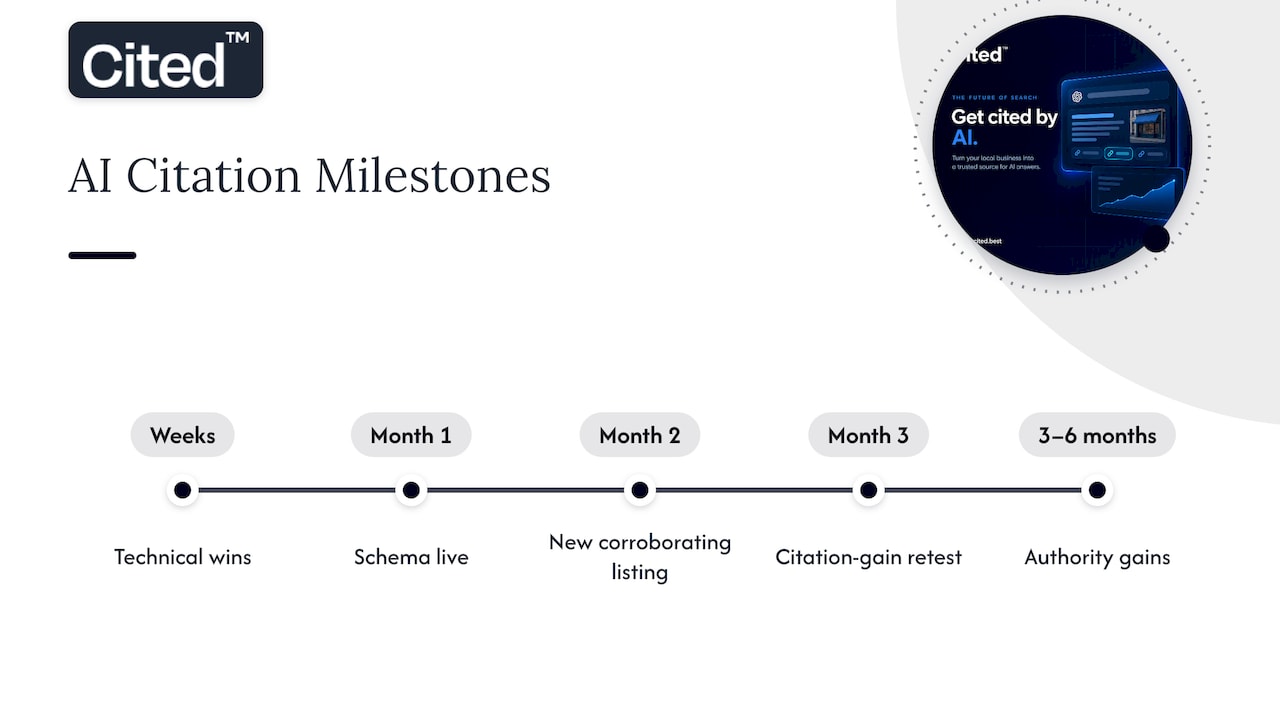
Expect initial technical wins within weeks and meaningful authority-driven gains over three to six months. Schema fixes and rewritten content get recognised quickly because they change what AI engines can extract immediately. Reviews, trade body listings and press mentions build more slowly because they depend on other people and publications acting.
Industry commentary on AI adoption among small and medium enterprises reflects this pattern: technical fixes tend to show up in testing within weeks, while authority signals compound over several months. Set monthly milestones: schema validated and live in month one, first new corroborating listing by month two, first re-test showing a citation gain by month three.
How do I build a keyword strategy for AI search as a local business?
A keyword strategy for AI search starts with the question your customer would actually type or say, not the keyword a tool suggests. AI engines match intent to answers, so your strategy needs to map every realistic question a prospective customer might ask about your service, your area and your pricing, then write a page that answers each one directly.
Group these questions into clusters: what you do, where you do it, how much it costs, how long it takes, and why someone should choose you over doing it themselves or going elsewhere. Each cluster becomes one or more pages built around a direct question in the heading and a concrete answer in the opening sentences. "How much does a boiler service cost in [area]" deserves its own answer with a price range, not a paragraph buried inside a general services page.
Long-tail, conversational phrases matter more here than short, generic keywords, because that is how people phrase prompts to AI assistants. "Best emergency plumber for a burst pipe" reflects a real prompt pattern more closely than "plumber services." Include service area terms explicitly rather than assuming local relevance will be inferred, since AI engines corroborate location facts from text, not just from your business address.
Refresh this content when prices, hours or services change. Stale answers get quietly dropped from citation even when the page still ranks in conventional search, because AI engines weigh recency as one of the four core signals. Treat your keyword strategy as a living list of customer questions you keep answering accurately, rather than a document you write once and leave.
How do I optimise for voice search and AI assistant visibility?
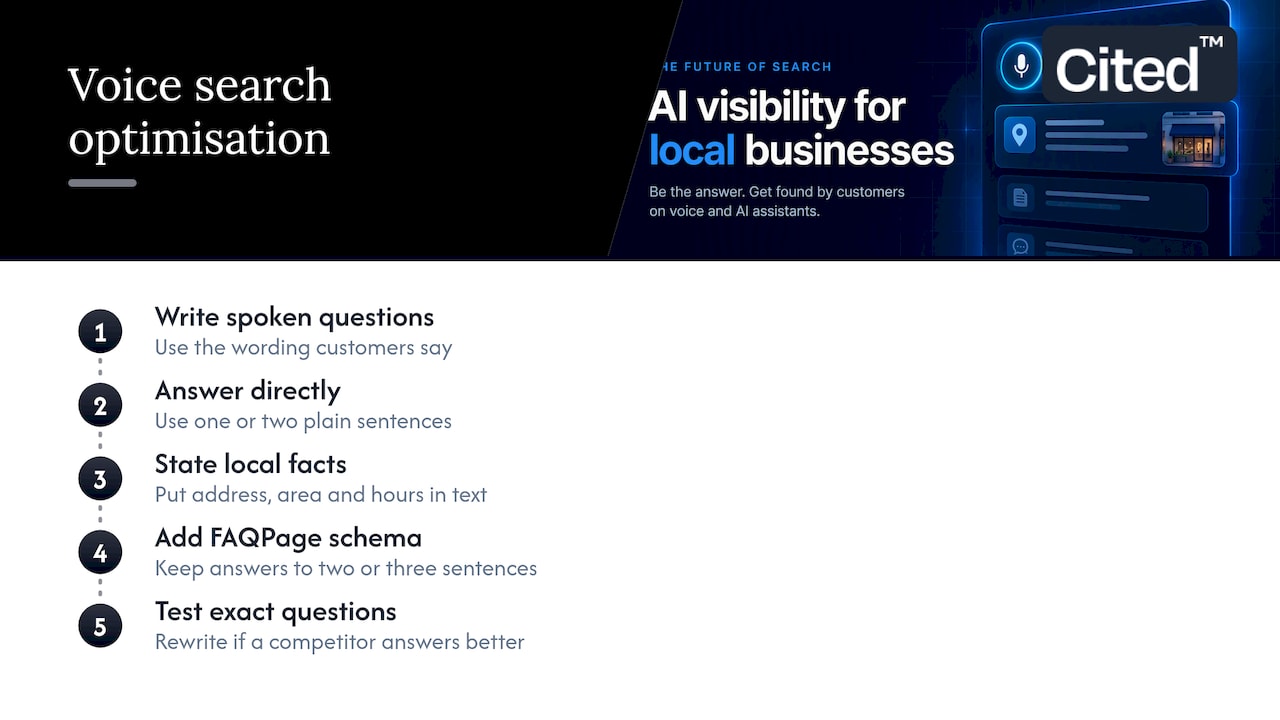
Voice search optimisation for local AI visibility means writing answers the way people speak, not the way they type. Spoken queries run longer and more conversational than typed ones, often phrased as full questions: "where can I get my car serviced near me today" rather than "car service near me."
Structure content to match that pattern. Open each service page with the question in that conversational form, then answer it in one or two plain sentences before adding detail. Avoid jargon and abbreviations that a voice assistant would struggle to match against a spoken query.
Local intent carries extra weight in voice search because so many spoken queries include "near me" or an area name. Make sure your address, service area and opening hours are explicit in text, not only in a map embed or an image, since voice assistants and AI engines both parse text, not graphics.
FAQPage schema supports this directly: a well-formed question-and-answer block is close to the exact shape a voice assistant needs to extract and read aloud. Keep answers to two or three sentences so there is a clean, quotable unit for the assistant to use. Our FAQPage checklist covers the schema side of this in detail.
Test your own voice optimisation by asking a smart speaker or phone assistant the exact questions your customers would ask. If your business does not come up, check whether a competitor's page answers that exact phrasing better than yours does, and rewrite accordingly.
Does page speed and mobile usability affect AI visibility?
Page speed, mobile usability and crawlability affect AI visibility because an AI engine cannot cite a page it cannot reliably load, render or crawl. Technical performance is the foundation underneath every content and schema improvement.
Start with crawlability: confirm your key pages are not blocked by robots.txt, return a proper 200 status, and are not accidentally set to noindex. A page that is well written but blocked from crawling cannot be cited, no matter how good the content is.
Mobile rendering matters because most discovery now happens on mobile devices, and a page that renders badly or hides content behind interactive elements on mobile may not expose its facts cleanly to automated extraction. Keep core facts, service details and FAQ content in plain text in the main page body rather than behind tabs or accordions that require a click to reveal.
Page speed affects how reliably a page gets crawled and re-crawled at all. Slow-loading pages get crawled less frequently, which works against the recency signal AI engines favour. Google's own tools and resources include free testing options for checking load speed, mobile rendering and crawl errors, worth running quarterly alongside your schema validation.
None of this is a one-off fix. Treat speed, mobile rendering and crawlability as ongoing maintenance, checked whenever you update a page or change a content management system plugin, since each of those changes can silently break something that was previously fine.
How does my business data reach Alexa, Google Assistant and Siri?
Your business data reaches voice assistants largely through the same structured facts and profile completeness that feed AI search engines, not through a separate submission process. Google Assistant draws heavily on Google Business Profile data, so a complete, accurate profile with correct categories, hours and services is the most direct lever you control.
Siri draws on Apple's own business listings alongside Maps data, so keeping your Apple Business Connect listing (where you have claimed one) consistent with your Google profile matters just as much as the Google side. Alexa relies more heavily on structured web data and third-party directories, which is another reason consistent NAP details across every listing genuinely matter rather than being a tidy-up task.
There is no single control panel that pushes your facts to every assistant at once. What works instead is making the same facts, name, address, phone number, hours, services, true and identical everywhere they appear: your website, your Google profile, trade directories and any assistant-specific listing you can claim directly. Assistants and AI engines alike treat agreement across sources as a trust signal, and a mismatch in even one detail, like an old phone number still listed somewhere, can be enough for a system to quietly drop your business rather than risk giving a wrong answer.
Can I use AI-generated content to improve local visibility responsibly?
You can use AI-generated content for local visibility if you treat it as a drafting tool and verify every fact before publishing, never as a substitute for accurate business information. AI engines are, after all, built to detect and favour verifiable, consistent facts, so content that contains errors or generic filler works against the very systems you are trying to be cited by.
Use AI tools to draft the first pass of a service page or FAQ answer, then edit in your actual prices, actual service area and actual turnaround times. Generic, templated answers that could apply to any business in any town are precisely what gets overlooked in favour of a specific, verifiable competitor.
Keep a human editorial check on anything published, particularly figures, claims about qualifications or certifications, and anything that touches safety or compliance. An AI-drafted paragraph that invents a statistic or misstates a regulation does more damage to citation prospects than no content at all, since it introduces exactly the kind of inconsistency that AI corroboration checks are designed to catch.
Disclose AI assistance where your industry or platform expects it, and avoid publishing AI-generated reviews or testimonials under any circumstances. That crosses directly into the fake review territory the CMA has already acted on, and the risk is not worth the shortcut.
How do I benchmark my AI visibility against competitors?
You benchmark AI visibility against competitors by running the same prompt-test protocol for their business names and service categories that you run for your own, then comparing which facts and sources each AI engine cites. This tells you not just whether you are visible, but why a competitor might be winning a citation you are missing.
Run a category query without any brand name, such as "best [service] in [area]," and record every business the engine names along with the sources it appears to be drawing from. If a competitor is cited and you are not, check their Google Business Profile completeness, their schema markup where visible, and whether they have a trade directory or press mention you lack.
Pay attention to the shape of their content as much as its substance. A competitor with a thin website but a well-optimised Google Business Profile and several independent reviews may outperform a business with a polished site but weak third-party corroboration, because AI engines weigh corroboration heavily.
Repeat this benchmarking monthly alongside your own prompt-test, since competitor visibility shifts as they make changes too. The goal is not to copy a competitor's tactics wholesale but to identify which of the four citation signals they are satisfying that you are not, then close that specific gap.
What actually moves AI citation fastest for local businesses?
In our work auditing local business websites, structured data fixes consistently produce the fastest visible change, faster than new content and faster than reviews. A business with accurate LocalBusiness and FAQPage schema, verified and current, tends to get recognised within weeks rather than months.
This week, pick your three most important service pages and check whether each one answers its core question in the first two sentences. If it does not, rewrite it before you touch anything else.
— Tom Heaton
Get a free AI audit and a prioritised fix list from Cited
Fixing structured data and third-party corroboration yourself takes time most business owners do not have spare. Running the free audit at Cited gives you a prioritised list of exactly what to fix first, checked by a certified AI technician rather than generated blind.
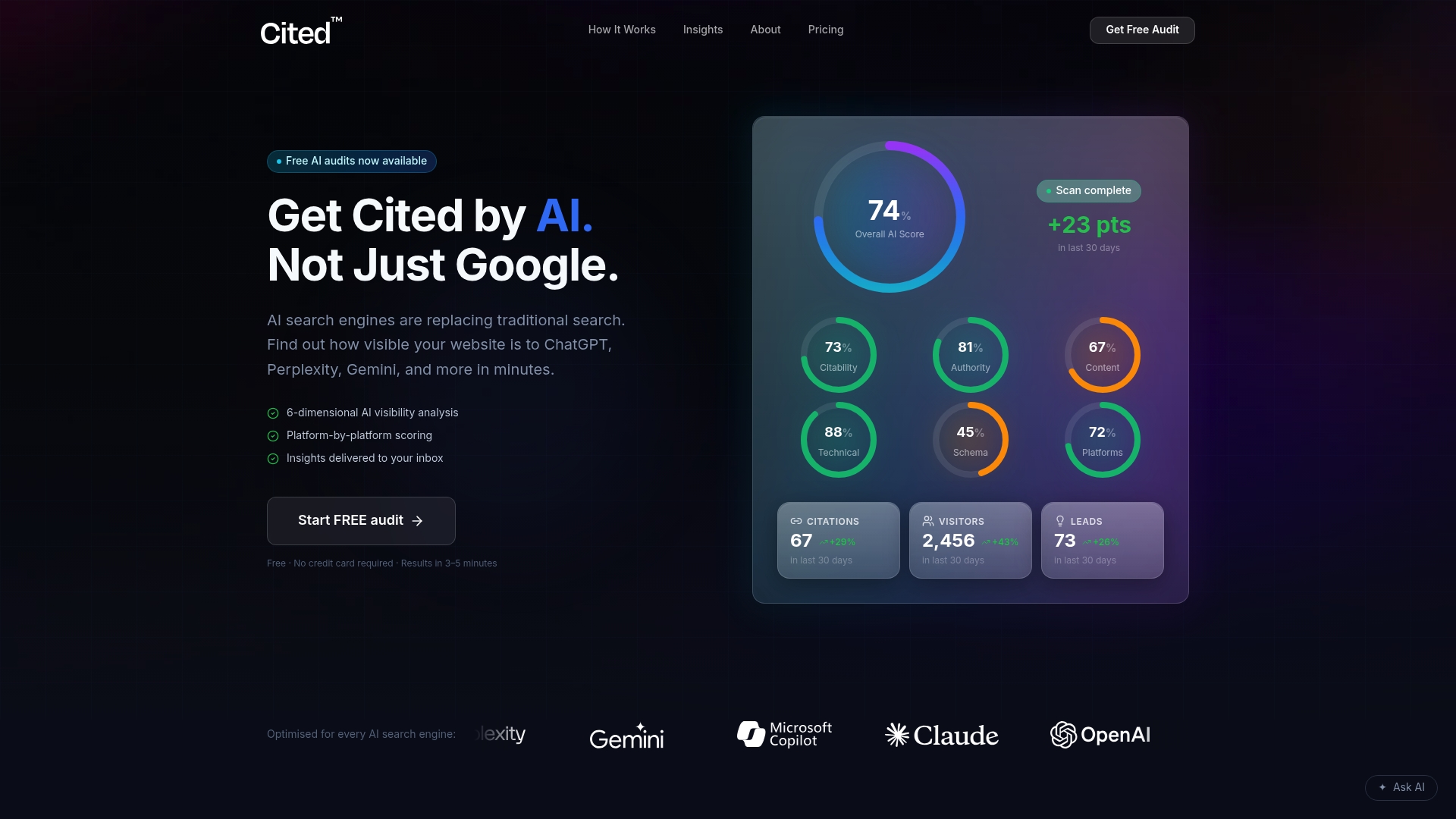
The audit covers:
- Schema and JSON-LD validity across your key pages.
- NAP consistency across your website and major listings.
- A prompt-test baseline showing whether AI engines currently cite you at all.
From there, Technical Fixes start at £495 one-off for the items the audit flags, and the AI Optimised plan from £995 per month covers ongoing implementation and monthly re-testing. Book a call once you have your results to talk through which fixes matter most for your business.
FAQ
What is AI visibility for a local business?
AI visibility is how often and how accurately AI engines such as ChatGPT, Perplexity, Gemini, Claude and Copilot cite your business when someone asks a relevant question. It depends on structured pages, third-party corroboration, recency and Q&A-shaped content, the four signals field testing identifies as dominant in local AI citations.
How is AI visibility different from traditional local SEO?
Traditional local SEO ranks pages in a search results list, while AI visibility determines whether your business gets named directly inside an AI-generated answer. The two overlap heavily on fundamentals like Google Business Profile completeness and reviews, but AI visibility places extra weight on structured data and consistent facts repeated across independent sources.
Are fake reviews a risk to my AI visibility?
Yes. The CMA has secured undertakings from Google meaning businesses found to benefit from fake reviews may receive warning alerts and have review functions disabled, which damages both conventional and AI visibility. Favour genuine, verifiable reviews collected transparently.
How much does a Cited AI audit cost?
The initial AI Audit is free with no credit card or account required. Implementation afterwards is priced separately: Technical Fixes start from £495 one-off, the AI Optimised plan starts from £995 per month, and Enterprise projects are priced individually.
How often should I re-test my AI citations?
Run the full prompt-test protocol monthly, since citations shift as you make changes and as competitors do too. Early on, after major schema or content fixes, a re-test within a few weeks will usually show whether the change had any effect.
Sources
Recommended
Ready for your AI score?
See how visible your site is to ChatGPT, Perplexity & Gemini.
Start FREE auditResults in minutes · 100% free