
FAQ pages can boost AI citations when they combine two things: concise, self-contained answers and proper FAQPage structured data markup. This checklist walks you through writing answers that AI systems will actually quote, implementing the schema correctly, and measuring whether it's working to increase your visibility in AI search results.
Win AI Citations: 5-Step FAQPage Checklist for SEO & Dev Teams
FAQ pages still matter for AI citation, but only when two conditions are met: the answers are concise and self-contained, and the page carries correct FAQPage structured data. This article covers how to write answers AI systems will quote, how to implement and validate the schema behind them, and how to measure whether either is working.
***
TL;DR: >- FAQ pages with concise, self-contained answers and correct FAQPage schema are more likely to be cited by AI systems.- Proper schema markup should be placed in server-rendered HTML, with all required properties correctly matching visible text.- Writing answers that stand alone without needing additional context improves their chances of being quoted accurately by AI.- Regular validation of schema markup using validators and Google's testing tools helps prevent silent errors that reduce AI citation potential.- Tracking search impressions and on-site engagement can reveal whether FAQ content effectively influences AI citations and search visibility.
***
Table of Contents
- Why FAQ pages still matter for AI search engines
- How FAQPage schema and structured data influence AI citation
- Writing FAQ answers that AI will quote
- Technical checklist: implement and validate FAQPage JSON-LD
- Measuring outcomes: metrics and experiments to track AI citation and impact
- Practical examples and templates for FAQ sections
- How we approach FAQ pages during an AI visibility audit
- Getting your FAQ pages audited and fixed
- Sources
- FAQ
Why FAQ pages still matter for AI search engines
AI answer engines work by extracting short, factual statements from web pages rather than summarising entire articles. A well-formed question-and-answer pair gives these systems exactly what they need: a bounded claim with a clear subject, verb and answer, sitting in isolation from the surrounding narrative. That is why Q&A format tends to outperform prose buried inside long-form guides when a system is deciding what to cite.
Government guidance backs this pattern. GOV.UK's schema documentation describes FAQPage schema being used across publishing guides and answers, noting that it supports machine-extracted answers and has been made available to Google Assistant. That is a rare case of a public body documenting how structured Q&A content feeds directly into an assistant's response, rather than just a search results page.
The regulatory picture is shifting too. The Publisher CR final decision sets out controls and transparency obligations so publishers can manage how their content is used in generative AI features, including expectations around attribution reporting. For anyone writing FAQ content with AI citation in mind, this matters because it changes what publishers can see and control about how their answers get reused, not just whether they appear at all.
FAQ pages do not help in every situation. Three patterns tend to cause problems:
- Duplication across pages: repeating the same question and answer on multiple URLs confuses which page should be treated as the authoritative source.
- Thin, generic answers: a one-line answer with no supporting detail gives an AI system little reason to prefer it over a competitor's fuller explanation.
- Zero-click cannibalisation: when an answer is complete enough to satisfy the query on its own, the reader may never click through, which can suppress on-site engagement metrics even as citation increases.
AI systems and search engines commonly extract short Q&A pairs to power snippets and AI-generated summaries, a pattern that shows up consistently across search and AI platform behaviour. The practical implication is that a FAQ page is not just a support tool. It is a citation surface, and it needs to be built with that job in mind.
How FAQPage schema and structured data influence AI citation
FAQPage schema is a structured data format, defined by Schema, that marks up questions and answers so machines can read them without parsing the surrounding page design. It sits alongside the visible Q&A text on the page, usually as a block of JSON-LD in the page's code, and describes the same content in a format a crawler can extract with certainty rather than guesswork.
The distinction matters because visible text and structured data serve different readers. A human sees the accordion, the heading, the answer paragraph. A crawler or AI extraction routine can use the JSON-LD to skip that layout entirely and pull the question and answer as a clean pair. Schema does not replace good writing, but it removes ambiguity about where an answer starts and ends.
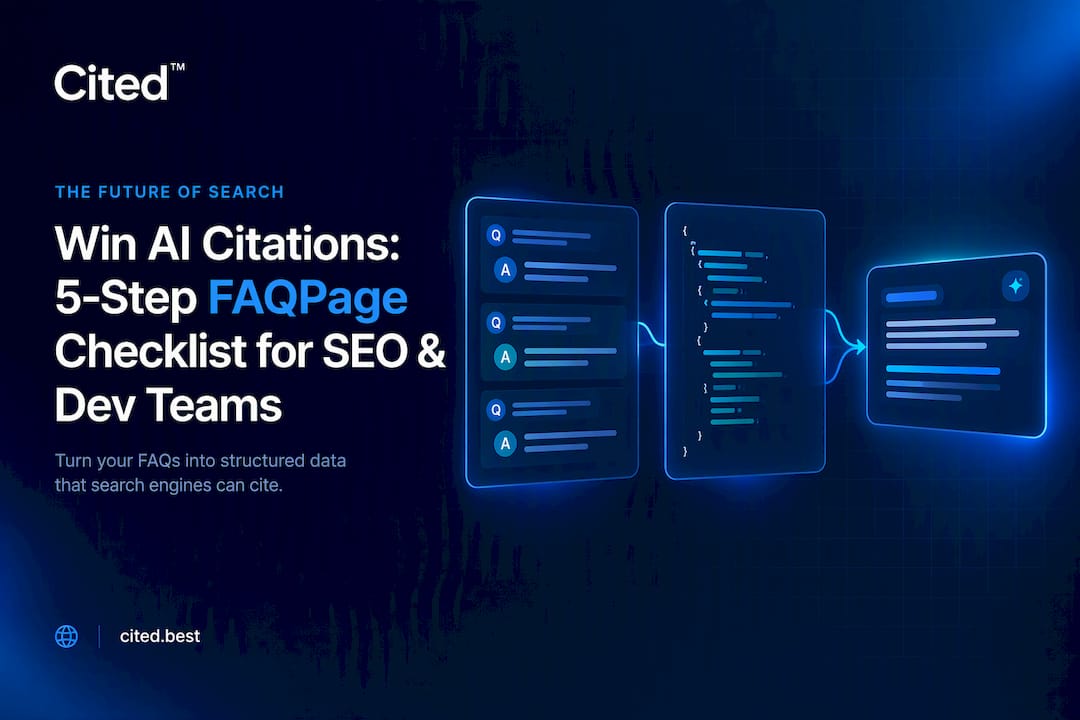
Does that translate into more citations? Schema.org's own documentation confirms the vocabulary exists for exactly this purpose, but as Cited's own analysis of whether schema markup actually gets you cited by AI search notes, presence of schema does not guarantee citation. It provides a high-confidence signal that many AI platforms prefer when deciding what to extract, which is a meaningfully different claim from a guarantee.
Validating the markup is a short, mechanical job:
- Run the page through a schema.org-compliant validator to catch missing or malformed properties.
- Use Google's rich results test to confirm the markup renders as an eligible FAQ result.
- Check Google Search Console's Search Performance report for FAQ-specific impressions and clicks, a feature Google's own guidance documents in detail.
Pro Tip: Validate schema after every template change, not just at launch: a small CMS update can silently break JSON-LD formatting without affecting how the page looks to a human visitor.
Writing FAQ answers that AI will quote
The answer AI systems quote most reliably is the one that stands alone without needing the rest of the page for context. That means starting with a direct, one-sentence answer, followed by a single clarifying sentence that adds the detail a reader needs to trust it. Anything beyond that belongs in the body of the article, not the FAQ answer itself.
Four rules keep answers citable:
- Open with the answer, not the question restated. Say what is true first, then explain why.
- Use question words in the heading. Guidance from a UK council's content style guide recommends how, what, when, why and where phrasing because voice and AI search queries are typically framed as natural questions.
- Avoid pronouns that depend on earlier context. Name the subject again rather than writing "it" or "this" if the answer could be lifted out and read in isolation.
- Keep answers to two or three sentences. Anything longer stops reading like an answer and starts reading like a paragraph pulled out of context.
Four short examples show the pattern across content types:
- Product page: "Does this router support mesh networking? Yes, it supports mesh networking with up to four additional nodes, configured through the companion app."
- Help centre: "How do I reset my password? Go to account settings and select 'reset password'. A reset link arrives by email within five minutes."
- Long guide: "What is a content cluster? A content cluster is a group of related pages built around one core topic, linked to help search engines understand the relationship between them."
- Knowledge base: "Is my data encrypted at rest? Yes, all stored data is encrypted using industry-standard AES-256 encryption."
None of these need the rest of the page to make sense, which is precisely the property that makes them easy for an AI system to lift and quote.
Technical checklist: implement and validate FAQPage JSON-LD
Getting FAQPage schema live and readable by AI crawlers comes down to five ordered steps, each catching a different failure mode that otherwise goes unnoticed until traffic or citations quietly drop.
- Place JSON-LD in server-rendered HTML. Client-side injection through JavaScript risks being invisible to crawlers that do not execute scripts, so the markup should exist in the page source before any script runs.
- Include all required properties. Every question needs a
mainEntity,nameandacceptedAnswerwith atextfield, matching what schema.org specifies for the FAQPage type. - Match visible text to markup exactly. The JSON-LD answer text should mirror what a visitor reads on the page, not a shortened or reworded version.
- Check accessibility. Answers need to make sense to screen readers as well as AI extraction routines, which usually means avoiding markup that hides answer text until a user interaction like an accordion click.
- Run a live test. Use Google's URL inspection tool in Search Console to confirm the page renders as eligible for FAQ rich results, alongside a schema validator pass.
Validation method | What it checks | Where to run it |
|---|---|---|
Schema validator | Markup syntax and required properties | schema.org-compliant validator |
Search Console URL inspection | Live rendering and crawl eligibility | Google Search Console |
Rich results test | FAQ eligibility for search features | Google's rich results tool |
Search Performance report | Impressions and clicks on FAQ results | Google Search Console |
Cited's own FAQ schema implementation guide walks through common causes of validation failure, most of which trace back to mismatched text or markup added after the page has already rendered.
Measuring outcomes: metrics and experiments to track AI citation and impact
Tracking whether a FAQ page is working for AI citation means watching four figures side by side: Search Console impressions for FAQ rich results, the split between organic and AI-referral traffic where platforms expose it, on-site conversions from FAQ-originated sessions, and any direct citation data an AI platform provides.
Google's Search Console reporting records impressions and clicks specifically for FAQ rich results, giving a baseline for whether the markup is being picked up at all before worrying about AI citation on top of that.
A simple test isolates what is actually driving change:
- Publish two versions of a comparable FAQ page, one with schema and one without, and compare Search Console FAQ impressions over a fixed period.
- Rewrite a batch of answers to follow the direct-answer-first pattern, leave a control batch unchanged, and track citation or referral differences between the two.
- Watch for shifts in on-site engagement alongside any AI referral signal, since an answer that fully satisfies a query on the results page can raise citation while reducing click-through.
The Publisher CR's transparency requirements mean the referral data available to publishers is likely to change over time, since the final decision sets expectations for how attribution gets reported. Until that settles, the more reliable approach is tracking on-site outcomes and Search Console's own FAQ metrics rather than waiting on a single attribution figure from any one platform. Cited's methodology for measuring AI visibility follows a similar principle, combining platform-level signals with on-site data rather than relying on one source alone.
Practical examples and templates for FAQ sections
Four page types call for four different FAQ structures, because the job the page does for the reader changes the length and grouping that works best.
- Product pages need short, spec-driven answers grouped by feature: compatibility, dimensions, warranty. Three to five questions is usually enough.
- Help centres need action-oriented answers grouped by task: account setup, billing, troubleshooting. Answers should end with the next concrete step.
- Long guides need FAQ sections that summarise, not repeat, the article's own content: a question the guide already answered in depth, condensed to its core claim.
- Compact knowledge bases need broader groupings by topic rather than by individual feature, since the goal is coverage across many small questions rather than depth on a few.
Choosing which questions to include comes down to two checks: does this question get asked often enough to justify a dedicated answer, and does the answer duplicate one already published elsewhere on the site. Grouping related questions under a shared heading, an approach covered in Kukoo Creative's guide to information architecture, helps avoid the second problem by making existing coverage visible before a near-duplicate question gets added.
A knowledge base answer following the template: "What happens if I cancel mid-cycle? Your account stays active until the end of the current billing period, and no partial refund is issued." A product page answer following the same logic: "Is the warranty transferable? No, the warranty applies only to the original purchaser and is not transferable to a new owner."
How we approach FAQ pages during an AI visibility audit
Across the audits Cited runs, the same handful of issues appear repeatedly: FAQPage schema present but malformed, answers that open with throat-clearing rather than the direct claim, and duplicate questions scattered across product and support pages with no single authoritative version. Tom Heaton, who leads this work at Cited, treats these as the highest-leverage fixes because they are quick to correct and immediately testable through Search Console and schema validators.
A realistic short-term win looks like corrected schema on an existing FAQ page plus rewritten opening sentences on the ten most-viewed answers, changes that typically surface in Search Console's FAQ impressions data within a few weeks rather than requiring a content rebuild.
— Tom Heaton
Getting your FAQ pages audited and fixed
A FAQ page with strong answers and broken schema, or clean markup and vague answers, will underperform either way. A free audit can check both at once, alongside the wider technical health, authority signals and platform coverage that determine whether AI search engines cite a site at all.
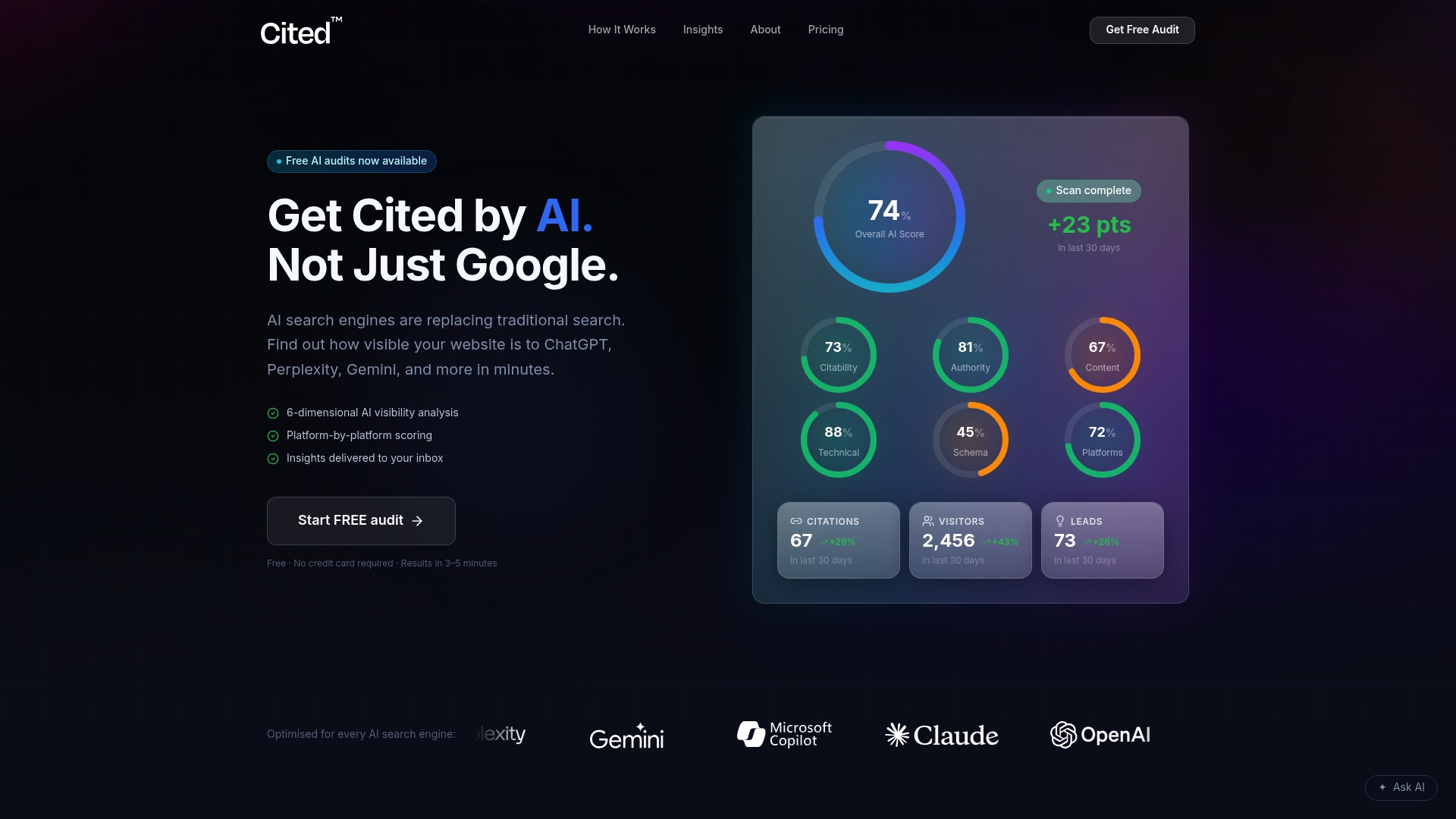
The free GEO audit requires no credit card or account, and it is reviewed by hand rather than generated automatically. Once you know what needs fixing, three routes are available depending on how much of the work you want done for you:
- Technical fixes for correcting schema, crawlability and other technical issues identified in an audit.
- Managed plans for ongoing implementation and optimisation across platforms.
- Enterprise services for larger sites with custom requirements.
If you want a clearer picture of the audit's scope before committing, the AI Audit page sets out exactly what gets checked. Otherwise, start with the Cited and see what it finds on your own FAQ pages.
Sources
- What data we expose as schema.org structured data - GOV.UK Developer Documentation
- Publisher CR final decision
- Rich Results and Search Console FAQs | Google Search Central Blog
- Schema
FAQ
How do I write FAQ answers that AI tools will quote?
Start each answer with a single direct sentence stating the fact, followed by one clarifying sentence, and avoid pronouns that rely on context from elsewhere on the page. Question-word headings such as how, what and why match the phrasing used in voice and AI search queries, according to content guidance from a UK council.
What does a good FAQ page look like in practice?
A good FAQ page groups questions by the reader's task or intent, such as billing, setup or compatibility, rather than listing every possible question in one long block. Each answer stands alone, and the page carries valid FAQPage schema matching the visible text exactly.
Do FAQ pages still help SEO and AI visibility?
Yes, FAQ pages still help when they combine self-contained, direct answers with correctly implemented FAQPage schema, since Google's Search Console reporting tracks FAQ rich result impressions and clicks separately from standard search results. They can also cause duplication issues if the same question and answer are repeated across multiple pages without a single authoritative version.
How do I create an FAQ page step by step?
Identify the questions readers actually ask, write a direct one-to-two sentence answer for each, and add matching FAQPage JSON-LD in the server-rendered page source. Validate the markup with a schema validator and Google's rich results test before publishing, then monitor performance through Search Console's Search Performance report.
Recommended
Ready for your AI score?
See how visible your site is to ChatGPT, Perplexity & Gemini.
Start FREE auditResults in minutes · 100% free