
To get your content cited by AI systems like ChatGPT and Perplexity, focus on making your pages server-rendered and crawlable, then add a JSON-LD entity graph with clear publication dates and author information. Sites that achieve a GEO score of 0.70 or higher see a 78% citation rate across AI search engines. The key is fixing technical infrastructure first—perfect metadata on an uncrawlable page won't help you get cited.
Hit GEO 0.70, Earn 78% AI Citations: License Content for AI for Devs
Licensing content for AI means adding metadata and technical signals, not signing legal training agreements, so answer engines can find, understand, and cite your pages. The single highest-impact action is making every page crawlable and server-rendered, then publishing a JSON-LD entity graph with machine-readable dates. Audits using the GEO-16 framework show that pages hitting a GEO score of 0.70 or higher see a 78% cross-engine citation rate.
***
TL;DR: >- Ensuring pages are server-rendered and crawlable remains the top priority, as these are essential for AI systems to read and cite content effectively.- Implementing a site-level JSON-LD entity graph with stable identifiers and proper schema helps AI trace content back to its creator and source, boosting citation chances.- Adding clear crawler instructions in robots.txt and verifying access with current user-agent lists prevents AI crawlers from being blocked during indexing.- Achieving a GEO score of 0.70 or higher with at least 12 pillar hits significantly increases the likelihood of AI citation, with rendering fixes showing results faster.- Regular audits of schema, rendering, and indexing are crucial, as schema accuracy alone cannot compensate for poor crawlability or server-side rendering issues.
***
Table of Contents
- What does it mean to license content for AI?
- A one-page checklist for AI content usage rights
- How do you implement the metadata AI systems actually read?
- What should developers test before shipping?
- How do you know it's working?
- Why most teams get the sequencing wrong
- Get a free AI visibility audit from Cited
- Sources
- FAQ
What does it mean to license content for AI?
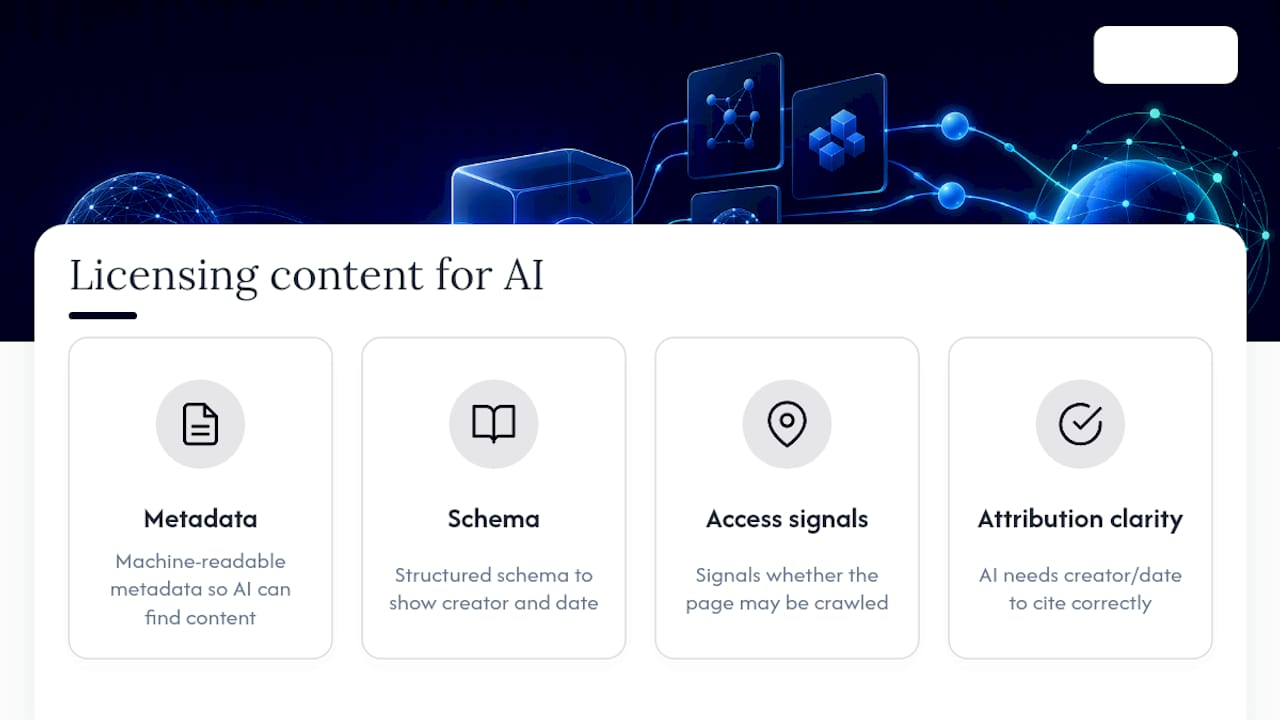
Forget the legal definition you might expect. In this context, licensing content for AI has nothing to do with copyright deals or training-data agreements between publishers and model builders. It means something far more practical: structuring your pages with machine-readable metadata, schema, and access signals so AI search engines such as ChatGPT, Perplexity, Gemini, Claude, and Copilot can find your content, understand who created it, and cite it correctly.
Content ownership in AI, in this technical sense, comes down to attribution clarity. If an AI system cannot confirm who wrote a page, when it was published, and whether it is allowed to crawl it, it will either skip the citation or attribute the claim to a competitor with cleaner markup. Getting AI content licensing right at the metadata level is what separates sites that appear in AI answers from sites that don't, regardless of how good the writing is underneath.
A one-page checklist for AI content usage rights
Start here before touching anything else. This is the order that removes the biggest technical blockers first.
- Allow the right crawlers. Add explicit Allow rules for GPTBot, OAI-SearchBot, and PerplexityBot in robots.txt, and verify user agents rather than guessing.
- Build the entity graph. Add a site-level JSON-LD structure using
@idand@graph, with stable identifiers and Article or TechArticle schema carryingdatePublishedanddateModified. - Attribute your images. Add ImageObject fields for creator, licence, and caption, and consider a C2PA manifest where provenance matters.
- Publish your maps. Add
/llms.txt, keep your sitemap current, and submit it to Bing Webmaster Tools as well as Google Search Console. - Confirm indexability. Pages must be indexed and snippet-eligible; server-render the primary content so crawlers never have to execute JavaScript to read it.
- Set a target. Aim for a GEO score (G) of 0.70 or higher with at least 12 pillar hits, the threshold tied to that 78% citation rate.
Pro Tip: Fix rendering and crawler access first. A perfect schema graph on a page that Googlebot or GPTBot can't render properly is invisible, no matter how well-tagged it is.
How do you implement the metadata AI systems actually read?
Developers need four building blocks: an entity graph, article-level schema, image attribution, and clear crawler instructions. Here's how each one works in practice.
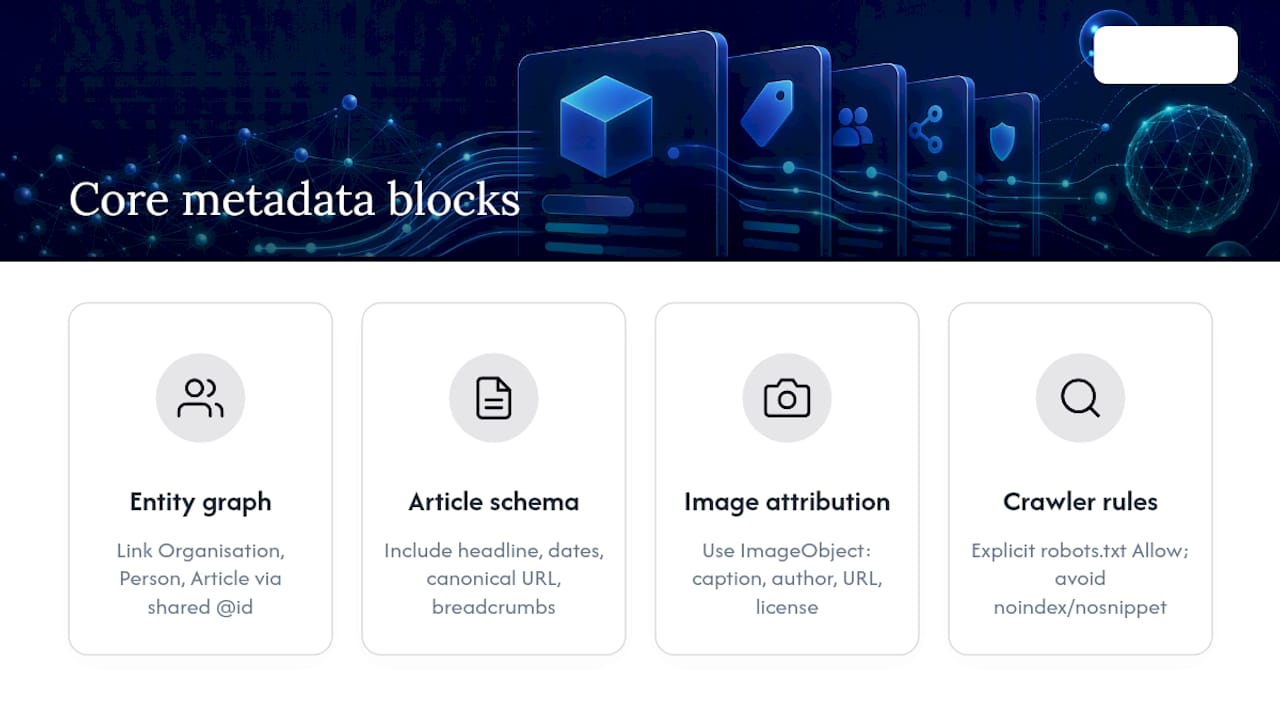
1. Build the entity graph with @id and @graph. A connected entity graph is the recommended schema strategy for AI systems because it reduces ambiguity. Instead of isolated JSON-LD blocks per page, link Organisation, Person, and Article entities through shared @id values inside a single @graph. Your organisation gets one stable @id (typically your homepage URL plus a fragment), your author gets another, and every article references both. This lets an AI system trace a claim back to a named author and a named publisher in one hop, rather than guessing from a byline string.
2. Populate Article or TechArticle schema properly. Every published page needs datePublished, dateModified, a canonical URL, and breadcrumb properties. Freshness is a genuine ranking signal for time-sensitive queries, so pair the machine-readable dates with a visible "Last updated" line on the page itself. Schema and visible text need to match exactly, because mismatches between structured data and page content are a documented cause of AI systems ignoring markup altogether.
3. Attribute images with ImageObject. Use ImageObject fields for creator, license, contentUrl, and caption. Host original images at stable URLs rather than relying on a CDN path that changes, and make sure the visible caption on the page matches the schema caption word for word. Guidance on ImageObject fields for AI attribution covers the exact property set worth prioritising for photographers and illustrators who need proper credit.
4. Add C2PA manifests where provenance matters. If your content includes original photography, video, or AI-assisted graphics, embedding a C2PA manifest gives a verifiable, tamper-evident provenance trail. It's optional for most text-first publishers, but worth doing for photojournalism, product imagery, or anything where authenticity claims carry weight.
5. Publish /llms.txt and /llms-full.txt. These are informal but increasingly useful maps that list your key pages and content summaries for AI crawlers to reference. Keep /llms.txt short and link out to /llms-full.txt for a fuller content inventory.
6. Set robots.txt Allow rules explicitly.
```
User-agent: GPTBot
Allow: /
User-agent: OAI-SearchBot
Allow: /
User-agent: PerplexityBot
Allow: /
```
Avoid page-level nosnippet or max-snippet:0 directives if citations are the goal. Both actively block the snippet eligibility that Google's own developer guidance says is a mandatory gate for generative AI features.
Pro Tip: Verify your crawler Allow rules against a live user-agent list rather than copying a robots.txt template from another site. Rules go stale fast as new AI crawlers launch. Cited's crawler user-agent guide tracks current UAs and IP ranges.
What should developers test before shipping?
Run these checks in order, and don't skip the rendering test just because the schema validates cleanly.
- Confirm server-side rendering. Run
curl -A "GPTBot" https://yoursite.com/pageand compare the raw HTML against what a browser renders. If your main content only appears after JavaScript executes, crawlers relying on the raw response miss it entirely. A headless render snapshot confirms parity. - Validate JSON-LD structurally and semantically. Run pages through Google's Rich Results Test, then manually check that every date, author name, and headline in the schema matches the visible page text.
- Group citation chunks by source, not by fragment. If you're building or auditing an internal AI search feature, Cloudflare's developer guidance recommends grouping returned chunks by document key, keeping only the highest-scoring snippet per source, and exposing scoring details for confidence filtering.
- Keep
@idand canonical URLs stable. Never let a redesign change entity identifiers. Automate sitemap regeneration and set sensible ETag headers so crawlers know when to re-fetch. - Wire up monitoring hooks. Log crawler hits by user agent, check Search Console and Bing Webmaster Tools indexing status weekly, and run a schema validation pass on every deploy that touches templates.
Pro Tip: Treat schema-content consistency as a CI check, not a one-off audit. A single template change can silently break dates or author names across thousands of pages overnight.
How do you know it's working?
Run a formal audit and treat a GEO score of 0.70 or higher with at least 12 pillar hits as your initial pass mark, the same threshold behind that 78% cross-engine citation rate.
Before and after any major change, sample the same set of queries across ChatGPT, Perplexity, and Gemini to check whether your domain starts appearing in cited sources with AI agents. This is slower than watching a dashboard, but it's the only way to confirm real-world citation behaviour rather than a proxy score.
- Check schema-content consistency monthly, not just at launch.
- Confirm visible timestamps match
dateModifiedafter every content update. - Re-verify indexing and snippet eligibility whenever you change templates.
- Log crawler response codes; a spike in 403s or 429s from GPTBot or PerplexityBot signals a server-level block worth investigating immediately.
Rendering fixes tend to show up in citation sampling faster than schema changes do, so re-audit two to three weeks after any server-side rendering work before touching anything else.
Why most teams get the sequencing wrong
The mistake I see most often is teams treating schema markup as the finish line. It isn't. A flawless entity graph on a page that renders as a blank shell to a crawler achieves nothing. The odds ratio of 4.2 between GEO quality and citation likelihood only holds once the basics, crawlability and server-side rendering, are already solved.
Prioritise in this order: crawler access, rendering, then the entity graph. A free audit service flags exactly this sequencing problem in the majority of sites reviewed, and developer teams that fix rendering issues first often see citation gains within two to three weeks, well before the fuller schema work is even finished. Start with the audit, then run a short, focused implementation sprint against the top three items it flags.
— Tom Heaton
Get a free AI visibility audit from Cited
Cited runs a free AI audit that checks the exact things this guide covers: metadata completeness, server-side rendering, schema validation, llms.txt presence, and ImageObject attribution, all scored against the GEO-16 framework rather than generic SEO checklists. This service focuses specifically on AI citation visibility across ChatGPT, Perplexity, Gemini, Claude, and Copilot, with a technician reviewing the results by hand rather than handing you a raw data dump.
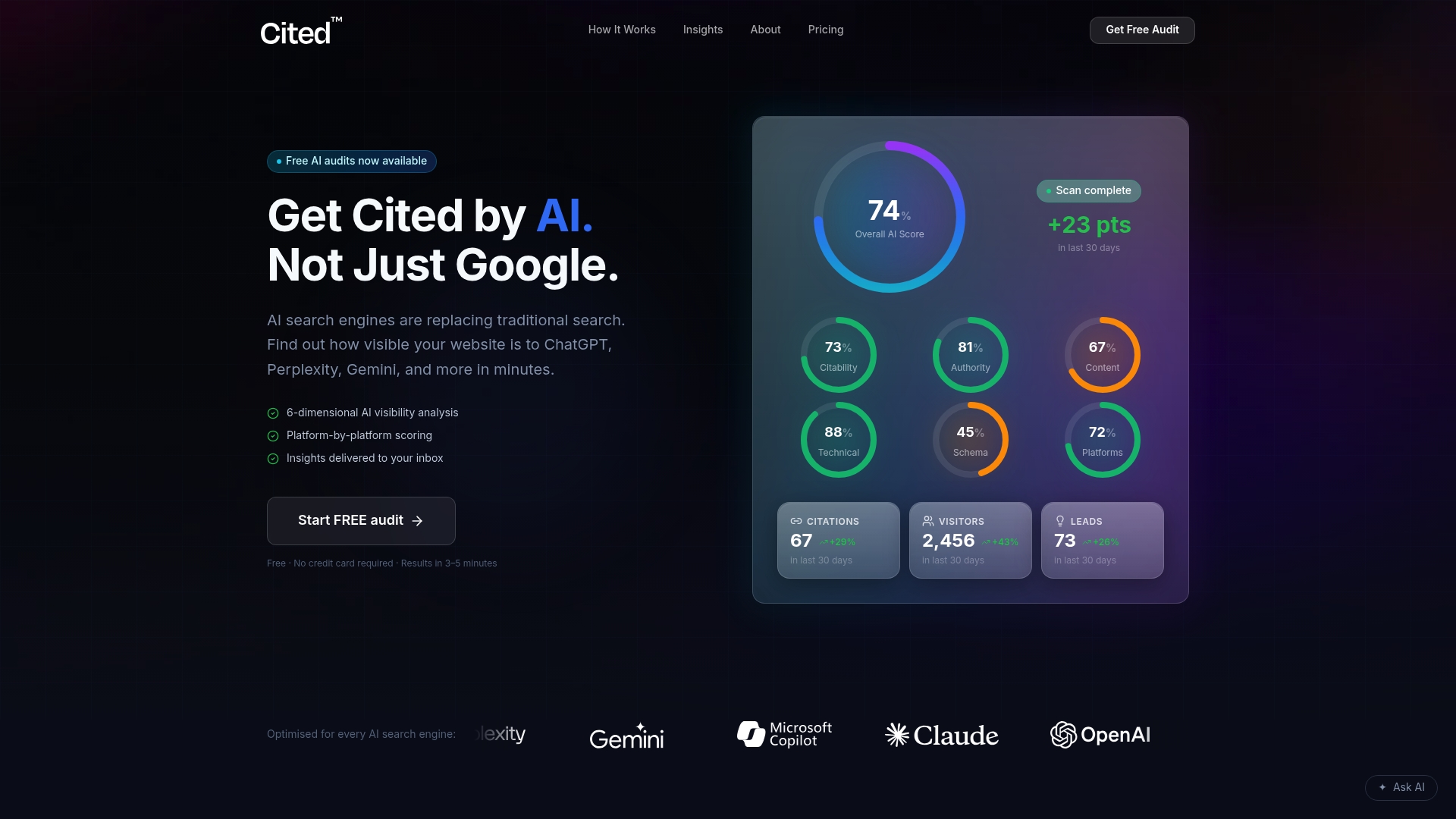
Once you've seen where your pages fall short, two ways to fix it are available: one-off Technical Fixes from £495 for the specific issues the audit surfaces, or a managed plan from £995 per month for ongoing implementation and monitoring as AI platforms change their crawling and citation behaviour. Enterprise pricing is available on request for larger site portfolios. Run the free audit at Cited and see your GEO score before deciding which route fits your team.
Sources
- AI Answer Engine Citation Behavior: Bringing the GEO-16 Framework in B2B SaaS
- Schema markup: what it is, how to use it, & real-life examples
- AI Search chunk citations (Cloudflare developer guidance)
- How Search works and generative AI eligibility (Google developer guidance)
FAQ
What does "license content for AI" actually mean?
It means adding metadata, schema, and crawler signals so AI search engines can find and cite your content correctly. It is not a legal licensing agreement covering how AI companies train their models.
Do I need C2PA manifests for every page?
No. C2PA provenance manifests matter most for original photography, video, or graphics where authenticity needs to be verifiable, and they're optional for standard text content.
What GEO score should I aim for?
Aim for a GEO score of 0.70 or higher with at least 12 pillar hits, the threshold linked to a 78% cross-engine citation rate in GEO-16 research. Cited's free audit measures your current score against this benchmark.
How long does it take to see citation improvements?
Rendering and crawler access fixes can show measurable citation gains within two to three weeks. Full entity graph and schema work usually takes longer to propagate across AI platforms.
How much does Cited charge for implementation?
Technical Fixes start from £495 as a one-off project, and the AI Optimised managed plan starts from £995 per month. Enterprise pricing is available on request via Cited's pricing page.
Recommended
Ready for your AI score?
See how visible your site is to ChatGPT, Perplexity & Gemini.
Start FREE auditResults in minutes · 100% free