
To improve AI image attribution, add ImageObject JSON-LD schema with complete fields like description and creator, pair it with a clear visible caption below the image, and ensure your image URL is crawlable and not blocked. These three elements work together to create a strong attribution signal that AI systems can follow, and skipping any one of them significantly reduces the chances your images will be cited.
7 ImageObject Fields to Make AI Attribute Your Images for SEOs & Devs
To get AI systems to cite your images, add ImageObject JSON-LD with a descriptive description and creator field, then pair it with a quotable visible caption and a crawlable image URL. Combine that with standard alt text and normal SEO fundamentals, and citation likelihood improves measurably. Miss any one piece and the attribution chain breaks.
***
TL;DR: >- Adding ImageObject JSON-LD with complete fields and nesting it within your main schema significantly increases the chances of image attribution by AI systems.- Writing a clear, specific caption immediately below the image boosts the likelihood of verbatim quoting by AI models, especially if it includes unique details.- Ensuring images are crawlable, high-quality, and accurately captioned can double citation rates, with schema validation and URL accessibility key to success.- Stock images are less likely to be cited than unique ones, as AI attribution depends on clear, singular source signals tied to early index dates.- Regularly monitor AI output and use schema and caption fixes to see improvements within two to three weeks, with ongoing optimization providing the best results.
***
Table of Contents
- Quick checklist: the five actions to apply now
- Why do AI systems prefer structured image metadata?
- How do you implement ImageObject JSON-LD correctly?
- How should you write alt text and captions for AI citation?
- What image quality and legibility do AI systems need?
- What delivery and crawlability checks matter for AI crawlers?
- How do you measure and improve image citation rates?
- What are the legal considerations around AI image citation?
- Author perspective: practical wins from Cited's audits
- Get a free audit of your image citation readiness
- Sources
- FAQ
Quick checklist: the five actions to apply now
Five changes account for most of the gap between images that get cited and images that get ignored:
- Add ImageObject JSON-LD to every genuinely informative image, with
description,creatorandlicensepopulated. - Write a one-sentence visible caption directly beneath the image, naming the subject explicitly.
- Write factual alt text under 125 characters, separate from the caption's wording.
- Confirm the image URL is crawlable: no robots block, no JavaScript gate, no login wall.
- Check the image is unique, not a stock photo already indexed on a dozen other domains.
Apply these to hero images and product pages first. Your supporting image library (blog illustrations, archive photos) can follow once the pages that drive traffic are fixed.
Pro Tip: If you can only do one thing this week, add the caption. It is the cheapest fix on this list and it doubles as the sentence an AI system is most likely to lift verbatim into its answer.
Why do AI systems prefer structured image metadata?
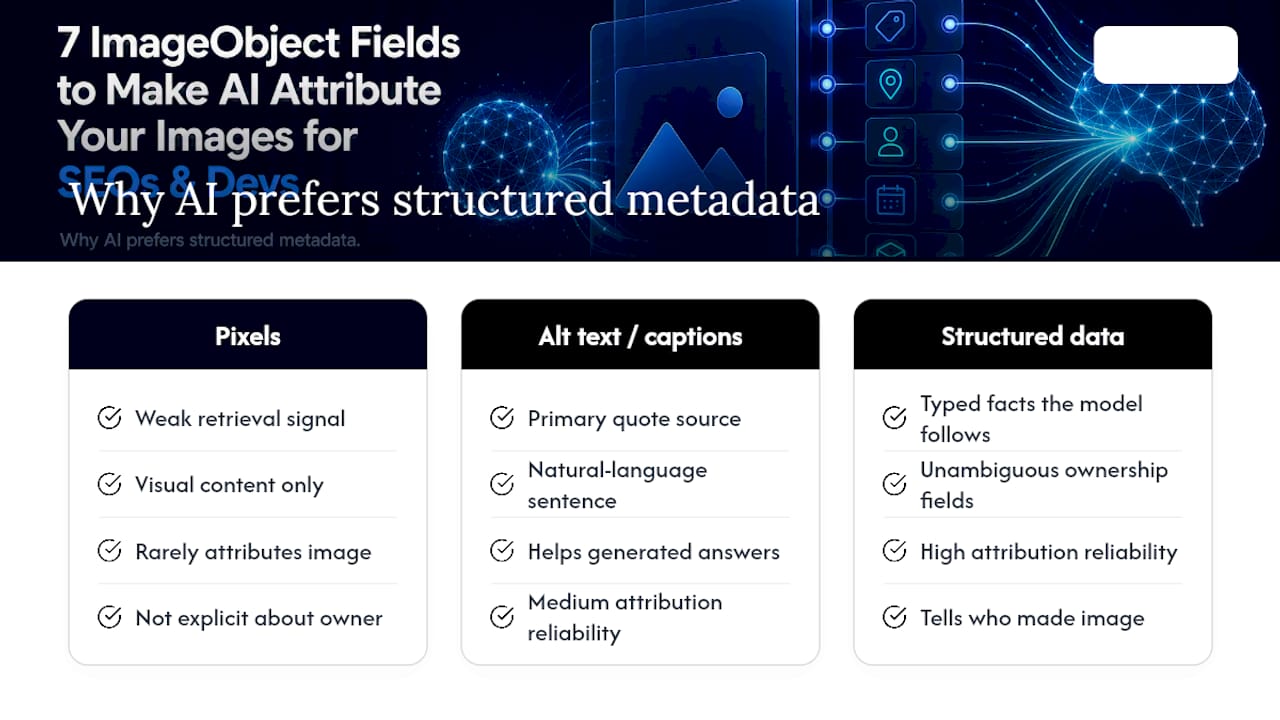
AI systems prefer structured metadata because pixels alone rarely tell a retrieval system who owns an image or why it matters. Retrieval systems read alt text, filenames, captions and structured data as the primary signals for selecting and attributing images in generated answers, not the visual content itself.
Structured data gives the model typed facts it can follow without guessing. A creator field is unambiguous in a way that "photo on our website" is not. Alt text and captions do a different job: they supply the actual sentence the AI might quote. An AI system rarely attributes an image from its pixels in retrieval mode; textual metadata remains the decisive signal for web-sourced images.
Put schema and text together and you get a high-confidence attribution chain: schema tells the model who made the image, and the caption gives it something worth repeating. Neither works as well alone. Sites that skip schema and rely on alt text alone consistently produce weaker attribution signals in practitioner testing.
How do you implement ImageObject JSON-LD correctly?
Start with seven fields. Schema.org's ImageObject specification supports many properties, but a handful do the actual work of attribution:
- contentUrl: the direct, fetchable URL of the image file.
- name: a short, specific title for the image.
- description: a full sentence explaining what the image shows and why it exists.
- creator: the person or organisation who made it, ideally linked to an Organisation or Person entity elsewhere on your site.
- license: a URL to your licensing terms or a Creative Commons reference.
- representativeOfPage: set to
trueonly for the genuine hero image, never for decorative assets. - datePublished: when the image first went live.
Nest the ImageObject inside your parent Article or Product schema using the image property, rather than leaving it as an orphaned block elsewhere on the page. That nesting is what lets a model connect the image to the entity the page is actually about.
Mark only genuinely informative images this way. Flagging decorative assets with the same schema dilutes the attribution signal rather than strengthening it.
Once the code is live, validate it in three steps: run the page through Google's Rich Results Test to catch syntax errors, check the JSON-LD against a Schema.org validator, and manually confirm the contentUrl actually returns a 200 status and loads the image. A schema block pointing at a broken or redirected URL is worse than no schema at all, since it teaches the crawler your metadata cannot be trusted.
How should you write alt text and captions for AI citation?
Write a short factual alt text for accessibility, then a separate full-sentence caption as the citation hook. They do different jobs and should never contain identical wording.
- Alt text: describe what's literally in the image, under 125 characters, no keyword stuffing.
- Caption: one complete sentence, containing named entities (a place, a product, a date) that give the model something specific to repeat.
- Heading placement: put a relevant heading immediately above the image, and the caption directly below it, so semantic proximity reinforces the same topic three times in a row.
Practitioners report that captions are often quoted verbatim by AI systems building an answer, which makes caption wording worth as much editorial attention as your opening paragraph. Write "A 2026 Ford Transit fitted with roof racks at our Bristol depot" rather than "Our van." The first sentence survives being lifted into a generated answer intact; the second gets discarded for being too vague to attribute.
Avoid duplicating the alt text and caption word for word. Search engines and AI crawlers both read that as filler rather than two distinct, reinforcing signals.
What image quality and legibility do AI systems need?
AI systems need text within images to be legible at the size they're actually served, not the size you designed at. OCR performance drops sharply once character height falls below roughly 30 pixels at served resolution, and low contrast compounds the problem further.
Test any image containing text (a chart, a screenshot, a diagram) at its final served dimensions, not the original export. Original photography also carries an advantage stock imagery can't replicate: if your URL holds the earliest index date for a genuinely unique image, that strengthens the case the image originated with you rather than being republished from elsewhere.
Practical production rules: use semantic filenames (bristol-depot-ford-transit.webp, not IMG_4021.jpg), keep on-image labels in a plain sans-serif rather than a stylised or script font, and avoid embedding critical information only as text inside a graphic when it could sit as real HTML text instead.
What delivery and crawlability checks matter for AI crawlers?
AI crawlers need images served as standard <img> elements with crawlable URLs, never blocked by robots.txt and never rendered only after a JavaScript interaction the crawler doesn't execute.
Beyond that baseline, a short technical checklist covers most of what image optimisation for answer engines requires:
- Serve images in WebP or AVIF where the platform supports it, with a fallback format.
- Use
srcsetfor responsive delivery, and always set explicitwidthandheightattributes. - Include every meaningful image in your XML image sitemap.
- Preload the hero image on key landing and product pages.
- Use lazy loading for below-the-fold images, but confirm your implementation still exposes the real
src(ordata-srcresolved server-side) rather than an empty placeholder that only a browser event fills in.
Rendering issues are one of the most common reasons a technically sound page still gets skipped; Cited's guidance on fixing rendering for AI walks through the specific fixes development teams miss most often.
How do you measure and improve image citation rates?
Monitor the actual outputs of ChatGPT (with browsing enabled), Perplexity and Gemini for your target queries, checking whether your image appears as a thumbnail or a linked source rather than a competitor's or none at all.
Set up scheduled queries against the phrases you'd expect to trigger an image citation, and log whether a thumbnail and source link appear, disappear, or change over several weeks. Cited's own measurement framework tracks these same signals across a site's full image inventory rather than one page at a time, which matters once you're managing more than a handful of URLs.
If an image still isn't being cited after a few weeks, work back through the chain: confirm the schema validates, check the caption still reads as a standalone factual sentence, and verify the URL hasn't moved behind a redirect or a lazy-load wrapper that hides it from the crawler.
What are the legal considerations around AI image citation?
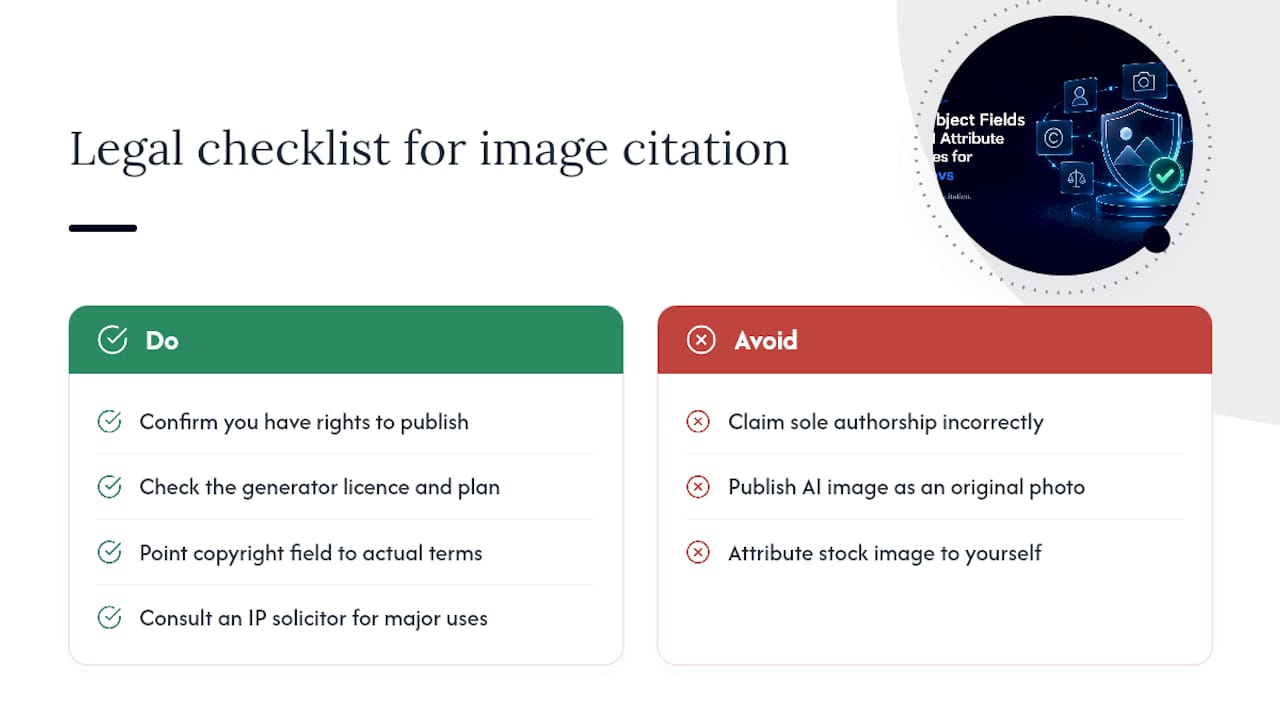
Copyright ownership of the image itself doesn't change because an AI system displays or links to it: you still need the rights to publish any photograph, illustration or graphic you're asking to be cited, whether you shot it, licensed it, or generated it with an AI tool.
Licensing gets more complicated with AI-generated imagery specifically. Different AI image generators carry different terms on commercial use and attribution, and those terms vary by provider and by the plan you're on, so check the licence attached to your specific generation before publishing it as an original asset with a creator field claiming ownership. Misrepresenting an AI-generated image as originally photographed, or claiming sole authorship of something built substantially from a third-party model, creates both a licensing risk and a factual accuracy problem in your own schema.
The license field in your ImageObject schema is doing real legal work here, not just SEO work. Point it at your actual terms, whether that's an all-rights-reserved statement, a Creative Commons licence, or a stock licence with its own redistribution limits. If you're using stock photography, its licence generally does not grant you the right to claim creator as yourself; leave that field pointing at the actual photographer or agency where the licence requires it.
None of this constitutes legal advice, and copyright rules around AI-generated content are still moving in most jurisdictions. Where an image carries real commercial weight (a product shot central to a paid campaign, for instance), a licensing question worth more than a quick guess is worth a conversation with a solicitor who handles intellectual property, not a blog post.
Author perspective: practical wins from Cited's audits
The pattern in Cited's audits is consistent: schema and caption fixes produce visible movement in two to three weeks, while original photography projects take longer because you're producing new assets, not just marking up existing ones. Sites that had never touched ImageObject schema saw the fastest early gains, simply because there was no competing signal to override. Cited's technical SEO guidance covers the rendering fixes that tend to surface once schema is in place, and they're usually the second problem, not the first.
— Tom Heaton
Get a free audit of your image citation readiness
Cited is built specifically for AI citation visibility, not general SEO with an AI label bolted on, and image schema is one of the six dimensions its audits check by default. Where a generic SEO agency might glance at alt text and move on, Cited's certified technicians review your ImageObject markup, caption structure and crawlability against the exact signals AI systems like ChatGPT, Perplexity, Gemini and Claude actually read.
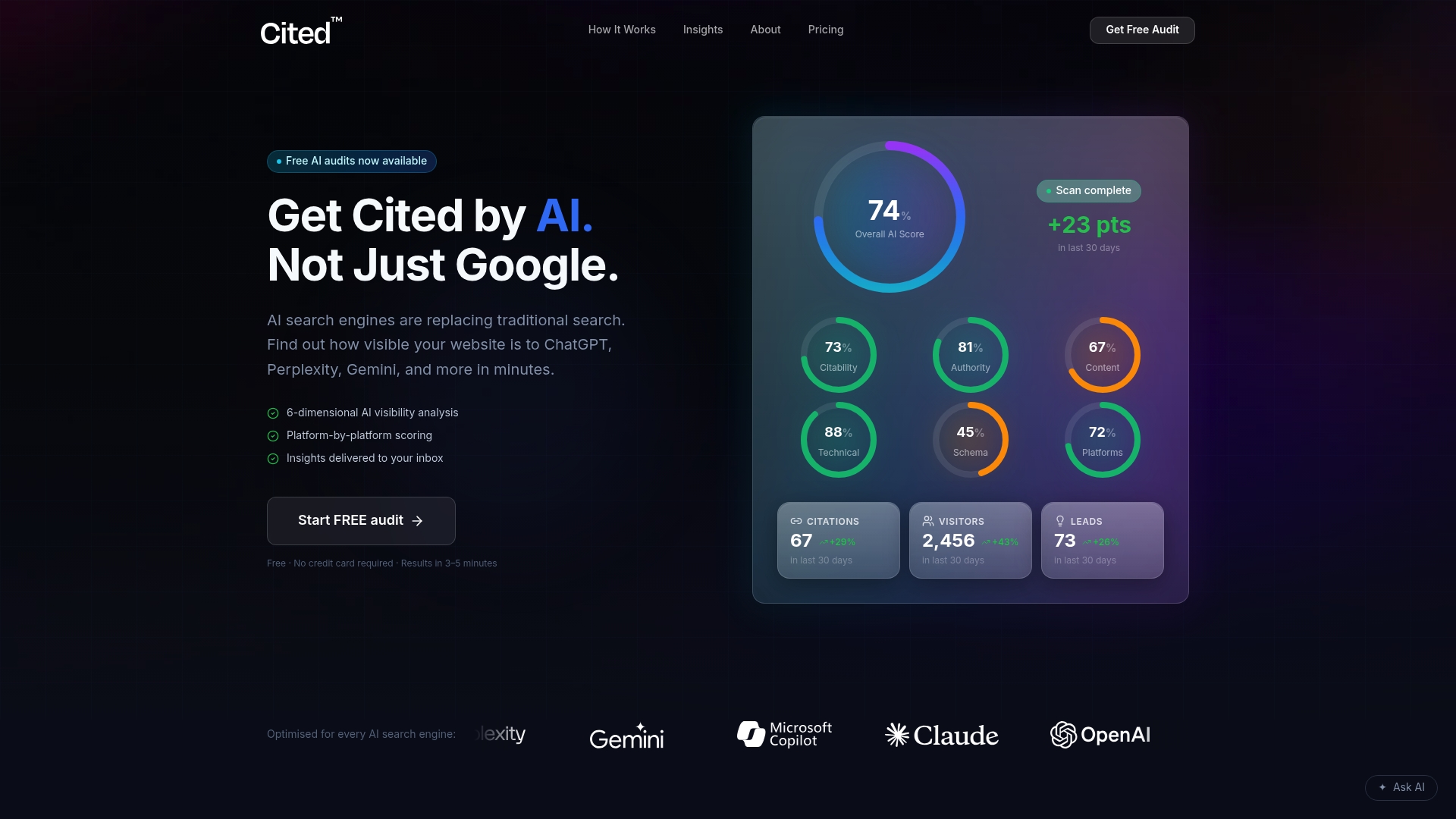
The free AI audit needs no credit card and no account, and it returns prioritised, implementable fixes rather than a data dump you have to interpret yourself. If your image markup needs work, Cited's Technical Fixes start from £495 one-off. For ongoing optimisation across schema, technical health and platform coverage, the AI Optimised plan runs from £995 per month, with custom Enterprise engagements available for larger catalogues. Run the audit at Cited and see exactly which of your images are citation-ready today.
Sources
Further reading: the Schema.org ImageObject reference, Search Engine Land's multimodal AI guide, and Cited's Open Graph for AI Insights piece.
- AI Image SEO: Why Schema.org Beats Alt Text for AI Citations | SEO Engico
- How ChatGPT, Claude & Perplexity read your website images
- Image SEO for multimodal AI | Search Engine Land
- Schema.org ImageObject definition
- Image optimisation for AEO — SearchForged
FAQ
What is the single most important field in ImageObject schema?
The creator field matters most for attribution, since it gives an AI system a direct entity to credit, but it only works alongside contentUrl and description filled in accurately.
Does alt text alone get images cited by AI?
Rarely. AI retrieval systems weigh alt text alongside captions and structured data, and schema-plus-caption combinations consistently outperform alt text used in isolation.
How long does it take to see AI image citations improve?
Schema and rendering fixes typically show movement within two to three weeks; original photography projects take longer because new assets need producing and indexing before they can be cited.
Can stock photography ever get cited by AI systems?
It's less likely, since a stock image indexed across many domains gives an AI system no clear single source to attribute, unlike a unique photograph tied to one URL's earliest index date.
What does Cited's free audit actually check?
Cited's free AI audit reviews image schema, alt text, captions, crawlability and four other dimensions of AI citability, returning prioritised fixes rather than raw data.
Recommended
Ready for your AI score?
See how visible your site is to ChatGPT, Perplexity & Gemini.
Start FREE auditResults in minutes · 100% free