
Open Graph tags act as machine-readable summaries that AI systems scan to decide whether to fully open and cite your page, and pages with properly aligned Open Graph tags, schema data, and visible content see around 23% higher AI citation rates. The five essential tags to optimize are og:title, og:description, og:type, og:url, and og:image—copy them directly from your page's H1 and meta description to ensure consistency, which AI systems treat as a trust signal. Use properly sized images at 1200x630 pixels over HTTPS and regularly test your metadata to keep everything aligned before publishing.
Gain 23% More AI Citations: Open Graph for AI for SEOs and Devs
Open Graph tags matter for AI visibility because they act as a compact, machine-readable summary that AI crawlers check before deciding whether a page is worth opening. The verdict is simple: if your og:title, og:description, og:url and og:image don't match your visible content and JSON-LD, fix that first. Everything else is secondary.
***
TL;DR: >- Matching Open Graph tags, schema data, and visible content is essential because mismatches reduce the likelihood of your page being opened and cited by AI systems.- The five key OG tags to optimize are og:title, og:description, og:type, og:url, and og:image, with their content best copied directly from your page's H1 and meta description for consistency.- Use high-quality, appropriately sized images at 1200x630 pixels served over HTTPS, with descriptive alt text to improve accessibility and AI parsing.- Regular testing—manually, automated in your build, and through quarterly audits—ensures OG tags and related metadata stay aligned and up to date.- For maximum AI visibility, ensure your OG tags are generated server-side in frameworks like Next.js or Astro, and confirm all technical and content elements match before publishing.
***
Table of Contents
- Why does Open Graph matter for AI search and citations?
- Which Open Graph tags matter for AI and how should you write them?
- What image specs and accessibility rules apply to OG images?
- Which tools validate Open Graph tags for AI readiness?
- How do you implement Open Graph across common tech stacks?
- What's the prepublish checklist for metadata alignment?
- How does Cited approach Open Graph for AI visibility?
- Get your free AI visibility audit
- Sources
- FAQ
Why does Open Graph matter for AI search and citations?
Open Graph matters because AI systems don't read every page in full. They fan out across thousands of candidates using metadata alone, then only open the pages that pass that first filter. ChatGPT's retrieval stack works this way, and the gap in outcomes is stark: pages that get opened are cited 74% of the time, versus roughly 7% for pages that are only retrieved as snippets. Open Graph tags are one of the clearest signals available at that fan-out stage.
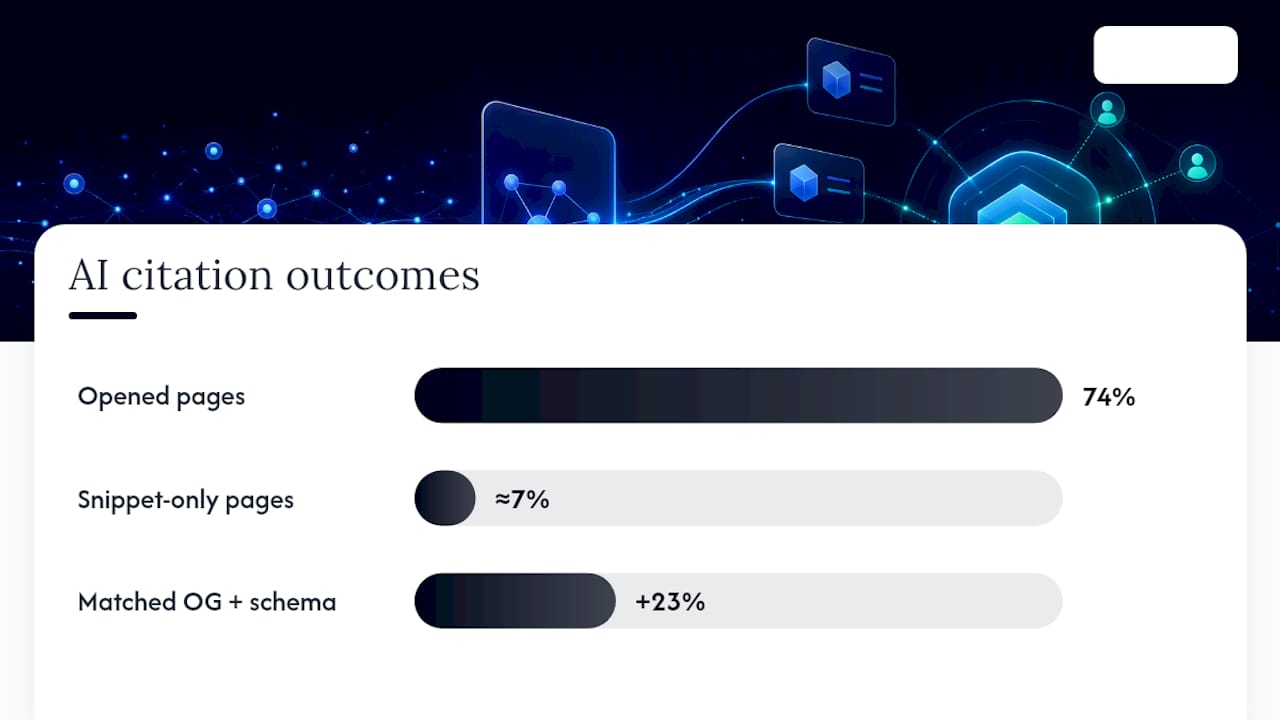
That's the mechanic behind why alignment pays off. Pages with fully matched OG and schema metadata show around a 23% higher AI citation rate than pages where the two contradict each other.
A few things follow from this:
- Metadata that fails the fan-out stage never reaches the expensive, higher-value stage where a page actually gets opened and read.
- OG tags work alongside JSON-LD schema, not instead of it. Neither substitutes for the other.
- Visible content still has to back up what the metadata claims. Mismatches get penalised, not ignored.
Which Open Graph tags matter for AI and how should you write them?
Five tags do almost all the work: og:title, og:description, og:type, og:url and og:image. Twitter's card equivalents (twitter:title, twitter:description, twitter:image) should mirror them exactly rather than introduce a second, slightly different version of your page.
Write each tag as if a machine, not a human scanning a social feed, is the primary reader:
og:title: state the actual subject in plain terms, under 60 characters where possible, so it isn't truncated in previews.og:description: one to two sentences, roughly 155 to 160 characters, summarising the specific answer or claim on the page.og:type: usearticlefor editorial content orwebsitefor general pages. Don't leave it as the default.og:url: the canonical address of the page. Never point it at a parameter-heavy or paginated variant.og:image: a real, hosted image URL served over HTTPS.
Pro Tip: Copy your og:title and og:description straight from your H1 and meta description rather than writing three slightly different versions. AI crawlers treat consistency as a trust signal, and inconsistency as a red flag.
Open Graph tags function as structured labels that AI systems parse during indexing and credibility checks, which is exactly why sloppy or duplicated values undercut a page that otherwise reads well.
What image specs and accessibility rules apply to OG images?
The standard OG image size is 1200×630 pixels, delivered as WebP or PNG over HTTPS, with a file size kept moderate so it loads fast during preview generation. That's the dimension most platforms and AI previews expect, and straying from it risks awkward cropping.
Design for a thumbnail, not a poster:
- Keep overlay text short, ideally under ten words, since anything longer becomes unreadable at small sizes.
- Use a safe crop zone: keep critical text and faces away from the outer 10% of the frame.
- Choose typography that survives compression and small display sizes, not thin decorative fonts.
- If you're generating the image with an AI tool, check the licence terms on the output before publishing and confirm the model isn't trained on restricted assets.
Always write descriptive alt text for the image itself, separate from the og:description. It serves a different audience and a different purpose: accessibility tools and, increasingly, AI systems parsing image context alongside the page.
Which tools validate Open Graph tags for AI readiness?
Testing your tags before publishing catches the errors that cost citations. A practical workflow runs through three stages:
- Preview and test manually. Tools such as Opengraph render how your tags will appear across platforms and flag missing or malformed properties, including image issues that break previews entirely.
- Automate the check in your build pipeline. Add an OG and schema validation step to continuous integration so a missing
og:imageor mismatchedog:urlfails the build rather than reaching production. - Monitor freshness after launch. Metadata drifts when content teams update a headline but forget the corresponding tag. Schedule a quarterly audit, and check your robots.txt at the same time to confirm you're explicitly allowing AI search crawlers such as OAI-SearchBot and PerplexityBot, while deciding separately whether to block training-only scrapers.
Cited's own technical SEO guidance for AI citation covers how these retrieval mechanics interact with page structure in more depth, if you want the fuller picture of how openings translate into citations.
How do you implement Open Graph across common tech stacks?
Server-side rendering is the rule that matters most: crawlers need to see complete OG tags in the initial HTML response, before any client-side JavaScript hydration runs, which ties closely to effective Website build, AI training, SEO & UK hosting — BasicBS. A tag injected after hydration may never be seen by a crawler that doesn't execute scripts.
- Next.js: use the built-in Metadata API to generate OG tags at the page or layout level, which outputs them server-side by default and keeps them in sync with your page title and description in one place.
- Astro: because pages are static or server-rendered by default, OG tags declared in the
<head>component render before any hydration, making it one of the more reliable stacks for this out of the box. - Traditional server-rendered apps: generate OG values from the same data source as your visible H1 and meta description, rather than maintaining them as separate hardcoded strings that drift apart over time.
Dynamic pages need particular care. Your og:url should always match the canonical URL, never a session-specific or tracking-parameter variant. For paginated content, point og:url at the canonical version of that specific page rather than page one of the series, and generate a distinct og:title and og:description for each page rather than reusing identical text across the sequence.
What's the prepublish checklist for metadata alignment?
Run this order before anything goes live, because fixing tags in this sequence catches the highest-impact errors first:
- Confirm
og:titleandog:descriptionmatch your H1 and meta description exactly, or as closely as length limits allow. - Confirm your JSON-LD headline mirrors the same title, since schema without matching visible content yields little benefit for direct LLM crawlers.
- Verify
og:imageis live over HTTPS, sized 1200×630, and loads without a redirect chain. - Check
og:urlequals your canonical tag exactly. - Confirm robots.txt allows the AI crawlers you want indexing you.
- Run a live URL inspection to confirm what's actually served differs from nothing you intended.
Check | Tool or method | Priority |
|---|---|---|
OG and H1 match | Manual review or CI script | High |
Schema headline matches visible content | JSON-LD validator | High |
Image loads over HTTPS at 1200×630 | OG preview tester | High |
Canonical equals og:url | Live URL inspection | Medium |
Robots.txt allows AI crawlers | Manual robots.txt check | Medium |
A short, ordered checklist like this closes the gap between what an audit finds and what engineering actually ships, since ambiguity between content and technical teams is usually where fixes stall, not lack of will.
How does Cited approach Open Graph for AI visibility?
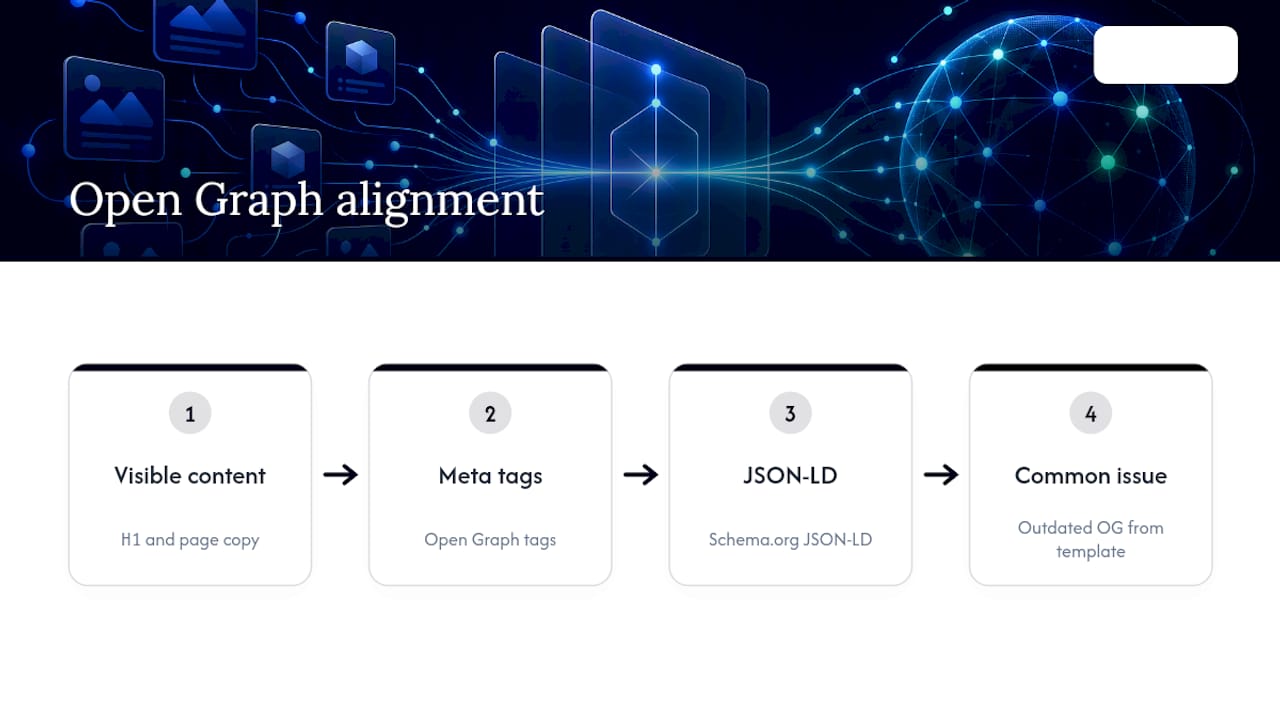
AI visibility audits treat Open Graph as one piece of a wider alignment check across visible content, meta tags and JSON-LD, because a mismatch in any one of those undermines the other two. A recurring finding is a page with a strong H1 and solid schema, but an og:description copied from a template months earlier and never updated. The fix is mechanical, but it is rarely made until someone checks for it.
Readers who want the fuller audit framework behind this can find it in Cited's methodology, alongside further findings in the Insights section on technical AI visibility.
— Tom Heaton
Get your free AI visibility audit
Fixing Open Graph tags yourself is entirely possible with the checklist above, but knowing which of your pages actually fail these checks, and in what order to fix them, is a different problem. A free audit can score your site across six dimensions of AI citability, including exactly the metadata and schema alignment covered in this article, so you know precisely where the gaps sit before spending engineering time.
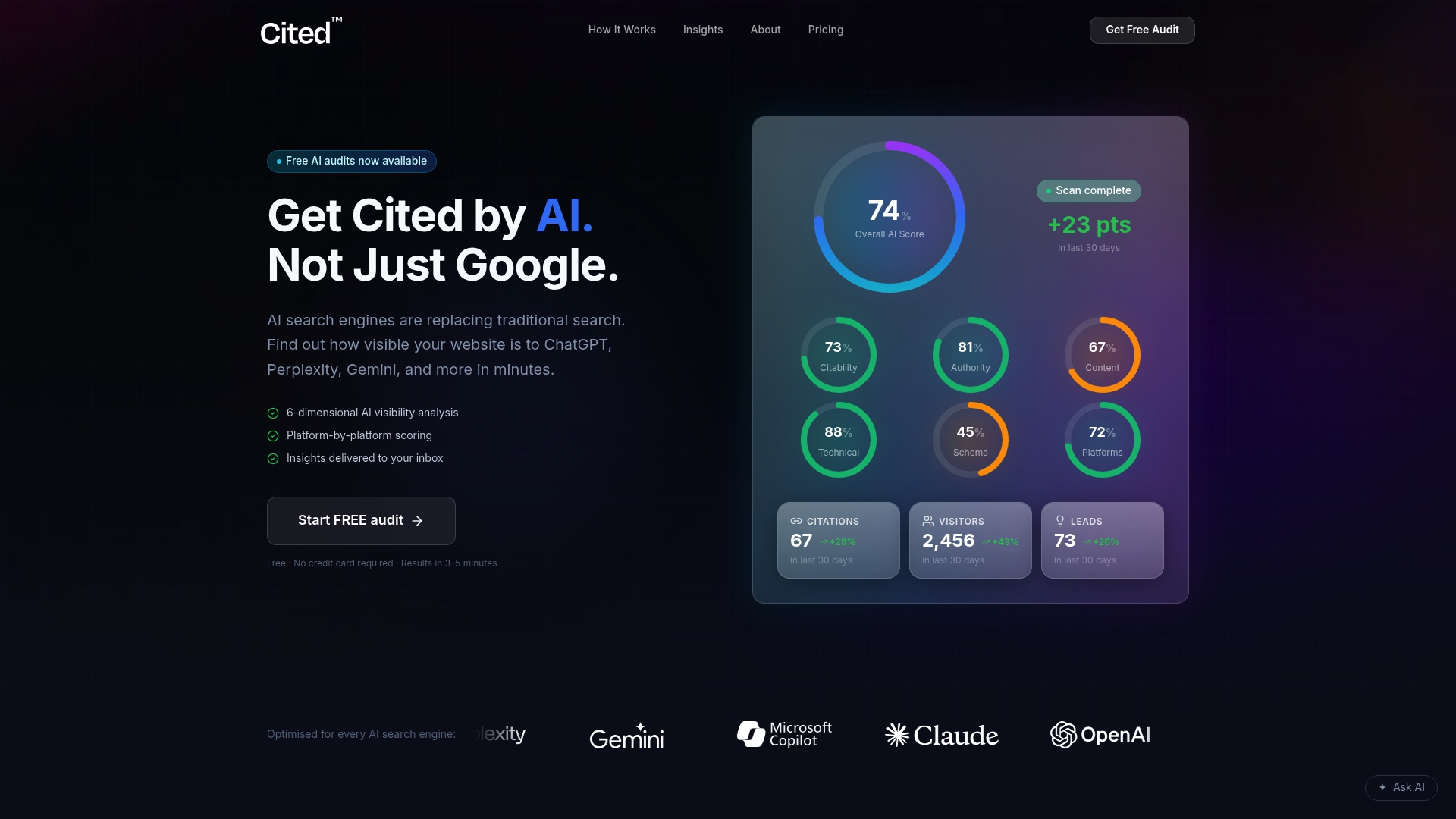
Start with the Cited, which flags OG, schema and technical health issues without any commitment. From there, the path depends on scale: one-off Technical Fixes at £495 suit a site with a handful of alignment problems, while the AI Optimised subscription at £995 a month suits publishers who need ongoing monitoring as pages and templates change. Larger organisations with complex stacks can book a call to discuss an Enterprise engagement scoped to their setup.
Sources
- What ChatGPT pulls, what it shows, what it cites — Search Engine Land
- Open Graph tags for AEO: The metadata layer AI crawlers see first — SearchForged
- Meta Tags for AI Search Engines: Optimizing for ChatGPT, Perplexity & Apple Intelligence — Open Graph Generator Blog
- Ziptie
FAQ
Is Open Graph free?
Yes. Open Graph is an open protocol with no licence fee. You simply add the meta tags to your page's HTML, and any tools you use to generate or test images (such as Opengraph) typically offer free tiers for basic checks.
Can you give an example of an Open Graph tag?
A basic example is <meta property="og:title" content="Your Page Title Here" />, paired with og:description, og:url, og:type and og:image tags in the same <head> section, all describing the same page consistently.
What does OG mean in SEO?
OG stands for Open Graph, a metadata protocol that describes how a page should appear when shared or indexed. In SEO and AI visibility work, aligned OG tags help both search engines and AI crawlers understand and correctly summarise a page.
What are OG images?
An OG image is the picture defined by the og:image tag that appears when a page is shared or previewed. The standard recommended size is 1200×630 pixels, served over HTTPS in WebP or PNG format.
Does Open Graph alignment actually affect whether AI systems cite my site?
Yes. Pages with OG tags, schema and visible content that all agree see roughly a 23% higher AI citation rate than pages with mismatches between these layers.
Recommended
Ready for your AI score?
See how visible your site is to ChatGPT, Perplexity & Gemini.
Start FREE auditResults in minutes · 100% free