
AI Overviews pull information from multiple sources to create a synthesized answer, while featured snippets extract a single passage from one page—and they require completely different optimization strategies. If you're chasing AI citations across Google and other platforms, focus on building authority and publishing original data rather than reformatting content. If you want a quick win in search results, structure your page to match the specific format the query expects, whether that's a list, table, or paragraph.
When AI Overviews Cut CTR to 8%: Overviews vs Snippets for SEOs
AI Overviews synthesise answers from multiple sources using retrieval-augmented generation, and link out inline as they go. Featured snippets extract one paragraph, list, or table from a single ranking page. If your goal is broad AI citation across ChatGPT, Perplexity, and Google's own AI Mode, build authority and original data. If your goal is a fast SERP win, structure a page to match a specific query format.
***
TL;DR: >- AI Overviews cite multiple sources based on their credibility, with moderate authority pages being more likely to be included than highly authoritative or low-quality ones.- The appearance of an AI Overview depends on query type, with informational and exploratory questions being more prone to trigger them, while navigational or transactional queries usually do not.- Optimizing for featured snippets focuses on formatting and immediate answer placement, while content aimed at gaining AI citations should emphasize originality, primary data, and clear source provenance.- Content restructures aimed at winning in AI Overviews are often ineffective, as the key signals for citation include source trustworthiness and original reporting rather than formatting alone.- Monitoring impact requires analyzing SERP feature impressions and click data, as AI Overviews significantly reduce organic click-through rates on affected queries.
***
Table of Contents
- AI overviews vs snippets: how each one actually works
- How does Google decide what to generate or extract?
- What do users actually see and click?
- What does the data say about frequency and clicks?
- How do you structure content to win featured snippets?
- How do you earn citations inside AI Overviews?
- Can you control whether your page appears in either feature?
- How do you measure the real impact on your traffic?
- Why do AI Overviews and snippets sometimes contradict each other?
- Where should you start fixing this on your own site?
- Stop writing definitions, start publishing evidence
- Get a free AI visibility audit before you rebuild anything
- Sources
- FAQ
AI overviews vs snippets: how each one actually works
An AI Overview is a generated summary that sits above the traditional blue links, built by pulling information from several web pages and blending it into a single, conversational answer. Google has confirmed these use retrieval-augmented generation with Gemini models, meaning the system retrieves relevant documents first, then generates prose that cites several of them inline. There's no single "correct" page behind an Overview. It's a composite, stitched together from whichever sources the model judges most useful for that specific query at that specific moment.
A featured snippet works differently. It's an extract, not a synthesis, pulled word-for-word (or close to it) from one page and displayed in a box above position one. Google's own documentation confirms featured snippets are extracts from individual pages, formatted as a paragraph, a numbered list, a bulleted list, or a table depending on what the query implies. Ask "how many teaspoons in a tablespoon" and you'll likely get a single-sentence paragraph snippet. Ask "how to change a bike tyre" and you'll probably get a numbered list.
The practical difference for your content strategy comes down to this:
- AI Overviews reward breadth and credibility. The model needs to trust your page enough to cite it alongside two, five, or eight others.
- Featured snippets reward precision and format matching. One page, one exact answer, one correctly structured HTML element.
- Overviews cite multiple domains per query; snippets crown a single winner. You're not competing for one slot, you're competing to be one of several.
- Overviews update dynamically per query phrasing; snippets are comparatively stable once a page earns the spot.
Confusing the two leads to wasted effort. Teams that spend weeks reformatting a page into a perfect table, hoping to land in an AI Overview, are optimising for the wrong mechanism entirely.
How does Google decide what to generate or extract?
Google generates AI Overviews by retrieving a pool of candidate pages, then asking a model to synthesise an answer from the strongest ones. Featured snippets, by contrast, come from a more conventional ranking process: Google's algorithm identifies which single page already answers the query cleanly and lifts the relevant passage.
Academic research on deployment patterns backs this up. A University of Bonn working paper on AI Overview deployment found that AIOs appear far more often on informational, exploratory queries than on navigational or high-conversion ones, and that the relationship with source quality follows an inverted U-shape: pages that are moderately authoritative get cited more than either very low-authority or oddly over-optimised ones.
Featured snippets depend far more heavily on structure. If a query implies a list, Google needs to find an <ol> or <ul> element with the right heading context sitting nearby. If it implies a definition, a short paragraph following an <h2> or <h3> that mirrors the question phrasing tends to win.
For AI citation specifically, a handful of signals matter more than most SEOs assume:
- Originality. Synthesised content copying someone else's angle rarely gets cited; primary data or first-hand reporting does.
- Source lists and clear provenance. Pages that cite their own sources transparently are easier for a model to trust and re-cite.
- Off-site citations. Being referenced by other authoritative sites feeds into how models weigh your credibility.
- Indexing health. A page that's slow to crawl, blocked, or inconsistently indexed simply won't be in the retrieval pool to begin with.
Pro Tip: Run a quick audit of your top 20 commercial queries and check whether Google already shows a "highly cited" or preferred-source marker on any result. If it does, that's a strong signal an AI Overview is likely for that query cluster, and format alone won't win you a citation there.
What do users actually see and click?
AI Overviews sit in a shaded box near the top of the page, with numbered inline citations that expand into a source carousel when clicked. Featured snippets sit in a plain white box, usually with a single source link and thumbnail beneath the extracted text. The visual weight is different too: Overviews often push organic results and even snippets further down the page, while a snippet simply occupies position zero above an otherwise normal set of blue links.
User behaviour diverges sharply between the two. When an AI Overview appears, most users read the synthesised answer and never click through at all. When a traditional snippet appears, users are more likely to click if the snippet only partially answers their question, since it acts as a preview rather than a complete answer.
- Overviews often satisfy the query fully within the SERP itself, reducing the incentive to click further.
- Snippets can still drive curiosity clicks, particularly for "how to" and comparison queries where the full answer needs more context.
- Both features compress the space available for standard organic listings, pushing position one further down the page.
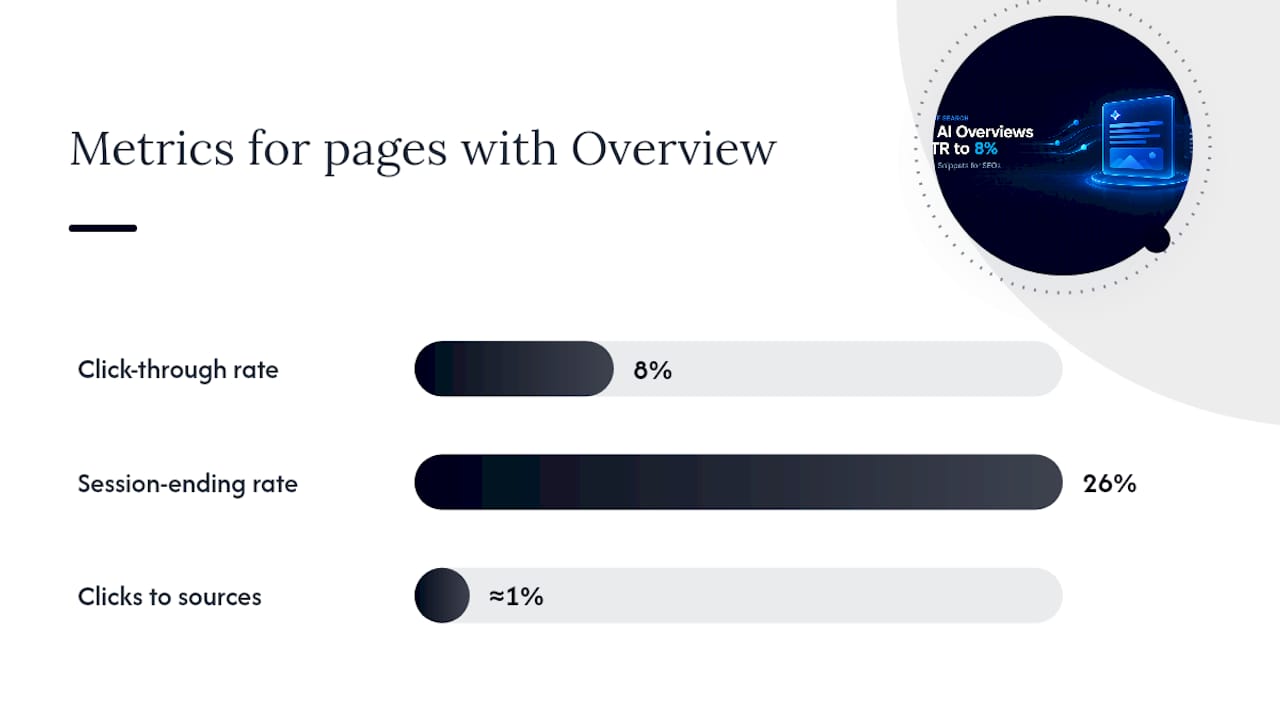
The scale of the click impact is stark. One panel study found that only around 1% of users click through to a source cited inside an AI Overview, and that pages appearing alongside an Overview saw click-through rates of 8% compared with 15% for pages without one, alongside session-ending rates of 26% versus 16%. That's not a marginal dip. It's close to half the click-through you'd expect on an equivalent query without an Overview present.
What does the data say about frequency and clicks?
AI Overviews appear more often on exploratory, informational queries and get suppressed on navigational or transactional ones where organic results already convert well. That pattern matters more for traffic forecasting than any single click-through number, because it tells you which parts of your content calendar are exposed to Overview-driven click suppression and which aren't.
The same panel research cited above gives the clearest empirical picture available of what happens once an Overview appears on a results page.
Metric | Pages with an AI Overview | Pages without an AI Overview |
|---|---|---|
Click-through rate | 8% | 15% |
Session-ending rate | 26% | 16% |
Click rate to cited sources | Around 1% | Not applicable |
Source: Investigating click behaviors on Google search result pages that produce an AI Overview
Read those figures against query type and the business interpretation becomes clearer. If your content sits mostly in the exploratory, top-of-funnel space, expect Overviews to appear frequently and expect click-through to soften regardless of your ranking position. If your content answers navigational or purchase-intent queries, an Overview is less likely to appear at all, and your traffic forecasts should weight organic ranking and snippet capture more heavily than AI citation.
The forecasting implication is simple but easy to miss: a keyword that historically drove strong click-through can quietly lose a third or more of its traffic the moment Google starts showing an Overview for it, even if your ranking position hasn't moved. Traffic models built purely on historical CTR curves will overstate expected sessions unless you segment by AIO exposure.
How do you structure content to win featured snippets?
You win a featured snippet by matching the exact format Google expects for a given query, and by making the answer extractable within the first few sentences of a section. This is largely a mechanical, testable process rather than a matter of authority or trust.
- Identify the query's implied format first. "What is" queries usually want a 40 to 60-word paragraph; "how to" queries want a numbered list; comparison queries want a table.
- Write the direct answer immediately under a heading phrased close to the query itself, before adding supporting detail.
- Use the matching HTML element, not just formatting that looks similar visually. A snippet-eligible list needs to be an actual
<ol>or<ul>, not a paragraph with line breaks. - Add anchorable subheadings and jump links so that if the snippet does trigger, the click lands the user exactly on the relevant excerpt rather than the top of a long page.
- Sample a set of target queries monthly and track whether you hold the snippet, using a SERP monitoring tool alongside Search Console's performance filters for "position 0" style behaviour.
- Check snippet impressions against clicks, since a snippet with high impressions but low clicks may mean users are satisfied without visiting, similar to the AI Overview pattern.
Google's own guidance confirms that featured snippets are extracted from individual pages, which means there's no synthesis step to influence, only structure and clarity. That's what makes snippet optimisation testable in a way AI Overview citation currently isn't: change the format, wait for a recrawl, check the result.
Pro Tip: Keep a spreadsheet of your top 30 snippet-eligible queries with a "format required" column. Most teams lose snippets not because a competitor wrote better content, but because they quietly restructured a page and broke the exact HTML element Google was extracting from.
How do you earn citations inside AI Overviews?
You earn AI Overview citations by publishing something genuinely original that a model can't get anywhere else, then making that content easy to discover and trust. Structure alone won't do it. Google needs a reason to pick your page out of a retrieval pool over ten others saying roughly the same thing.
- Publish primary data or first-hand reporting. A model synthesising an answer needs a distinct fact, figure, or angle to pull from; generic restatements of existing consensus rarely get selected.
- Build a clear source-list page that shows your own citations and provenance transparently, which makes it easier for a retrieval system to verify your claims. Cited's guidance on building AI citation ready source-list pages covers the structural elements this needs.
- Create a durable, canonical page for original coverage rather than splitting the same story across multiple near-duplicate posts.
- Encourage third-party citation. Being referenced by other credible sites feeds into the authority signals models weigh when choosing what to synthesise from.
- Confirm technical discoverability. A page needs to be indexed cleanly, ideally reachable through an RSS feed for freshness signals, and linked internally in a way that reinforces its topic relevance, something covered in more depth in Cited's piece on SEO friendly links and citation likelihood.
Pro Tip: If two of your pages cover the same topic from slightly different angles, merge them. Split coverage dilutes the single strongest canonical page a retrieval system might otherwise cite.
Can you control whether your page appears in either feature?
You can suppress both features on your own pages, but you cannot opt in to either one. Google confirms there is no markup that guarantees inclusion in AI Overviews; technical readiness and content quality are the only real levers available.
What you can control is exposure:
nosnippetstops both featured snippets and AI Overview text extracts from your page entirely, at the cost of losing any visibility in either feature.max-snippetlets you cap the length of any extract Google shows, useful if you want partial visibility without giving away your full answer.- Structured data (schema) helps Google understand your content faster, which supports discovery, but no schema type guarantees an AI Overview citation.
- Robots.txt policies control whether crawlers can access your content at all, which matters more than most teams assume when troubleshooting sudden citation drops. Cited's guide on robots.txt policies for AI crawlers walks through safe configurations.
Test any of these changes on a staging environment first, and monitor Search Console for indexing errors before rolling a nosnippet or max-snippet directive out site-wide. Rollback plans matter here: these directives take effect fast, but recovery after a mistaken block can take weeks to fully reindex.
How do you measure the real impact on your traffic?
You measure impact by combining SERP feature tracking with your own analytics, not by watching rankings alone. Rankings tell you almost nothing about whether an Overview or snippet is quietly eating your click-through rate.
- Track SERP feature impressions for your priority queries using a rank tracker that flags AI Overview and snippet presence separately, not just position.
- Cross-reference Search Console's click and impression data against those flagged queries to see whether CTR is dropping specifically where an Overview now appears.
- Watch session depth and assisted conversions in Analytics, since a query that loses direct clicks may still contribute to brand recall and later direct visits.
- Run query-sampling A/B checks by comparing CTR trends on similar queries where one shows an Overview and a near-identical one doesn't, isolating the feature's effect from seasonal noise.
Cited's own framework for combining these signals is covered in more detail in its guide on measuring AI search visibility, which pairs Search Console data with citation-frequency tracking across AI platforms.
Why do AI Overviews and snippets sometimes contradict each other?
Contradictions happen because the two features often draw from different source sets, and one may be running on slightly staler data than the other. An Overview might synthesise from five pages while a snippet extracts from a sixth, entirely different page, and if one of those sources has since been corrected or updated, the mismatch becomes visible to users.
When you spot a contradiction involving your own content, triage fast:
- Check the AI Overview's cited source list first to see which pages it drew from and whether any are outdated.
- Update your original page directly rather than publishing a correction elsewhere, since freshness and provenance both feed back into future retrieval.
- Decide whether the gap needs a correction, an expanded resource, or a new primary-data piece covering the specific point that's causing disagreement.
Acting quickly matters here more than in traditional SEO, because Overviews can regenerate for a query within days of new content becoming available.
Where should you start fixing this on your own site?
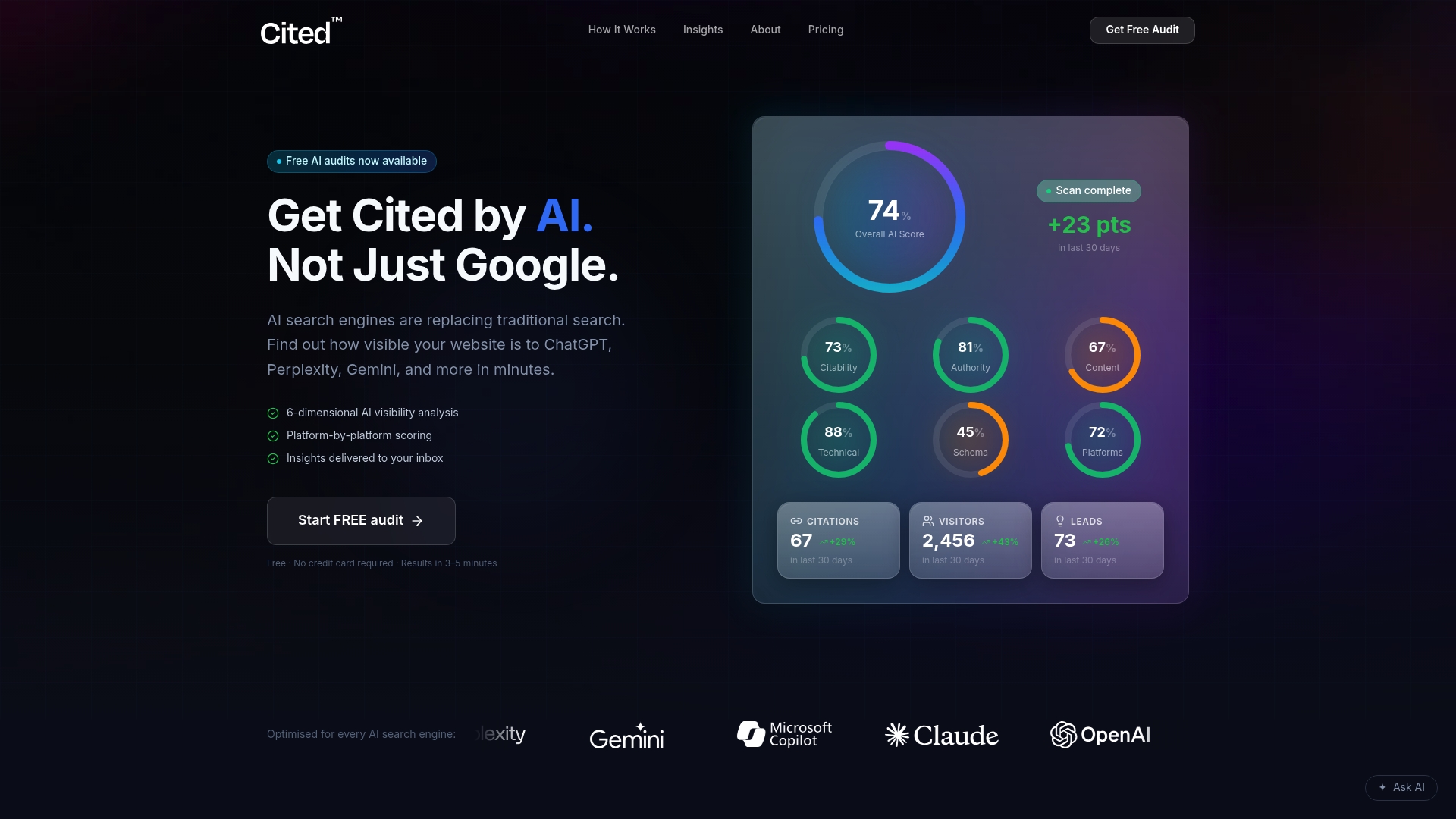
Cited's free AI audit checks six dimensions of AI citability: technical health, schema markup, authority signals, source provenance, platform coverage, and indexing readiness. Typical quick fixes include schema corrections, source-list pages, RSS feeds, and robots policy cleanup. After fixes, track citation frequency across ChatGPT, Perplexity, Gemini, Claude, and Copilot rather than rankings alone.
Stop writing definitions, start publishing evidence
Most sites still chase snippets with reformatted definition pages, a tactic that's increasingly wasted effort for AI Overview visibility. Prioritise queries by business impact first, then check whether they historically show Overviews or snippets before deciding which mechanism to chase.
— Tom Heaton
Get a free AI visibility audit before you rebuild anything
Our service offers a free audit reviewed by a human technician, not just an automated score, to identify fixes that might improve your AI citation rate. Rather than a generic SEO report, The audit checks several dimensions and provides a prioritised list of factors potentially blocking citation, such as missing source-list pages, robots misconfigurations, or thin schema coverage.
If the audit turns up structural issues, Technical Fixes start from £495 as a one-off project. If you want ongoing implementation and monthly monitoring as Google's Overview behaviour continues to shift, the AI Optimised plan runs from £995 per month, with custom Enterprise scopes available for larger sites. For teams that need development capacity alongside the audit findings, Setworks builds and implements the technical changes an audit recommends.
Start with the Cited and see exactly where your site stands before spending a penny on fixes.
Sources
- Featured snippets | Google Search Central
- Investigating click behaviors on Google search result pages that produce an AI Overview
- AI Mode in Google Search and AI Overviews get Gemini upgrades
FAQ
Should you trust AI Overviews?
Treat AI Overviews as a useful starting summary rather than a final answer, since they synthesise from multiple sources and can inherit errors or outdated facts from any one of them. Checking the cited sources directly, especially for anything factual or time-sensitive, remains the safer habit.
What's more accurate, AI Mode or an AI Overview?
Neither is inherently more accurate; both draw on the same underlying retrieval-augmented approach and Gemini models. AI Mode tends to allow more conversational follow-up, which can surface corrections or additional context an initial Overview doesn't show.
Why did I stop getting AI Overviews for a query I used to see them on?
Google adjusts Overview deployment based on query intent and how well existing organic results already satisfy searchers, so a query can lose its Overview if organic results improve or if source quality in the retrieval pool changes. There's no setting you can toggle to force an Overview back on, since there's no opt-in markup for AI Overviews.
Are Google's AI Overviews accurate?
Accuracy varies by query and source quality, since Overviews are only as reliable as the pages they synthesise from. Google has stated its intent is to help users explore the web further, not replace it, which is why inline citations exist for verification rather than blind trust.
How much does an AI visibility audit from Cited cost?
Cited's initial AI audit is free, with no card or account required. If the audit identifies structural problems, one-off Technical Fixes start from £495, and the ongoing AI Optimised plan starts from £995 per month, with Enterprise pricing available on request.
Recommended
Ready for your AI score?
See how visible your site is to ChatGPT, Perplexity & Gemini.
Start FREE auditResults in minutes · 100% free