

Building topical authority for AI citations requires three key steps: create a coherent topic cluster with a strong pillar page and supporting pages using consistent terminology, earn third-party citations from reputable sources to boost credibility, and fix technical SEO issues like crawlability and schema markup so AI engines can actually cite your content. You can see meaningful results in 2–3 weeks by prioritizing these fundamentals before expanding your content volume.
Win AI Citations in 2–3 Weeks: Audit to Action for Topical Authority

Topical authority for AI means a search or generative engine recognises a site as the most reliable, well-corroborated source on a defined subject, and cites it accordingly. The single highest-impact first action is to map a coherent topic cluster around one pillar subject, then prioritise earning at least one high-quality third-party citation for that pillar. The rest of this article sets out the mechanisms, the technical checklist, and the measurement approach that make this work in practice.
***
TL;DR: >- Building a strong topic cluster with a well-structured pillar page and supporting pages that use consistent terminology increases the likelihood of being cited by AI engines.- Earning third-party citations, especially from reputable sources in the target language and region, significantly boosts AI discoverability and conversion rates.- Technical SEO fixes such as improving crawlability, canonical clarity, schema markup, and machine-readable fact blocks are essential for content to be cit-able by AI systems.- Measuring citation share and citation-to-conversion rates provides the most meaningful indicators of top-tier AI visibility and ongoing topical authority growth.- Prioritizing technical fixes and outreach to authoritative sources before expanding content volume enhances the efficiency and sustainability of establishing topical authority.
***
Table of Contents
- What topical authority means, and how it differs from domain authority
- Why topical authority matters for AI discovery and conversions
- How AI and generative engines judge topical authority
- Practical steps to build topical authority for AI
- Technical checklist that improves AI citability
- How to measure topical authority and AI visibility
- A tested workflow to win AI citations
- Challenges and common pitfalls in building AI topical authority
- Where topical authority fits in a 2026 content strategy
- Start with a free AI visibility audit
- FAQ
- Sources
What topical authority means, and how it differs from domain authority
Topical authority describes how completely and credibly a site covers a defined subject, not how powerful its overall domain profile looks. Domain authority and DR-style metrics measure aggregate backlink strength across an entire site, regardless of subject. A site can carry a high domain score while having thin, scattered coverage of any single topic, and generative engines increasingly see through that gap.
Topical authority shows up differently. It appears as breadth (how many relevant subtopics a site covers), depth (how thoroughly each one is treated) and corroboration (whether independent, credible sources reference or validate the content). A valid structure usually looks like a pillar page covering the core subject, supported by a cluster of pages addressing specific questions, use cases and edge cases within it.
What signals this structure to an engine:
- A pillar page answers the core question directly and links to supporting pages covering subtopics in depth.
- Supporting pages use consistent terminology and entity names, so the cluster reads as one coherent body of work rather than disconnected articles.
- Independent sites, publications or institutions reference or quote the content, giving it corroboration a domain-wide metric cannot capture.
A strong cluster with weak corroboration still underperforms. Both halves need to be built together.
Why topical authority matters for AI discovery and conversions
Being citable now changes how discovery converts into revenue. Generative engines favour earned citations over brand-owned claims, which raises the commercial stakes of being referenced rather than merely ranked. Case studies on sites cited within AI overviews showed improved conversion rates and different click behaviour compared with uncited peers, according to Search Engine Land's analysis of 2026 content strategy.
Users who arrive from an AI citation often convert at higher rates, because the engine's citation has already done part of the persuasion work before the click happens, as Search Engine Land reports. A reader who sees your site named as the source behind an AI-generated answer arrives pre-sold on your credibility, which shortens the path from discovery to action.
None of this replaces the fundamentals. Fast, accessible, well-structured sites still perform better in every search environment, AI-driven or otherwise. Topical authority adds a layer on top of technical SEO rather than substituting for it: an engine cannot cite a page it cannot crawl, parse or trust, however deep the subject coverage.
How AI and generative engines judge topical authority
AI search systems favour earned media and third-party authoritative sources over brand-owned content, a bias confirmed by comparative experiments across verticals in research on generative engine optimisation. This matters because it changes where effort should go: a well-written owned page without external corroboration competes poorly against a thinner page that independent sources vouch for.
Engines also differ from one another in what they reward, and plurality matters. A claim phrased one way might get picked up by one engine and ignored by another, so engines are sensitive to exact phrasing, structure and source verifiability rather than treating all well-written content equally.
Practical signals that determine citability:
- Machine-scannable structure: clear headings, direct answers near the top, and facts stated plainly rather than buried in narrative.
- Verifiable sourcing: claims tied to named, checkable sources rather than vague attribution.
- Local-language and regional corroboration: engines prize third-party validation in the language and market you target, so generative engine optimisation research recommends engaging publishers and institutional sites per region rather than relying on a single global source base.
Practical steps to build topical authority for AI
Building a citable cluster is a sequence, not a single project. The order below reflects what tends to compound fastest, starting with structure and ending with earned coverage.
- Choose one pillar subject that reflects a genuine area of depth, not a keyword with volume, and define the five to ten supporting questions a reader would ask around it.
- Draft a cluster map before writing anything, showing the pillar page, each supporting page, and how they interlink in a hub-and-spoke pattern rather than a flat list.
- Write for entities and facts, naming specific tools, standards, figures and organisations rather than generic descriptions, and vary phrasing across pages so the cluster does not read as templated repetition.
- Build internal links from supporting pages back to the pillar, and from the pillar out to each supporting page, so engines can trace the cluster's full extent from any entry point.
- Brief writers with a citation-ready sourcing standard: every factual claim needs a checkable source attached before publication, not added afterwards.
- Route drafts through human review that checks sourcing accuracy, entity consistency and whether claims are stated in a way an engine could quote directly.
- Prioritise low-friction wins first, such as fixing internal linking and adding missing supporting pages, before committing resources to outreach.
- Identify three to five realistic earned-media targets, such as trade publications, academic pages or industry bodies that plausibly cover your subject.
- Pitch for expert quotes, reviews or institutional mentions rather than generic guest posts, since generative engine optimisation research shows engines weight third-party corroboration far above brand-owned claims.
- Track which outreach targets convert into actual citations, not just backlinks, and double down on the publication types that do.
Pro Tip: Brief every writer with the exact entity names and terminology used elsewhere in the cluster, so an engine reads the set as one consistent source rather than several competing ones.
Low-friction technical and structural fixes should come before expensive earned-media campaigns. A cluster with broken internal links or inconsistent terminology will undercut even the best outreach result, because the engine has no coherent structure to attach the new citation to.
Technical checklist that improves AI citability
Content cannot be cited if an engine cannot reliably crawl, render and parse it. A technical foundation sits underneath every topical authority effort, and it is usually the fastest layer to fix.
- Crawlability and canonical clarity: confirm every pillar and supporting page resolves to one canonical URL, with no conflicting signals from pagination, parameters or duplicate content.
- Consistent rendering: verify that JavaScript-rendered content appears in the raw HTML an engine's crawler actually receives, not only in the browser-rendered version a human sees.
- Schema markup for claims and authorship: structured data that marks up facts, author identity and organisation details gives engines a machine-readable shortcut to the information they need to justify a citation, a point reinforced in TDMP's coverage of Google's AI Mode, which highlights structured, factual content as central to how AI Mode selects answers.
- Hub-style URL structure: a logical URL hierarchy that mirrors the cluster map makes topical depth visible to a crawler scanning site architecture.
- Accessible endpoints: pages should return clean 200 responses with no redirect chains, broken links or blocked resources that interrupt a crawl.
- Machine-readable fact blocks: short, clearly stated facts near the top of a page give an engine an easy extraction point, rather than forcing it to infer a claim from surrounding narrative.
Our guide to technical SEO for AI covers the implementation detail behind each of these fixes.
How to measure topical authority and AI visibility
Citation share, not raw traffic volume, is the metric that matters here. Recommendations from the University of Exeter's web team stress defensible KPIs and traffic quality over inflated visibility numbers that cannot be verified or reported to stakeholders with confidence.
A practical reporting stack pairs an AI visibility dashboard tracking citation frequency across engines with existing tools like Google Search Console and server log analysis to confirm crawler access.
Metric | What it shows | Where to source it |
|---|---|---|
Citation share | How often your pages are cited versus competitors on tracked queries | AI visibility dashboard |
Citation-to-conversion rate | Whether cited visits convert better than standard organic traffic | Analytics platform, segmented by referral source |
Crawl frequency and success | Whether AI crawlers can reliably access and render pages | Server logs |
Rendering and schema fixes shipped | Short-term technical wins that precede citation gains | Internal audit tracker |
Report both layers to stakeholders: short-term technical wins that move quickly, and structural gains such as cluster completeness and earned citations that build over months. Our guide to measuring AI search visibility sets out how to build this dashboard from scratch.
A tested workflow to win AI citations
We built our audit-to-fix workflow around the gap most sites have: strong content that engines still cannot parse or justify citing. The sequence runs in four stages.
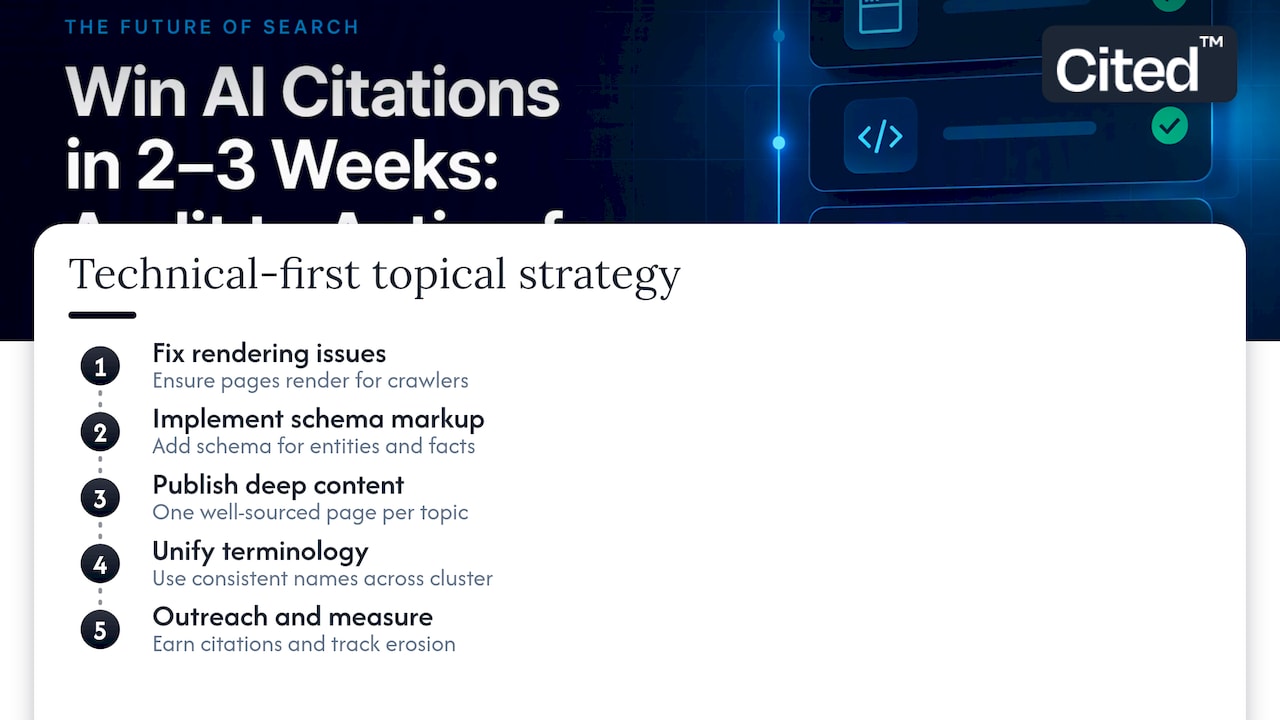
- Audit: our free GEO audit identifies rendering failures, missing schema and canonicalisation conflicts that block citation, scoring the site across the technical dimensions an engine checks before it trusts a source.
- Fix: we prioritise the technical fixes with the fastest payoff, rendering repairs, schema implementation and canonical cleanup, then verify content claims against checkable sources.
- Earn: we run outreach aimed at publisher engagement and institutional mentions, the third-party corroboration that generative engines weight most heavily.
- Measure: rendering and schema fixes typically produce citation gains within two to three weeks of implementation, giving an early, verifiable signal before longer outreach campaigns mature.
This order matters because outreach wins mean little if the underlying page still fails to render for a crawler.
Challenges and common pitfalls in building AI topical authority
The most common failure is treating topical authority as a content volume exercise. Publishing twenty thin pages around a subject looks like coverage but reads to an engine as noise, since none of the pages carries enough depth or corroboration to be worth citing over a competitor's single well-sourced page.
A second pitfall is inconsistent terminology across a cluster. When supporting pages use different names for the same entity or concept, an engine struggles to recognise the set as one coherent authority, which undermines the entire structure however much time went into writing it.
Outreach is often rushed or skipped entirely because it is slower and harder to control than publishing owned content. Teams default to what they can ship this week, even though earned citations carry more weight with generative engines than anything published on-site alone.
Technical debt is the quietest pitfall. A cluster can be well-written and well-linked while sitting behind rendering issues that keep it invisible to crawlers, so nothing built on top of it gets a fair chance to be cited. Fixing rendering and schema first, before investing further in content or outreach, avoids wasting effort on a foundation that cannot carry it.
Finally, teams frequently stop measuring after the first citation win, missing the slower erosion that happens when a competitor's cluster becomes more complete over time.
Where topical authority fits in a 2026 content strategy
Earned citations will increasingly decide recommendation share inside generative engines, more than domain-wide link profiles ever did. Our advice: fix technical blockers first, since they are quick and cheap, then split remaining budget between outreach and genuinely deep content rather than more volume. If you do one thing this quarter, fix rendering and schema before writing another page.
— Tom Heaton
Start with a free AI visibility audit
We run a free GEO audit that reviews your site across the technical, schema and authority signals covered in this article, with no card or account required. You receive a prioritised list of fixes and a clear next step, whether that is a one-off technical project or ongoing support.
Run the Cited to see where your pages currently stand, or book a call to talk through the results with our team.
FAQ
Is SEO dead now with AI?
No. Technical SEO, crawlability and site structure remain the foundation an engine needs before it can cite anything, and Google's AI Mode still depends on well-structured, factual pages. What has changed is the added weight on earned citations and machine-readable structure on top of those fundamentals.
What is authority SEO?
Authority SEO describes optimising a site to be recognised as a credible, well-corroborated source on a specific topic, combining topical depth with third-party validation rather than relying on domain-wide link metrics alone. It sits alongside technical SEO rather than replacing it.
Is SEO still worth it in 2026?
Yes. Sites cited within AI overviews see improved conversion behaviour compared with uncited peers, according to Search Engine Land, and citation depends on the same crawlable, well-structured foundation that traditional SEO has always required.
Which domain of AI is used in Alexa?
Alexa relies on natural language processing and speech recognition to interpret spoken queries and generate responses. This sits outside the generative search and citation mechanics covered in this article, which focus on text-based AI search engines rather than voice assistants.
Sources
- Generative Engine Optimization: How to Dominate AI Search
- Google AI Mode now live in the UK - What you need to know | TDMP
- Mentions, citations, and clicks: Your 2026 content strategy
- AI Visibility Tracking: SEO’s dirty secret | Web Team Blog | University of Exeter
Recommended
Ready for your AI score?
See how visible your site is to ChatGPT, Perplexity & Gemini.
Start FREE auditResults in minutes · 100% free