
When buyers ask AI assistants like ChatGPT or Perplexity to recommend software, your SaaS product needs to show up in the answers—a form of visibility that traditional SEO can't fully replace. Start by running an AI visibility audit to measure how often you're cited and whether you appear in major AI answer engines at all. Then focus on improving your citation rate through consistent brand information, accurate facts, and optimized content that AI systems can easily extract and quote.
Free AI Audit: GEO First Playbook to Win SaaS AI Visibility
SaaS AI visibility is your brand's presence in the answers AI systems like ChatGPT, Perplexity, Gemini, Claude and Copilot give when buyers ask for a product like yours. The immediate next step is to run an AI visibility audit and check two signals: how often you are cited, and whether you appear at all in the major answer engines. Everything else in this guide builds from that baseline.
***
TL;DR: >- Most SaaS brands need to focus on increasing their citation rate and answer share across major AI answer engines to improve visibility before competitors do.- Consistent entity representation, accurate facts, and clear answer spans on high-traffic pages are crucial to enhance citation fidelity and drive downstream conversion metrics.- Regular weekly monitoring of prompts and citations helps identify content and schema issues early, enabling rapid fixes that can boost AI citations within a few weeks.- Implementing structured data schemas and optimizing content for extraction can significantly increase the likelihood of being quoted correctly in AI-generated answers.- Outsourcing AI visibility audits and fixes to specialized services can save time and improve results, especially for teams lacking the resources to sustain continuous monitoring.
***
Table of Contents
- Why AI visibility matters for SaaS teams
- How to measure AI search visibility for a SaaS product
- Search-engine-agnostic tactics: GEO, schema and content design
- Operational monitoring: prompts, queries and workflows to run weekly
- Content operations: a practical checklist to make product pages quoteable
- What evidence shows these tactics work, and how Cited measures visibility
- Case studies or examples of successful SaaS AI visibility implementations
- Future trends and evolving AI algorithms affecting SaaS visibility
- Integration of AI visibility strategies with overall SaaS marketing and SEO
- Common pitfalls SaaS teams repeat, and how to avoid them
- How Cited helps: free audit and implementation options
- Sources
- FAQ
Why AI visibility matters for SaaS teams
Buyers now ask AI assistants to shortlist software before they ever visit a vendor's site. When ChatGPT or Perplexity names three tools for "best project management software", the businesses left out lose a form of visibility that traditional SEO cannot fully replace, because the assistant's answer is often the only touchpoint a prospect sees before deciding who to evaluate further.
This shift has attracted regulatory attention. The UK Competition and Markets Authority's Fair Ranking compliance requirements now cover search generative AI features, requiring objective, non-discriminatory ranking and greater transparency from platforms that surface these answers. That matters for SaaS marketers because it signals AI-generated results are being treated as a serious ranking surface, not an experimental add-on, and it puts pressure on platforms to be clearer about how citations are chosen.
Adoption data backs up the urgency. The ISBA generative AI survey found that among UK advertisers running at least one live generative AI use case, adoption rose from 9% to 41% between April 2024 and July 2025, with most advertisers now implementing or developing formal Gen AI policies. Marketing teams are not just watching AI search, they are actively building workflows around it.
For SaaS specifically, the outcomes that track most closely with citation gains are:
- Demo requests and trial sign-ups sourced from sessions where the referrer or landing behaviour suggests an AI assistant sent the visitor.
- Reduced discovery friction, visible as shorter time-to-first-touch in the funnel when a prospect arrives already knowing your category position.
- Branded search lift, since a citation often prompts a follow-up search for the product name rather than an immediate click.
Adoption of generative AI among UK advertisers with at least one live use case rose from 9% to 41% between April 2024 and July 2025, according to ISBA's survey. That pace of change means a SaaS brand invisible to AI answer engines today is competing against rivals who are actively closing that gap.
How to measure AI search visibility for a SaaS product
Measuring AI visibility means tracking whether you are cited, how prominently, and whether that citation is accurate, then connecting those signals to downstream product metrics. Four terms define the framework:
- Citation rate: the percentage of relevant prompts (across a defined prompt set) where your product is mentioned at all.
- Answer share: your citations as a proportion of all citations across the same prompt set, a rough measure of category dominance.
- Citation fidelity: whether the AI's description of your product, pricing or features matches what is actually true on your site.
- Referral lift: the measurable change in demo requests, trial starts or branded search after a citation-focused content or technical fix ships.
Gathering these numbers requires a mix of manual prompt sampling and analytics instrumentation. Run a fixed set of category prompts (for example, "best [category] software", "[category] alternatives", "compare [category] tools") across ChatGPT, Perplexity, Gemini and Copilot on a consistent schedule, and log whether your brand appears, what was said, and which URL (if any) was cited. On the analytics side, tag landing pages that are frequently cited so you can watch for referral traffic patterns and correlate content updates with visibility shifts, a practice outlined in more detail in how to measure AI search visibility.
A reasonable baseline for a mid-market SaaS brand starting from zero is to aim for consistent citation in at least one major engine within a single content or technical fix cycle, then expand prompt coverage from there. The table below shows how the four core metrics differ in what they capture and how they are typically gathered.
Metric | What it measures | How it is gathered |
|---|---|---|
Citation rate | Frequency of any mention across a prompt set | Manual or scripted prompt sampling across engines |
Answer share | Your citations relative to all citations in a category | Comparative logging across repeated prompt runs |
Citation fidelity | Accuracy of facts, pricing and features in the citation | Manual review against your site's canonical facts |
Referral lift | Change in demo starts, trials or branded search | Analytics tagging and before/after comparison |
Retrieval-augmented systems that re-rank passages before generating an answer tend to produce more accurate citations, according to Ai2's Scholar QA research, which found that pipelines combining retrieval, re-ranking and controlled generation improve both citation accuracy and answer quality. That is a useful reminder that fidelity is not fixed: it improves as the underlying retrieval pipeline gets better inputs to work with, which is exactly what your content and schema decisions control.
Search-engine-agnostic tactics: GEO, schema and content design
The tactics that improve AI citation likelihood are largely the same regardless of which engine is asking, because most systems rely on some form of retrieval before generation. Generative Engine Optimisation, or GEO, centres on three principles: entity clarity, meaning architecture, and concise answer spans, as outlined in Business. Entity clarity means your product name, category and core claims are stated the same way everywhere they appear online. Meaning architecture means your content is organised so a machine can identify which sentence answers which question. Concise answer spans mean the actual answer sits in one or two sentences a system can lift cleanly, rather than being spread across a paragraph of qualifiers.
Schema markup anchors product identity for retrieval systems, even though schema alone is not enough. GEO practitioners report that consistent entity representation across multiple independent sources raises an AI system's confidence to attribute a claim to a brand, which means schema needs to be paired with unambiguous facts the content itself supports. For SaaS product pages, the schema types worth prioritising are:
- SoftwareApplication schema to declare your product category, operating system compatibility and pricing tier.
- Organization schema to fix your legal name, logo and official URLs as a single canonical identity.
- FAQPage schema on pages that answer specific buyer questions in a snippet-ready format.
- Product and Offer schema where pricing plans are listed, so figures are machine-readable rather than buried in prose.
A resource worth reading alongside your own schema audit is Denver County Web Design's piece on grounding entities before adding schema, which makes the point that markup describing an inconsistent or ambiguous entity does not help retrieval systems trust the claim.
Content patterns matter as much as markup. Extractable answers tend to share a structure: a direct definition or answer in the first sentence, followed by supporting detail. Avoid hedged phrasing like "it depends" or "in most cases" in the sentence meant to be the answer, since retrieval systems favour a clean, quotable claim over a qualified one. Ambiguity is the most common reason a well-optimised page still fails to get cited: if your pricing page says a plan "starts around" a figure without stating it plainly, an AI system has nothing firm to quote.
Pro Tip: Put your single clearest answer sentence within the first 40 words of any section you want an AI system to quote, then support it with detail below.
For teams building this out at scale, technical SEO for AI covers how schema, crawlability and passage retrieval interact in more technical depth, and a broader implementation view is available from Tekforth's digital marketing resources for teams weighing in-house build against outside help.
Operational monitoring: prompts, queries and workflows to run weekly
Ongoing AI visibility requires a repeatable weekly check, not a one-off audit, since engine outputs shift as models update and competitors publish new content. Job postings for SEO and GEO specialist roles now routinely list technical audits, schema work and cross-engine visibility tracking as standard duties, which tells you this has become an operational function rather than a project.
A workable weekly loop looks like this:
- Run a fixed prompt set across ChatGPT, Gemini, Perplexity and Copilot, covering "best [category]", "[category] alternatives", "compare [category] tools" and any branded variants relevant to your product.
- Record the result for each prompt: whether you were cited, the exact wording used, the source URL the engine pulled from, the engine name, and the date and time of the check.
- Flag fidelity issues separately from absence, since a wrong price or outdated feature list is a different fix to simply being missing.
- Prioritise remediation by starting with pages already ranking in traditional search but absent from AI answers, since those usually need a content or schema fix rather than a full rebuild.
- Assign an owner to each flagged gap so the fix does not stall between marketing and engineering.
The minimal record worth keeping from each run is five fields: the quote itself, the source URL cited, the engine name, the timestamp, and the remediation owner. Anything less makes it hard to prove whether a fix worked. Practitioner workflows that produce measurable citation lift tend to focus this loop on correcting identity confusion first, such as inconsistent naming or duplicate URLs, before moving on to authority-building steps like publishing whitepapers or datasheets on high-authority pages, a pattern also described in GEO specialist role listings.
This cadence does not need to be expensive. A single analyst running the prompt set and logging results in a spreadsheet on a Monday morning is enough to catch drift before it compounds into weeks of lost visibility.
Content operations: a practical checklist to make product pages quoteable
Product pages get cited when they give an AI system a fact it can lift cleanly, without needing to infer or reconcile conflicting information. A practical checklist for any page you want considered:
- Add a short definition box answering "what is [product]" in one or two plain sentences near the top of the page.
- State canonical facts once, including pricing, category and key features, and repeat them identically elsewhere on the site.
- Confirm schema is present and valid for SoftwareApplication, Organization and any FAQPage content.
- Use consistent naming for your product, plans and company across every page, footer and metadata field.
- Remove hedged pricing language such as "from around" where an exact figure exists, keeping only genuine "from" pricing where a range truly applies.
When building comparison or alternatives content, name the category rather than specific competitors, describing the broader field as "enterprise platforms" or "entry-level tools" rather than a named rival list. This keeps the page useful to an AI system summarising the category without turning your own content into free advertising for another vendor.
Testing citation lift does not require a large experiment. A lightweight approach is to refresh one page's answer span, log the before-and-after citation rate over two to four weekly monitoring cycles, and compare it against an unchanged control page in the same category. Retrieval-augmented pipelines that combine retrieval, re-ranking and controlled generation improve citation accuracy and answer quality, according to Ai2's research, which is exactly the mechanism a clearer answer span is designed to exploit. For deeper worked examples of this kind of content refresh, Cited's content optimisation guide walks through the pattern in more detail.
What evidence shows these tactics work, and how Cited measures visibility
The case for GEO and structured content rests on three separate strands of evidence rather than one study. Regulatory, academic and industry-survey sources all point the same direction.
- The CMA's Fair Ranking CR requires objective, non-discriminatory ranking and covers search generative AI features, which increases transparency obligations on the platforms generating these answers and, by extension, rewards brands with clear, fact-based content.
- The ISBA survey confirms generative AI adoption among UK advertisers is no longer niche, with 41% running at least one live use case as of July 2025.
- Academic work on retrieval-augmented generation, including Ai2's Scholar QA system, demonstrates that citation accuracy improves when retrieval and re-ranking are combined with controlled generation, reinforcing why concise, unambiguous answer spans matter more than volume of content.
Retrieval-augmented pipelines that combine retrieval, re-ranking and controlled generation improve citation accuracy and answer quality for QA systems.
This is the same logic behind Cited's methodology, which audits a website across six dimensions of AI citability, technical health, schema markup, authority and platform coverage among them, before recommending fixes. Rather than treating AI visibility as a single score, the methodology separates out where a page is failing (missing schema, ambiguous facts, weak authority signals) so remediation work targets the actual cause. Readers who want to see the framework applied to a real site can review it directly through Cited's Insights, which publishes worked examples alongside the underlying research.
Case studies or examples of successful SaaS AI visibility implementations
Publicly documented SaaS AI visibility work is still limited, since most of it sits inside internal marketing reports rather than published case studies. The pattern that recurs across the practitioner sources available, including GEO specialist job listings describing day-to-day duties, is consistent: teams that fix entity consistency and schema first, then build out concise answer spans on high-traffic pages, see citations appear within a small number of weekly monitoring cycles rather than months.
The mechanism behind this is straightforward. A SaaS product with an inconsistent name across its own site, LinkedIn and review platforms gives a retrieval system conflicting signals about what entity to cite. Once that identity is unified through consistent schema and canonical facts, the same retrieval systems described in Ai2's research have a cleaner signal to work from, and citation fidelity improves alongside citation rate.
For SaaS teams without an existing example to benchmark against, the practical approach is to treat your own product as the case study: fix identity and schema issues first, log citation rate weekly, and use the improvement (or lack of it) as evidence for what to prioritise next. That is precisely the loop an AI visibility audit is designed to kick off.
Future trends and evolving AI algorithms affecting SaaS visibility
AI answer engines are shifting toward more sophisticated retrieval architectures, and that shift will keep changing what "citable" content looks like. Research such as EWEK-QA shows that combining web retrieval with knowledge graph or passage re-ranking materially increases the coverage and accuracy of answer spans used by citation-based QA systems, which suggests future engines will lean more heavily on structured, verifiable facts rather than surface-level keyword matching.
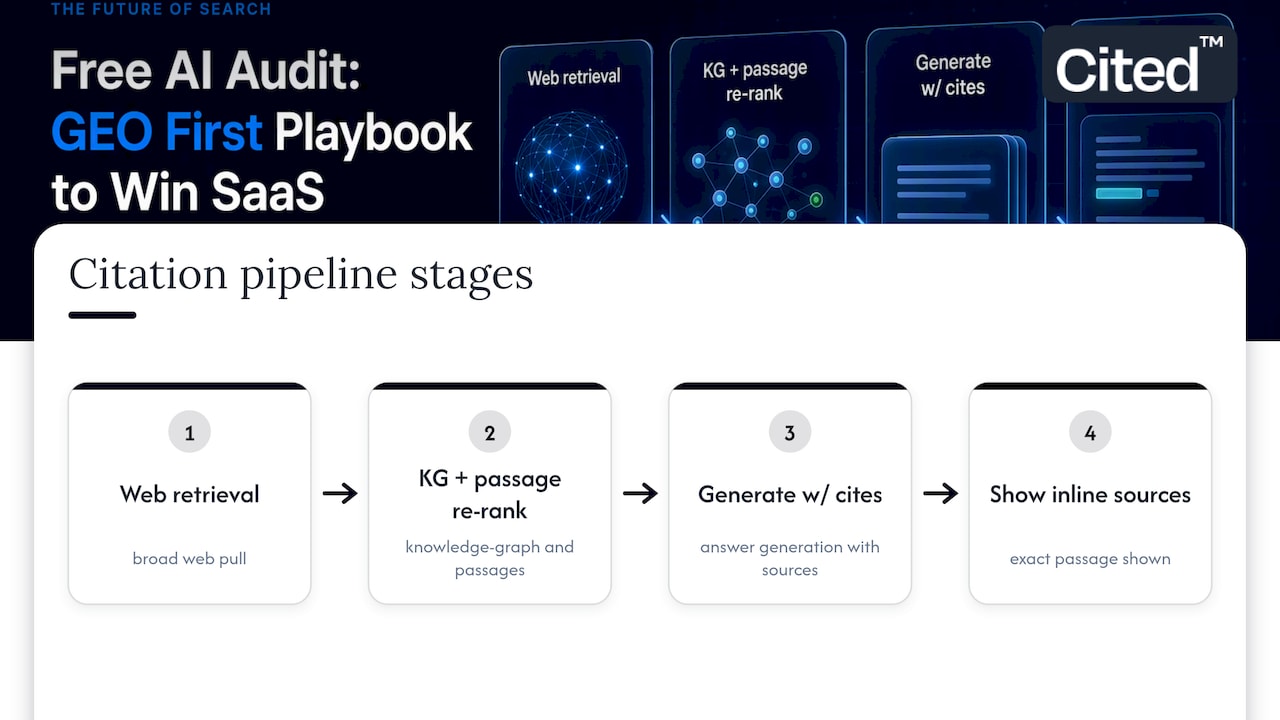
Multi-stage pipelines that retrieve, re-rank and then generate with citations, as demonstrated in OpenScholar's research, point toward answer engines that increasingly show their sources inline, making citation fidelity a more visible and higher-stakes concern for brands. If an AI assistant starts showing users the exact passage it pulled from, sloppy or contradictory facts on a page become immediately obvious rather than quietly wrong.
Regulatory scrutiny is also likely to intensify rather than fade. The CMA's Fair Ranking CR already brings generative AI features into its compliance scope, and further guidance covering how these features must disclose sourcing seems a reasonable expectation given the direction of the current requirements. SaaS teams that already maintain clean, well-sourced content are better positioned for whatever transparency rules follow, since the underlying discipline (clear facts, consistent entities, verifiable claims) does not change even as the specific algorithms do.
Integration of AI visibility strategies with overall SaaS marketing and SEO
AI visibility is not a separate discipline from SEO, it is an extension of the same underlying discipline applied to a new set of surfaces. The technical foundations, clean schema, fast page loads, clear information architecture, serve both traditional search rankings and AI retrieval systems simultaneously, which means most of the investment overlaps rather than competes for budget.
Where the two diverge is in content shape. Traditional SEO content can afford to build an argument across several paragraphs before reaching a conclusion, because a human reader will scroll. AI retrieval systems favour the direct answer up front, which means SaaS content teams need to restructure existing pages rather than write entirely separate content for AI engines. In practice, this means the same content calendar can serve both goals if editors add a concise answer span near the top of each piece rather than commissioning duplicate content.
Reporting should follow the same integration. Rather than a separate AI visibility dashboard sitting apart from SEO reporting, citation rate and answer share sit naturally alongside organic traffic, keyword rankings and conversion metrics in a shared SaaS analytics view, since they are measuring the same underlying goal: being found and trusted by the right buyer at the moment they are researching a solution.
Common pitfalls SaaS teams repeat, and how to avoid them
Three mistakes show up repeatedly across SaaS content that fails to get cited. First, teams chase volume, publishing dozens of blog posts while their core product pages still carry ambiguous or inconsistent facts, which is where citations actually originate. Second, teams add schema without fixing the underlying content, assuming markup alone will make a page citable when the facts it wraps are still vague. Third, teams treat AI visibility as a one-off audit rather than a weekly monitoring habit, so gaps reopen the moment a competitor publishes clearer content.
When developer time is scarce, prioritise fixes in this order: identity and naming consistency first, since it is cheap and affects every page at once, schema markup second, and new content last. Schema and content work compound faster once the entity itself is unambiguous.
- Mistake: publishing volume instead of fixing core page clarity. Fix: audit your five highest-intent pages before writing anything new.
- Mistake: adding schema to vague content. Fix: rewrite the answer span first, then mark it up.
- Mistake: treating visibility as a one-off project. Fix: run the weekly prompt loop and assign an owner.
Pro Tip: If your team cannot name who owns AI citation monitoring, that is usually the clearest sign it is time to bring in outside help.
The point at which it makes sense to buy an audit rather than build this in-house is usually when the weekly monitoring loop keeps slipping because nobody owns it, or when a technical fix (schema errors, crawlability issues) has been flagged but sits unresolved for more than a sprint.
— Tom Heaton
How Cited helps: free audit and implementation options
Fixing AI visibility yourself is possible, but it takes a weekly monitoring habit and technical work most SaaS marketing teams do not have spare hours for. Cited runs a free AI audit covering six dimensions of citability, technical health, schema markup, authority and platform coverage, so you get a prioritised list of what is actually broken before spending a single hour on fixes.
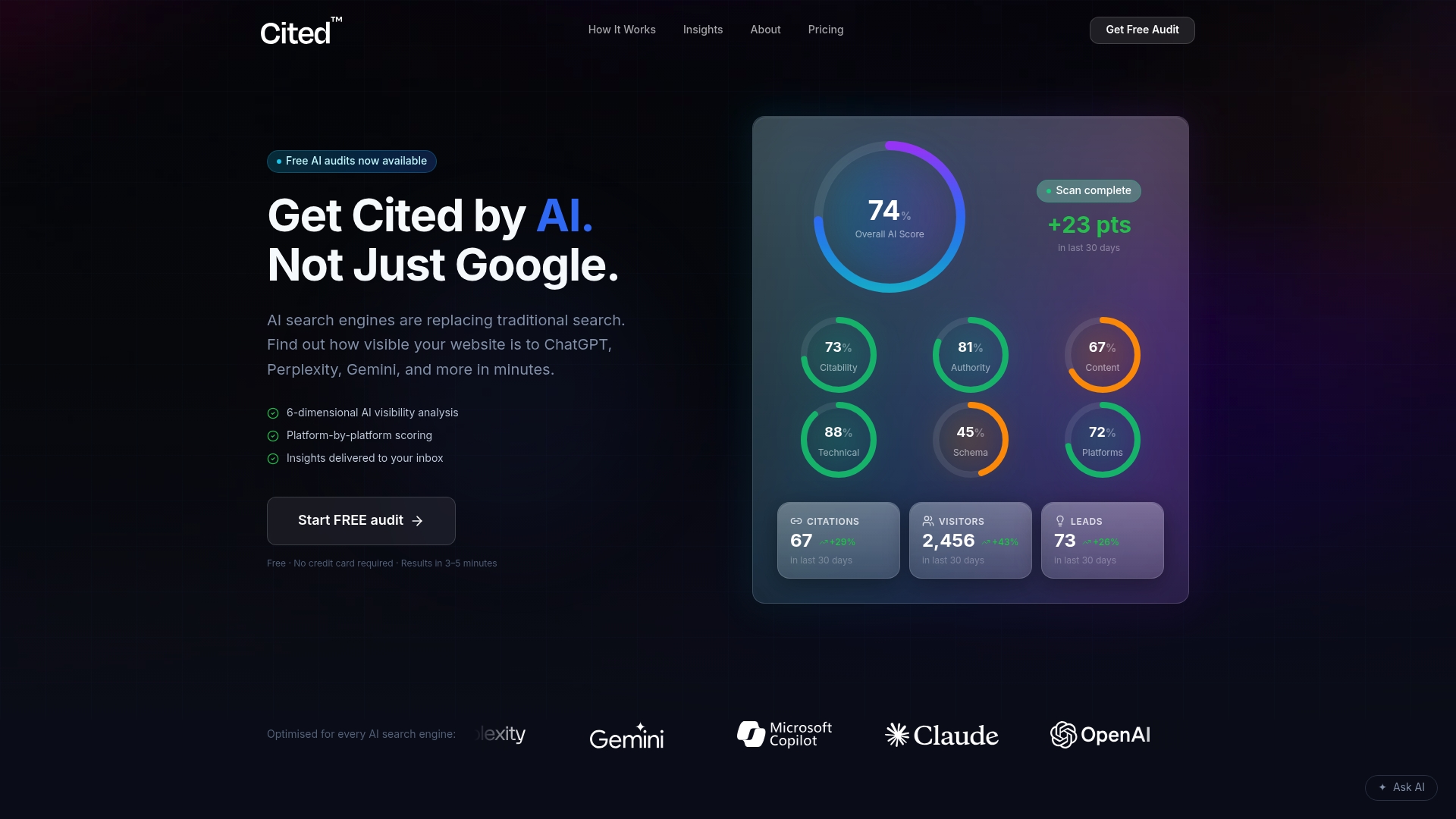
The audit itself requires no credit card or account, and a certified AI technician reviews the results by hand rather than handing you a raw data dump. From there, two paths are available depending on how much of the implementation work you want handled for you:
- Technical Fixes, a one-off engagement from £495, suited to teams that want specific schema, crawlability or content issues resolved.
- AI Optimised, an ongoing plan from £995 per month, for teams that want the weekly monitoring loop and remediation work managed continuously.
- Enterprise, for larger SaaS organisations with custom pricing available on request.
The practical next step is straightforward: run the free AI audit, review the prioritised fixes it surfaces, and book a call if you want the implementation handled rather than managed in-house.
Sources
- Fair ranking compliance and reporting, CMA final decision
- Business
- Ai2 Scholar QA: retrieval-augmented generation for scientific QA (arXiv)
FAQ
What is the 30% rule for AI?
If you have seen the term used, treat it as informal shorthand rather than an industry standard, and rely on measured metrics like citation rate and answer share instead.
What is the rule of 40 in SaaS?
The Rule of 40 is a SaaS financial benchmark stating that a company's growth rate plus profit margin should equal or exceed 40%, used mainly by investors to judge the balance between growth and profitability. It is a business health metric, not an AI visibility measure, though strong SaaS fundamentals often support the budget needed for ongoing visibility work.
Which type of AI visibility solution is best for a B2B SaaS company?
The right solution depends on how much implementation work you want handled internally versus externally. A managed service such as Cited's AI Optimised plan suits teams that want ongoing monitoring and fixes handled for them, while a one-off Technical Fixes engagement suits teams that only need specific schema or content issues resolved.
What does AI visibility mean?
AI visibility means how often and how accurately your brand is cited when AI systems like ChatGPT, Perplexity or Gemini answer questions relevant to your product. It is measured through citation rate, answer share and citation fidelity rather than traditional search rankings alone.
Recommended
Ready for your AI score?
See how visible your site is to ChatGPT, Perplexity & Gemini.
Start FREE auditResults in minutes · 100% free