
Perplexity rewards content structured as standalone, self-contained passages of 40 to 60 words that answer questions directly in the opening sentence and cite external sources by name. The fastest way to get cited is to restructure your existing high-traffic pages using clear question-based headings, inline source attribution, and visible publication dates, rather than creating new content from scratch. Technical basics like fast load times, correct schema markup, and a crawlable robots.txt are essential, but the real difference comes down to writing passages that make sense in isolation, since Perplexity extracts and quotes individual paragraphs rather than ranking whole pages.
How to optimise for Perplexity search and win more citations
Perplexity favours short, self-contained passages that answer a question directly, back it with named external sources, and show visible freshness signals. Cited and Tom Heaton have turned that pattern into a repeatable playbook. Use the checklist below to apply it to your own pages.
***
TL;DR: >- Structuring content as clear, self-contained questions with direct answers in the first sentence increases the likelihood of citation by Perplexity.- Using 40 to 60 word passages that stand alone without extra context improves passage extractability and citation chances.- Attaching three to five verifiable external citations per page, with sources named inline, enhances factual credibility and relevance for Perplexity's reranker.- Ensuring technical factors like fast response times, correct schema markup, and visible freshness signals are in place is crucial for reliable crawling and citation.- Focusing on existing high-traffic pages with small structural improvements yields faster citation gains than creating new content from scratch.
***
Table of Contents
- What is Perplexity search optimisation and why does it differ from SEO?
- Action checklist: what to change on-page now
- How do you make a page crawlable enough for Perplexity to cite it?
- How should you write headings and passages that Perplexity will quote?
- How do you measure whether Perplexity citations are actually improving?
- Author perspective: why a passage-first approach beats page-first SEO
- Get a free AI visibility audit from Cited
- Sources
- FAQ
What is Perplexity search optimisation and why does it differ from SEO?
Perplexity search optimisation means writing and structuring content so an AI answer engine can lift a passage straight out of your page and cite it, rather than simply ranking your URL on a results page. Perplexity runs live web retrieval for every query, pulls short passages of roughly one to three sentences, and attaches inline citations to those passages in its answer.
Traditional SEO optimises for a click. Perplexity SEO optimises for a quote. That distinction changes what "good content" looks like at the sentence level. A page can rank well in Google and still get ignored by Perplexity if its answers are buried three paragraphs deep, hedged with qualifiers, or written in a style that only makes sense once you've read everything above it.
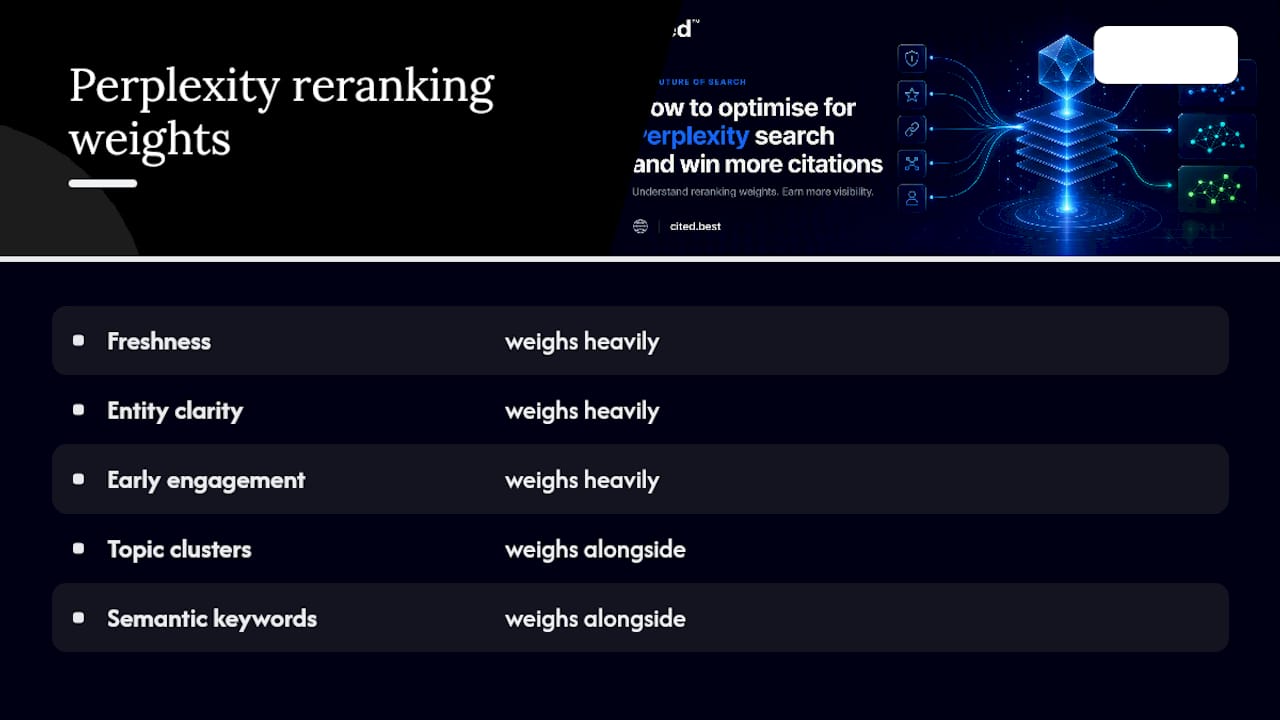
Perplexity's reranking system weighs freshness, entity clarity, and early engagement heavily, alongside topic clusters and semantic keywords. Getting cited in Perplexity, then, is less about backlink volume and more about whether a single paragraph can stand on its own, prove its claim, and show it was written or checked recently.
Action checklist: what to change on-page now
Start with your existing highest-traffic pages rather than writing new ones from scratch. The fastest wins come from restructuring content Perplexity has already seen.
- Rewrite H2s as literal questions. Change "Benefits of X" to "What are the benefits of X?" and answer it in the very first sentence underneath.
- Build 40 to 60 word standalone passages. Each key claim should live in its own two or three sentence block that makes sense with zero surrounding context, in line with Perplexity's extraction preferences.
- Attach three to five external citations per page. Name the source in the sentence itself, not just in a link, so the claim reads as verifiable even before a reader clicks.
- Show a visible published and updated date. Put it near the headline, not buried in a footer, and back it with Article schema.
- Cut cross-paragraph references. Phrases like "as mentioned above" or "see the next section" break extractability because Perplexity reads paragraphs in isolation.
Beyond the checklist, watch for two habits that quietly undo good structure:
- Don't stack three claims into one sentence. Perplexity extracts cleaner passages from single, specific statements.
- Don't answer a question halfway then explain the caveats before finishing the thought. Answer first, qualify second.
Pro Tip: Pick your five most-visited pages and run this checklist against them before writing anything new. Editing what already has traffic and topical fit tends to produce citations faster than fresh content with no track record.
How do you make a page crawlable enough for Perplexity to cite it?
PerplexityBot has to fetch your page reliably before any of your writing matters, so the technical layer comes first, not last. Confirm your robots.txt allows PerplexityBot, keep your sitemap accessible, and serve core content through server-side rendering or static HTML rather than client-side JavaScript that only populates after render.

Response times matter more than most teams assume. A slow server risks a retrieval timeout before the crawler even sees your answer, so keep response times low and page weight practical.
Structured data does the rest of the verification work. Perplexity's L3 reranker filters on entity clarity, factual verifiability and freshness, and schema is how you hand that information over directly rather than hoping the crawler infers it.
Schema type | What it should include | Why it matters here |
|---|---|---|
Article | datePublished, dateModified, headline | Signals freshness directly to the reranker |
Organisation | name, logo, sameAs links | Anchors your brand as a verifiable entity |
Person | author name, credentials, sameAs | Strengthens entity clarity for author claims |
FAQ | question, direct answer | Matches Perplexity's passage extraction pattern |
- Add
dateModifiedevery time you make a substantive edit, not just on publish day. - Use
sameAsto link author and organisation profiles to LinkedIn, X, or a Wikipedia entry where one exists. - Consider IndexNow pings when your CMS supports them, since faster indexing can surface updates before a competitor's stale page holds the citation.
Pro Tip: If you can only fix one technical item this month, fix dateModified visibility. It costs almost nothing to implement and it's one of the clearest freshness signals Perplexity can read.
Cited's own audit methodology checks all four schema types above as part of its technical health score, alongside crawlability and rendering checks most teams skip because they assume Google's indexing rules already cover them. They don't.
How should you write headings and passages that Perplexity will quote?
Phrase every heading as the exact question a reader would type, then answer it in the first sentence beneath it. That single habit does more for citation odds than any amount of extra word count.
- Lead with the answer sentence, then use the next one or two sentences to prove or expand it.
- Keep each paragraph self-contained, roughly 40 to 60 words, so it can be lifted whole.
- Name entities explicitly, "Perplexity's reranker" rather than "the algorithm", and cite the source inline.
- Use one statistic per sentence when citing numbers, never stacking two figures into a single claim.
- Reserve lists and comparison tables for genuinely evaluative content, and build tables around generic metric columns rather than naming specific vendors, since standardised metric tables extract more cleanly.
A few structural habits separate citable writing from merely readable writing:
- Avoid hedges like "some believe" or "it could be argued"; state the claim and attribute it properly instead.
- Write FAQ sections in strict question-then-answer pairs, since this format mirrors Perplexity's own extraction shape.
- Use internal links to reinforce which entity or concept a page is actually about, which supports the reranker's entity-clarity checks.
Getting this right is largely a matter of discipline rather than talent: write the answer first, then justify it, every single time.
How do you measure whether Perplexity citations are actually improving?
Run a baseline audit before changing anything, so you have a real citation count to compare against later. Cited's free audit captures exactly this: how many times target pages currently get cited, and where the technical or structural gaps sit.
After that baseline, track three numbers consistently:
- Citation frequency for each target page, checked on a fixed schedule rather than ad hoc.
- Referral clicks arriving from Perplexity specifically, not lumped in with general AI traffic.
- Time elapsed between publishing or updating a page and its first citation.
Reddit and YouTube rank among Perplexity's most-cited external domains, so testing Focus Modes such as Reddit or YouTube alongside Default search reveals channel gaps that on-page fixes alone won't close. Prioritise pages that already have strong topical fit but comparatively few citations. The cost of edits is lower there, and gains tend to show up faster than on brand-new content.
Make one change at a time where possible, re-run the audit, and confirm the shift before rolling the same edit out across a wider set of pages.
Author perspective: why a passage-first approach beats page-first SEO
Traditional SEO chases rankings; Perplexity chases quotable proof. That's a different job, and treating it as the same one wastes effort. Cited's audits routinely flag pages ranking well on Google that get zero Perplexity citations, purely because nothing on the page is written as a standalone, sourced answer. The fixes we deliver most often, restructured H2s, added schema, tightened passages, are small edits with an outsized effect.
— Tom Heaton
Get a free AI visibility audit from Cited
You don't need to guess whether your pages meet the standards above. Cited's free audit scores your site across six dimensions of AI citability, including technical health, schema, and passage structure, then hands you a prioritised list of quick wins.
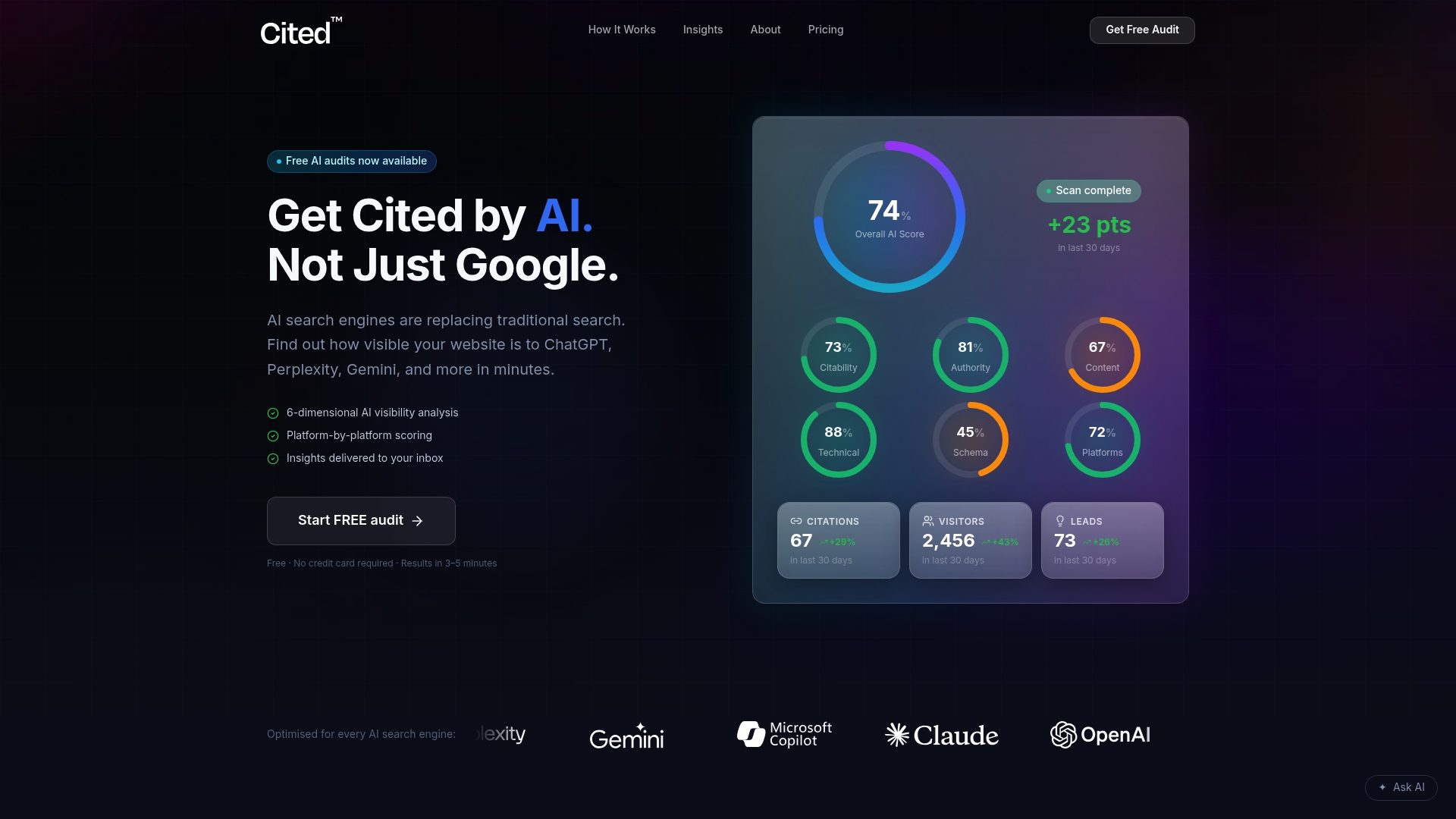
The audit itself costs nothing and returns a clear site score alongside the specific fixes holding your pages back from citation. If you want the detail behind how that score gets calculated, the Cited methodology page walks through every dimension measured. For teams that want the fixes implemented rather than just diagnosed, Technical Fixes start at £495 as a one-off project, and the ongoing AI Optimised service runs £995 a month for continuous schema, freshness, and passage-structure work; enterprise projects are scoped individually. Start with the free audit at cited.best/audit, then book a call if you want Cited to implement the changes directly.
Sources
- How do Perplexity work?
- How to optimise for Perplexity AI
- How to Optimize for Perplexity
- How Perplexity decides which sources to cite
FAQ
What does Perplexity actually cite from a page?
Perplexity extracts short passages, typically one to three sentences, and attaches them as inline citations, so it's citing a specific answer rather than an entire page.
How long should an extractable passage be?
Aim for 40 to 60 words per key claim, written as two or three self-contained sentences that make sense without any surrounding context.
Does schema markup really affect Perplexity citations?
Yes. Article, Organisation, Person, and FAQ schema with visible dateModified fields help Perplexity verify freshness and entity identity, which its reranker weighs directly.
How is optimising for Perplexity different from traditional Google SEO?
Google SEO optimises for ranking a URL; Perplexity optimises for extracting a quotable, sourced passage, so the unit of success shifts from the page to the paragraph.
How can Cited help improve my Perplexity citation rate?
Cited runs a free audit scoring your site across six AI citability dimensions, then offers paid Technical Fixes or an ongoing AI Optimised service to implement the changes.
Recommended
Ready for your AI score?
See how visible your site is to ChatGPT, Perplexity & Gemini.
Start FREE auditResults in minutes · 100% free