

IndexNow is a protocol that instantly notifies search engines when you update a page, cutting discovery time from days to seconds—which matters for AI systems that need fresh data to answer questions accurately. However, it's not a ranking tool and doesn't guarantee your content will appear in AI answers; you still need quality content, proper structured data, and clear internal linking. The key first step is verifying IndexNow is set up correctly on your domain and testing it with a batch of real URLs.
IndexNow for AI: Get Product Updates to Search in Seconds

IndexNow speeds discovery for AI search and shopping systems, but it must be implemented correctly and paired with clear discovery signals to raise the chance of citation. It is not a ranking tool and does not guarantee inclusion in an AI answer. The immediate action for most site owners is to verify IndexNow is active and submit a recent batch of URLs to confirm the setup works.
***
TL;DR: >- Host the verification key as a text file at the domain root, keep sitemap change dates accurate, and link submitted pages internally for crawler context.- Submit only meaningful changes, such as price, stock, or substantial content updates; debounce rapid edits and log endpoint errors to catch verification or path failures.- Use individual notifications for routine updates, since Bing advises against large batch submissions; reserve bulk requests for related catalog changes or migrations.- Fabrice Canel says IndexNow can cut crawling from days or weeks to seconds, but indexing and AI citations still depend on page quality and schema.
***
Table of Contents
- What is IndexNow and how does it work?
- Why does IndexNow matter for AI search and shopping agents?
- How does IndexNow fit with sitemaps, links and structured data?
- How do I implement IndexNow across different platforms?
- What are the best practices and pitfalls to avoid?
- How does an AI visibility audit uncover IndexNow gaps?
- What results have sites seen from using IndexNow?
- How do you score IndexNow signals in an AI audit?
- How does IndexNow compare with traditional crawling for AI content?
- What should you realistically expect from IndexNow?
- Get a free AI audit before you build your IndexNow setup
- FAQ
- Sources
What is IndexNow and how does it work?
IndexNow is an open protocol that lets website owners notify participating search engines the instant a URL is added, updated or removed, rather than waiting for a crawler to revisit the page on its own schedule. We treat it as one of the clearest wins available for reducing the gap between publishing and discovery.
Several major engines participate in the protocol, and a notification sent to one partner is typically shared across the network rather than requiring separate submissions to each. Verification relies on a key file: a text file containing a unique key, hosted at the root of a domain (or the path specified through an optional keyLocation parameter), which confirms ownership before a submission is accepted.
The IndexNow documentation sets out two practical submission formats:
- A single-URL submission, typically a simple GET request pointing to the changed page.
- A bulk POST submission, which allows a list of URLs to be sent in one request, useful after a larger content update or migration.
- Engine metadata published via searchengines.json, which tells participating search engines where to find partner endpoints and how notifications propagate.
Hosting the key file at the root of the domain is the recommended approach, since it keeps verification straightforward and avoids path-specific key conflicts across subdirectories.
Why does IndexNow matter for AI search and shopping agents?
IndexNow matters for AI systems because it shortens the window between a content change and the moment a search engine's index reflects it, which is the data that grounded AI answers and shopping agents actually draw from. Large language models are trained periodically and cannot absorb a price change or a new product listing the moment it happens. Grounding is the mechanism that fills that gap: AI systems query a live, frequently updated search index at the moment of a user's question, rather than relying solely on what was baked into the model during training.
According to Microsoft's Fabrice Canel, IndexNow can cut the time it takes search engines to crawl and index content from days or weeks down to seconds, which directly improves the odds that updated information is available when a shopping agent or AI assistant looks for it, as described in Search Engine Journal's coverage of the protocol.
Bing's webmaster guidelines recommend IndexNow specifically for notifying Bing and Copilot when pages change, and advise streaming individual updates rather than sending large batch submissions, since batching increases server load and can reduce indexing accuracy. The same guidance stresses that freshness signals and structured data keep content eligible for grounding in Copilot and similar AI experiences.
None of this amounts to a ranking promise. IndexNow increases the likelihood that a page is crawled promptly; what happens after that, whether the page is indexed, ranked or cited, still depends on quality, relevance and the usual mix of discovery signals working together.
How does IndexNow fit with sitemaps, links and structured data?
IndexNow works alongside sitemaps and internal linking rather than replacing them, and each covers a different gap in discovery. A sitemap tells a search engine everything that exists on a site and when it last changed; IndexNow tells it what changed right now. Relying on IndexNow alone leaves older or less-linked pages undiscovered, while relying on sitemaps alone means waiting for the next scheduled crawl to pick up a change.
A few checks keep the two systems working together rather than against each other:
- Keep the
lastmodvalue in your XML sitemap accurate, since a stale sitemap can contradict the freshness signal IndexNow just sent. - Make sure internal links point to any page submitted through IndexNow, since orphaned pages are harder for crawlers to revisit and interpret in context.
- Add or update Schema.org structured data on changed pages, particularly Product, Offer and FAQPage types, so AI systems can interpret the content correctly once it is crawled.
- Confirm the submitted URL renders correctly and returns a 200 status before notifying, since a broken or blocked page wastes the notification.
Bing Webmaster Tools reflects submission status for IndexNow-notified URLs, which gives a direct way to confirm a notification was received and acted on rather than guessing whether it worked.
Pro Tip: Treat IndexNow as the trigger and structured data as the explanation: the notification gets a crawler to look, but schema and clean markup are what help it understands what it is looking at.
How do I implement IndexNow across different platforms?
Most site owners can get IndexNow running in under an hour, following a practical on-page SEO checklist with AI-ready audit steps, and the route depends on the platform behind the site.
- WordPress and Shopify: check for a built-in IndexNow integration or an official plugin first, since several major CMS platforms now expose the protocol through a toggle in settings rather than requiring manual code.
- Custom-built sites: generate a unique key, save it as a text file named after the key itself, and host it at the domain root (for example,
yourkey.txtathttps://yoursite.com/yourkey.txt). - Single-page submissions: form a GET request to the IndexNow endpoint containing the URL, your key and the key location, triggered whenever a page is published or updated.
- Bulk submissions: use a POST request with a JSON body listing multiple URLs, useful after a sitemap regeneration, a product catalogue refresh or a content migration.
- Automate the trigger: hook submissions into your publishing workflow, whether that's a CMS save event, a deployment pipeline step, or a CDN edge function that fires on cache purge.
- Choose the right endpoint: use the shared global endpoint for most cases, since participating engines poll it and redistribute notifications; call an engine-specific endpoint only where the documentation recommends it for a particular workflow.
For teams managing large catalogues, tying IndexNow submissions to the same event that updates stock or pricing data keeps the notification tightly scoped to genuine changes rather than running on a blanket schedule. Developers working across multiple environments should also confirm the key file is excluded from staging-to-production path rewrites, since a missing or mismatched key is the most common reason a submission fails verification.
What are the best practices and pitfalls to avoid?
The biggest risk with IndexNow isn't underusing it, it's flooding search engines with notifications that dilute their usefulness. Submit a URL only when something meaningful has changed: a new page, an updated price, a restocked product, or a substantial content revision. Re-submitting the same URL repeatedly for minor edits teaches nothing useful to the receiving engine and can look like noise rather than a genuine freshness signal.
A few habits keep submissions reliable:
- Add debounce logic so rapid successive edits to the same page trigger one notification, not one per save.
- Batch genuinely related changes (a catalogue update, a bulk price revision) into a single bulk POST rather than firing hundreds of single-URL requests in quick succession.
- Filter automated submissions to the page types that matter most: product pages, pricing and stock pages, and significant editorial updates, rather than every minor template tweak.
- Log non-200 responses from the IndexNow endpoint and review them regularly, since a pattern of failures often points to a key file problem or a path misconfiguration.
Bing's guidance is explicit that streaming individual updates is preferable to batch floods, both for server load and for indexing accuracy on the receiving end.
Pro Tip: Log every submission and its response code somewhere queryable, even a simple spreadsheet, so a sudden drop in successful notifications is visible before it becomes a discovery problem.
How does an AI visibility audit uncover IndexNow gaps?
An AI visibility audit checks whether the technical groundwork behind IndexNow is actually in place, not just whether a plugin is switched on. That means confirming the key file exists and resolves correctly, checking that sitemap lastmod values match real publish dates, and verifying submitted pages render fully rather than returning partial or blocked content to a crawler.
A thorough audit typically examines:
- Key file presence, correct hosting location and successful verification against the domain.
- Sitemap accuracy, including whether
lastmoddates reflect genuine changes. - Renderability, canonical tags and robots directives on recently changed URLs.
- Schema markup coverage on pages most likely to need AI grounding, such as product and FAQ pages.
Findings are typically prioritised by impact: a missing or misconfigured key file blocks every submission and gets fixed first, while thinner schema coverage is addressed as a secondary pass once the submission pipeline itself is confirmed working.
What results have sites seen from using IndexNow?
Results from IndexNow adoption tend to show up first as a measurable change in crawl frequency rather than an overnight shift in rankings. Site owners who automate submissions alongside publishing typically see updated pages picked up within the same day, compared with the days or weeks a crawler might otherwise take to revisit a lower-priority page on its own schedule, consistent with the reduction Fabrice Canel has described.
The more useful pattern to watch for is consistency rather than a single dramatic jump. A retailer that notifies search engines every time stock status or pricing changes builds a track record of fresh, reliable data, which matters more to a shopping agent deciding whether to trust a listing than any single fast crawl. Editorial sites that pair IndexNow with strong internal linking and updated schema tend to see faster reflection of corrections and updates in search results, because the crawler is told where to look and what the content means once it arrives.
What we don't see, and what no credible source claims, is IndexNow alone producing a citation in an AI answer. The protocol closes the discovery gap; everything else, from content quality to structured data to authority signals, still determines whether that freshly crawled page earns a place in a grounded response.
How do you score IndexNow signals in an AI audit?
Scoring IndexNow within an AI visibility audit means treating it as one input among several, not a standalone pass or fail. A sensible methodology weighs whether the key file is present and verified, whether submissions are automated rather than manual or absent, and whether the submission pattern matches genuine content changes rather than erratic bulk floods.
Each of those checks feeds into a broader technical health score alongside schema coverage, renderability and crawl accessibility, since a working IndexNow setup is only valuable if the pages it notifies can actually be read and understood by the crawler that receives the signal. A site with perfect IndexNow automation but broken canonical tags or missing schema will still score poorly overall, because the fast notification achieves little if the destination page confuses the systems reading it.
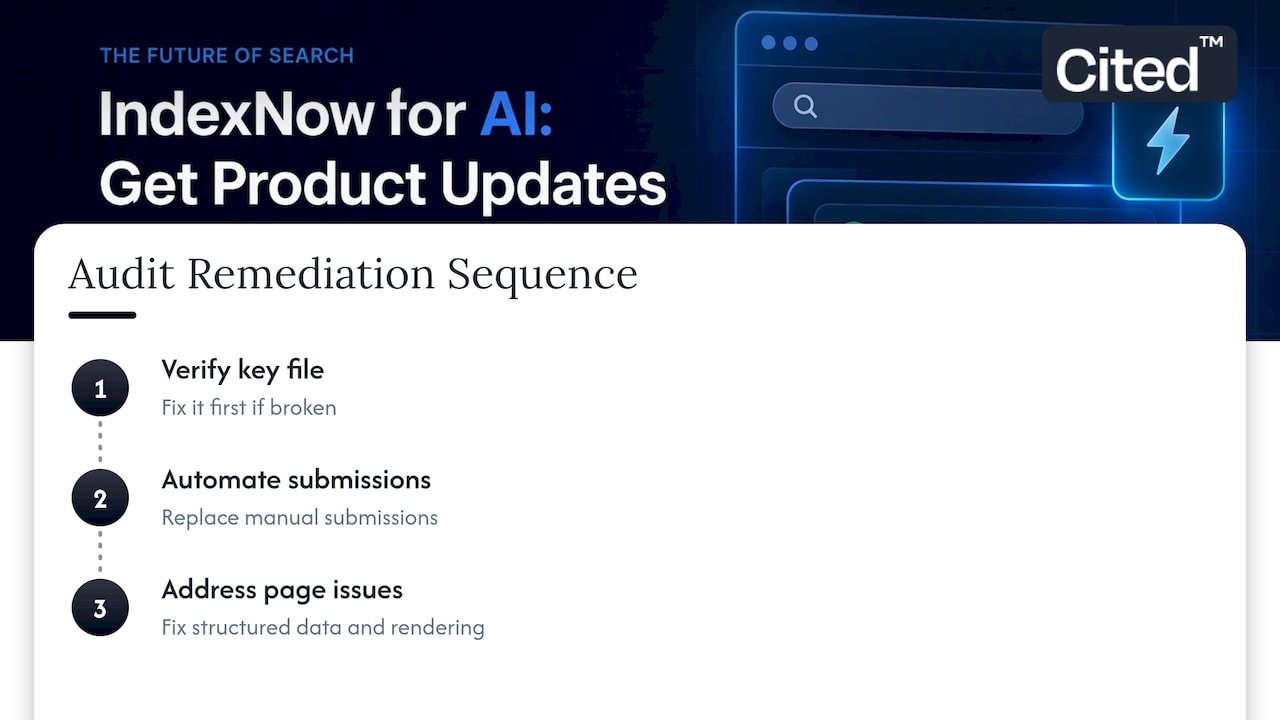
The practical output of this kind of scoring is a prioritised list: fix the key file first if it's broken, then automate submissions if they're manual, then address the structured data and rendering issues that determine whether the fast crawl actually translates into a usable, citable page. This layered approach mirrors how technical SEO checks feed AI citation likelihood more broadly: speed of discovery and quality of what's discovered are scored together, not separately.
How does IndexNow compare with traditional crawling for AI content?
Traditional crawling relies on a search engine's own schedule and its assessment of how often a given page is likely to change, which works reasonably well for stable content but leaves fast-moving pages, like product availability or pricing, waiting for a revisit that might not come for days. IndexNow inverts that model: instead of the crawler guessing when to return, the site tells it exactly when something worth seeing has happened.
For AI-driven indexing specifically, this distinction carries more weight than it did for traditional search alone. A shopping agent checking stock or price needs data that reflects the current state of a page, not a cached version from the last scheduled crawl. Fabrice Canel's description of crawl times dropping from days or weeks to seconds is precisely the gap that matters for this use case.
Traditional crawling still has a role IndexNow doesn't replace: discovering genuinely new content with no existing signal pointing to it, and periodically revisiting pages that haven't explicitly changed but might warrant a fresh look. The two approaches work best in combination, with IndexNow handling known changes instantly and scheduled crawling providing the broader safety net underneath it.
What should you realistically expect from IndexNow?
In the short term, expect faster crawling of updated URLs, visible in crawler logs and Bing Webmaster Tools within hours rather than days. In the medium term, expect better grounding and freshness in AI answers, but only where the underlying content quality and structured data already support it. The next steps are straightforward: run an audit, automate submissions into your publishing workflow, and monitor the results rather than assuming the job is done once the key file is live.
— Tom Heaton
Get a free AI audit before you build your IndexNow setup
We run a free AI audit that checks exactly the groundwork IndexNow depends on: key file verification, sitemap accuracy, renderability, canonical signals and schema coverage, so you know what to fix before automating submissions rather than after. Where the audit turns up deeper technical issues, we offer services to resolve them, including ongoing implementation and monitoring to keep discovery signals consistent as your site changes. Larger sites with more complex platforms can request a custom service arrangement.
Start with the Cited to see exactly where your IndexNow setup and wider AI visibility stand today.
FAQ
How is AI used in search engines?
AI is used in search engines to interpret queries, rank results and generate grounded answers that pull from a live, frequently updated index rather than relying only on what a language model learned during training. Systems like Copilot combine this indexed data with generative responses, which is why fresh, well-structured pages matter for the chance of being cited.
What is indexing in AI?
Indexing in AI search refers to the process of crawling, storing and organising web content so it can be retrieved and used to ground an AI-generated answer at the moment a user asks a question. IndexNow speeds up one part of that process: how quickly a change on a page reaches the index in the first place.
Is IndexNow free?
Yes, IndexNow is a free, open protocol that any website owner can implement without a licence fee or subscription. Implementing it well, including key file hosting, automation and monitoring, may still require development time or a paid service if you want it handled for you.
How can artificial intelligence be used in SEO?
Artificial intelligence is used in SEO to analyse content quality, predict ranking factors, generate structured data, and assess how likely a page is to be cited by AI-powered search tools. Pairing AI-driven audits with protocols like IndexNow helps close the gap between publishing a change and that change becoming visible to the systems deciding what to cite.
Sources
- Indexnow
- Webmaster guidelines | Bing Webmaster Tools
- IndexNow: A Digital Retailer's Guide To Smart Content Change Notifications | Search Engine Journal
Recommended
Ready for your AI score?
See how visible your site is to ChatGPT, Perplexity & Gemini.
Start FREE auditResults in minutes · 100% free