
To win AI citations, you need to make your content machine-readable and verifiable: ensure your pages are properly indexed with clear author information, structured data, and author pages that AI systems can trust. Original evidence like timestamped case studies and datasets matter far more to AI than they do to traditional search, since AI systems need to verify claims rather than just rank pages. Start with technical basics—check indexability, author signals, and provenance—before optimizing anything else, as this is where most sites fail.
3 Technical Checks to Win AI Citations With EEAT, Google and CMA
EEAT for AI means verifiable provenance plus demonstrable topical expertise, presented in ways both machines and humans can check. The single highest-value first move is technical: confirm the page is indexable and carries clear author and provenance signals, an author page, structured data, visible evidence, before touching anything else. Google's own guidance backs this order of priorities, and Cited's audits find the same fault line on almost every site they review.
***
TL;DR: >- Ensuring page indexability and verified author signals are crucial for AI to reliably retrieve and trust content.- Original evidence such as timestamped case studies and datasets significantly boost content credibility for AI systems.- Disclosing AI use and maintaining transparent provenance help preserve trust and meet emerging moderation standards.- Improving canonical tags, structured data, and freshness signals offers immediate technical gains for AI visibility.- Building well-sourced, diverse content enhances system corroboration and mitigates bias in AI-generated responses.
***
Table of Contents
- How AI changes what E-E-A-T looks like
- Core signals AI systems use and how to satisfy them
- Technical discovery and machine-readable signals for AI
- Authorship, provenance and experience: what belongs on the page
- Content production, AI-generated content and disclosure practices
- Measuring AI visibility and the regulatory context to plan for
- Evidence in practice: what Cited's audits find and fix
- Impact of E-E-A-T on AI content moderation policies
- Role of user feedback in validating AI content quality and trustworthiness
- Strategies to enhance AI content credibility through real-world data integration
- Implications of E-E-A-T for AI bias detection and mitigation
- Where E-E-A-T for AI will stabilise next
- How Cited helps: a free audit and clear next steps
- Sources
- FAQ
How AI changes what E-E-A-T looks like
Generative search tools do not rank pages in the traditional sense, relying instead on retrieval-augmented generation architecture to fetch and synthesize information from trusted sources. They retrieve candidate passages from an index, then generate an answer grounded in whichever sources pass a relevance and trust filter. This process, known as retrieval-augmented generation, means a page has to be found, parsed and judged trustworthy inside a single pipeline rather than simply climbing a results list.
That shift changes what each part of E-E-A-T has to prove:
- Experience now needs visible evidence: dated case studies, screenshots, first-hand data, not just a claim of having done something.
- Expertise needs to be demonstrable in the text itself: named credentials, specific terminology used correctly, depth that a generic rewrite could not fake.
- Authoritativeness increasingly rests on corroboration across independent sources rather than link volume alone.
- Trustworthiness depends on machine-readable provenance: who wrote this, when, and how it can be verified.
Google Search Central's guidance on helpful content remains the baseline framework here. It has not been rewritten for AI specifically, but its emphasis on people-first, verifiable content maps directly onto what retrieval systems reward.
Core signals AI systems use and how to satisfy them
AI systems favour content that is easy to verify, not just easy to read. Three categories of signal do most of the work.
Content-level signals include factual density (specific figures, named entities, dates), original data that cannot be found elsewhere, and internal consistency that survives a fact-check. Provenance signals include a working author page, credentials that can be independently confirmed, and links out to primary sources rather than to other summaries. Corroboration signals matter because a claim repeated by several independent, credible sources is easier for a model to trust than a claim carried only by high-authority backlinks. Link volume alone is a weak proxy: a page with fewer links but clearer sourcing can outperform one built purely on domain authority, a distinction we cover in more detail in our comparison of E-E-A-T and domain authority.
For a fast triage, run through this in order:
- Check whether the page returns HTTP 200 and is actually indexed, not just crawlable in theory.
- Confirm the author byline links to a real author page with credentials and other published work.
- Look for at least one piece of original evidence on the page: a dataset, a case study, a timestamped result.
Pro Tip: Run the triage on your three highest-traffic pages first. If none of them pass all three checks, that is your priority list, not a new content brief.
Technical discovery and machine-readable signals for AI
Fix discovery before anything else, because a page an AI system cannot reliably crawl or parse never gets the chance to be judged on expertise at all.
Start with the indexability basics: HTTP 200 responses, no accidental noindex tags, correct canonical URLs, and full sitemap coverage. Then move to structured data. Google Search Central's guide to AI experiences recommends specific JSON-LD properties: author, datePublished, mainEntity and licence information, because JSON-LD is the format generative systems parse most reliably.
Beyond the schema basics, a few less obvious factors affect how often a page gets pulled into an answer:
- RSS or comparable feeds help crawlers detect fresh content faster than a sitemap ping alone.
- Crawl frequency data in server logs shows whether AI crawlers are visiting at all, a detail most teams never check.
- Freshness signals, a genuinely updated dateModified rather than a cosmetic one, affect whether a model treats the page as current.
A technical SEO checklist for AI visibility walks through each of these in more depth. This is also the exact set of checks a free audit at cited.best/audit runs automatically, flagging which fixes will move the needle first.
Pro Tip: If you fix only one thing this week, fix canonical tags. Misconfigured canonicals quietly remove otherwise strong pages from the retrieval pool.
Authorship, provenance and experience: what belongs on the page
An author page needs to answer one question convincingly: could a stranger verify this person actually knows the subject? That means a real name, a stated role, links to other verifiable published work, and, where relevant, a professional credential that can be checked independently.
Demonstrating first-hand experience is more concrete than most guidance suggests:
- Include a dated case study with specific figures, not a generic summary of "results".
- Link to an original dataset, document or screenshot rather than describing it secondhand.
- Timestamp updates honestly, so a model can tell recent verification from an unchanged page.
Machine-readable provenance closes the loop. Schema.org's Person properties, applied consistently across an author's byline and author page, let a system connect a specific claim to a specific, checkable identity rather than an anonymous "team". Practical templates for this, including timestamped case study microdata, are covered in a step-by-step guide to author page fixes.
Content production, AI-generated content and disclosure practices
Using AI in content production is not the trust problem. Undisclosed, unverified AI content is. Google's guidance on helpful, people-first content is explicit that creators should disclose automated generation where reasonable and keep the focus on who wrote it, how, and why.
A workable set of rules for teams using AI in production:
- Have a named human verify every factual claim before publication, not after a complaint.
- Keep a visible source list on the page itself, not buried in an internal document.
- Maintain a revision history that shows what changed and when, rather than silently editing.
- Disclose automation plainly: state who used the tool, how it was used, and why, in a short note near the byline.
Automation harms trust when it replaces verification rather than assisting it. A disclosed, human-checked AI draft with named sources will outperform an undisclosed, unchecked one every time a model has to decide which source to trust.
Measuring AI visibility and the regulatory context to plan for
Measuring AI visibility means tracking citations directly, not inferring them from traffic. Useful KPI candidates include AI citation counts where a platform exposes them, generative AI performance reports inside Search Console, identifiable referral sources from AI platforms, and proxy metrics such as branded search lift after a citation appears.
The Publisher Conduct Requirement sets page and directory-level opt-out controls, transparency obligations and an attribution expectation for Google's generative AI features, according to the CMA's final decision. This matters because it formalises what publishers can require of Google around attribution, rather than leaving it to goodwill.
The CMA's own announcement confirms Google must improve transparency and attribution accuracy for content used in generative AI features, giving publishers both controls and referral information.
Build a monitoring routine around this:
- Check Search Console's generative AI performance report monthly, not quarterly.
- Watch for unexplained referral drops that might indicate a citation without attribution.
- Keep a log of which pages get cited and cross-reference it against the technical fixes applied.
Evidence in practice: what Cited's audits find and fix
We audit sites across dimensions of AI citability including technical health, schema markup, authorship and provenance, content structure, cross-source authority, and platform coverage across major AI platforms. The methodology behind the scoring explains how each dimension is weighted.
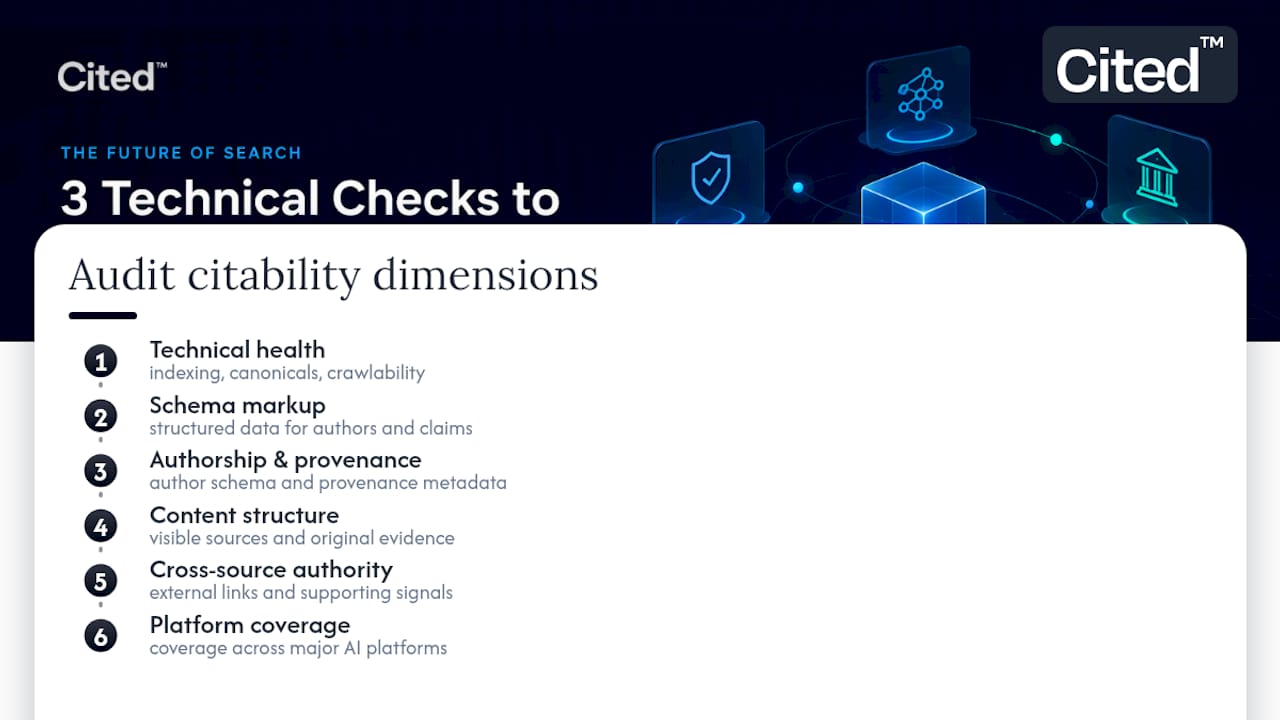
In practice, The fixes prioritised most often address canonical and indexability issues that exclude strong pages, author schema improvements and expansion of author pages, and the addition of visible source lists and original evidence where pages only assert claims.
The audit is free, requires no credit card or account, and is reviewed by a human technician rather than generated automatically. Businesses running content at scale can commission a free audit to see which gaps apply before deciding what to fix.
Impact of E-E-A-T on AI content moderation policies
E-E-A-T signals increasingly double as moderation inputs, not just ranking inputs. When a generative system decides whether to surface a claim at all, it is effectively running a lightweight moderation check: does this source look credible enough to repeat.
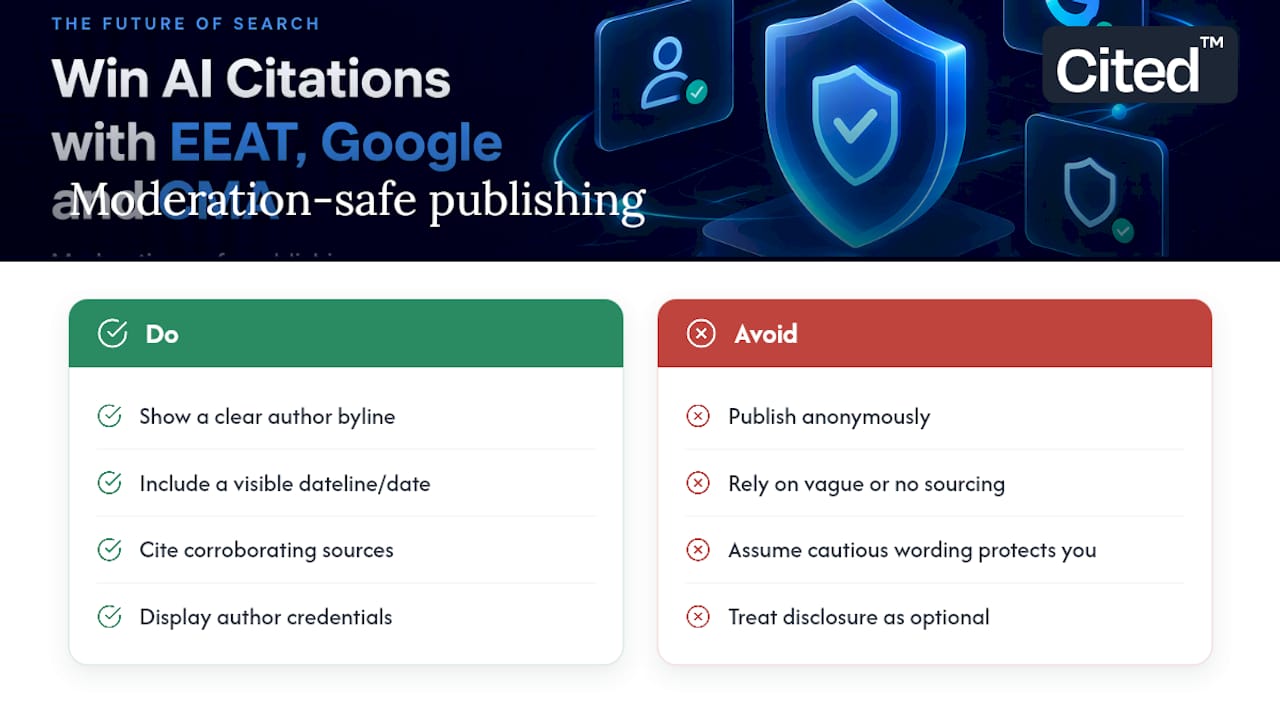
Weak provenance does not just reduce citation likelihood, it can get a page filtered out of the candidate pool before generation even begins. A page with no identifiable author, no dateline and no corroborating sources looks, to a moderation layer, indistinguishable from low-quality or spam content, regardless of how accurate the underlying claim actually is.
This has a practical consequence for anyone publishing on contested or sensitive topics. Health, finance and legal content already sits under stricter scrutiny in traditional search, and the same caution appears to extend into generative systems, which tend to favour named, credentialed sources on these topics over anonymous ones. The safest response is not to write more cautiously, but to make authorship and sourcing more visible, since that is the signal moderation layers appear to weight most heavily.
Publishers who treat disclosure and provenance as a moderation safeguard, not just an E-E-A-T checkbox, are better placed as these systems tighten. The overlap between "will this get cited" and "will this get filtered" is likely to grow, not shrink.
Role of user feedback in validating AI content quality and trustworthiness
User feedback acts as a secondary trust signal that reinforces or undermines what provenance and schema already claim. When readers consistently correct, flag or contest a piece of content, that pattern can inform how future systems weight the source, even where the mechanism is not always visible to the publisher.
The most direct form of this is explicit correction: comments, replies or citations that dispute a claim, especially where they come from other identifiable, credentialed sources. Independent corroboration works the same way in reverse, when multiple separate publishers state the same fact with consistent sourcing, that consistency reinforces trust more than any single site's internal metrics can.
There is a practical takeaway here for content teams: build a visible way for readers to flag inaccuracies, and act on it quickly and publicly. A dead comment section or an unanswered correction request signals the opposite of what E-E-A-T asks for. Treat feedback loops as part of the provenance story, not as an afterthought to community management.
Strategies to enhance AI content credibility through real-world data integration
Original, real-world data is one of the strongest credibility signals available, because it cannot be reproduced by a competitor simply rewriting the same page. A page built entirely from secondary sources is easy for a retrieval system to treat as redundant with dozens of similar pages.
Practical ways to integrate real-world data include publishing a small original dataset with methodology notes, running and reporting a first-hand test rather than summarising someone else's, and citing primary sources directly rather than linking to a summary of them. Each of these gives a generative system something specific to point to, rather than a generic paraphrase it has already seen elsewhere.
Timestamps matter as much as the data itself. A dataset labelled with when it was collected, and updated honestly when it changes, signals currency in a way a static, undated claim cannot. This is also where corroboration and originality intersect: a unique dataset that other credible sources go on to cite becomes exactly the kind of cross-source evidence that strengthens authoritativeness over time.
Implications of E-E-A-T for AI bias detection and mitigation
E-E-A-T signals play a growing role in how generative systems attempt to detect and correct bias in their own outputs, because a diverse, well-corroborated source set is one of the few practical checks against a single skewed source dominating an answer. Ofcom's discussion paper on generative search notes that AI summaries can draw on a limited source set, which raises the stakes on which sources get selected in the first place.
If a topic is dominated by a small number of sources with weak provenance, any bias in those sources propagates directly into the generated answer, with no independent check available. Strong, verifiable E-E-A-T signals across a wider range of independent publishers give a retrieval system more material to corroborate against, which reduces the chance that a single flawed source defines the answer.
For publishers, the practical implication is straightforward: contributing well-sourced, transparently authored content on a topic is not just good for your own citation odds, it improves the overall evidence pool a model draws from. Thin, uncorroborated content does the opposite, and its risks compound when the pool of sources on a given topic is already small.
Where E-E-A-T for AI will stabilise next
Attribution will tighten as regulatory scrutiny increases. Prioritise provenance you can prove over speculative AEO tactics, and watch your Search Console generative AI report monthly rather than guessing.
— Tom Heaton
How Cited helps: a free audit and clear next steps
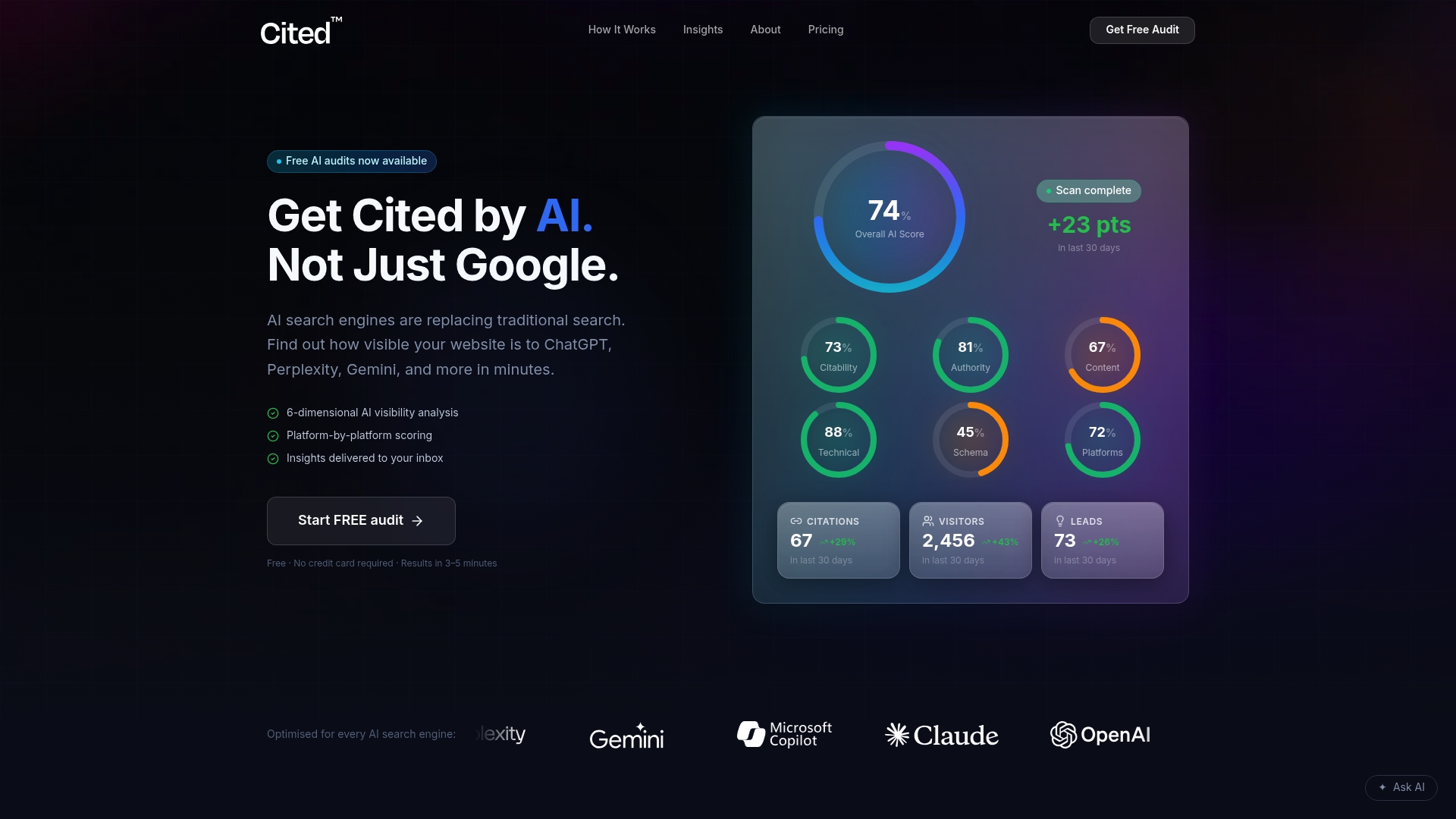
Most sites lose citations to fixable technical faults, not weak writing. Cited's free audit checks indexability, schema and provenance across all six dimensions and hands back a prioritised report, reviewed by a human technician rather than an algorithm alone.
- Free audit with no cost or card required.
- Technical fixes available as one-off services.
- Managed optimisation plans offered for ongoing support.
- Custom enterprise services with pricing available on request.
Run the free audit at Cited or book a call to talk through what a report is likely to find.
Sources
- Publisher CR final decision
- Top ways to ensure your content performs well in Google's AI experiences on Search
- CMA strengthens proposals allowing people choice over their search service
FAQ
What is E-E-A-T in AI search results?
E-E-A-T in AI search means the same four qualities Google defines for traditional search, experience, expertise, authoritativeness and trustworthiness, but proven through machine-readable provenance as well as good writing. A generative system needs to verify a claim's source before citing it, so schema, author pages and original evidence matter more than in a standard ranking context.
How do I know if my content is being cited by AI platforms?
Check the generative AI performance report inside Google Search Console for citation data, and watch for referral traffic from AI platforms in your analytics. Some platforms, including Bing Webmaster Tools' AI Performance feature, now expose citation counts directly, though citation counts alone are an incomplete measure of visibility.
Can SEO be done with AI, or does it undermine E-E-A-T?
AI can assist SEO work, drafting, research and technical audits included, without undermining E-E-A-T, provided a human verifies claims and the site discloses automated production where reasonable. Google's own guidance treats disclosed, verified AI assistance as compatible with people-first content standards.
Is SEO still worth doing given how much AI search has grown?
Yes: the technical and provenance work that improves AI citation likelihood, indexability, schema, author credentials, overlaps almost entirely with sound SEO practice. Traditional search still carries the majority of query volume, and the fixes that win AI citations tend to strengthen conventional rankings at the same time.
What is the CMA Publisher Conduct Requirement and why does it matter?
The Publisher Conduct Requirement is a regulatory decision that sets page and directory-level opt-out controls and attribution expectations for Google's generative AI features, as set out in the CMA's final decision. It gives publishers formal grounds to expect clearer transparency and referral reporting rather than relying on informal goodwill.
Recommended
Ready for your AI score?
See how visible your site is to ChatGPT, Perplexity & Gemini.
Start FREE auditResults in minutes · 100% free