

An AI audit score tests six key factors—citability, technical health, schema markup, authority, platform coverage, and answer quality—to predict whether AI search engines will cite your pages. The most common reason well-written pages go uncited is technical issues like robots.txt blocks or noindex tags that prevent crawlers from even seeing the content. To fix citations that stick, you need to run repeatable tests across multiple AI platforms, prioritize technical fixes first, then move to schema and content improvements, tracking results in a spreadsheet so you can prove what actually worked.
Stop Losing Citations: AI Audit Score in Six Dimensions for Businesses

An AI audit score measures how likely a page is to be cited by AI search engines, by testing six specific factors: citability, technical health, schema markup, authority, platform coverage and answer quality. The score itself is only a diagnostic. What matters commercially is the prioritised action list it produces. The human review that checks the findings make sense, and the ongoing monitoring that confirms fixes actually shift citations.
***
TL;DR: >- Technical eligibility issues like robots.txt, noindex tags, and blocked resources are the most common reasons a well-optimized page remains uncited by AI systems.- Schema markup only improves citation chances if it accurately matches the visible content and is properly validated before publishing.- Pages should start with a clear, concise answer and use descriptive headings, as AI search relies heavily on accessible, task-focused writing.- Testing across multiple platforms and recording exact prompts, citation details, and timing ensures a reliable measurement of citation progress over time.- Fixes involving content rewriting or schema restructuring are best handled by professionals to ensure coordination across disciplines and effective results.
***
Table of Contents
- What does an AI audit score measure? The six dimensions explained
- How do you run a defensible AI audit? A step-by-step checklist
- Which technical eligibility fixes usually block citation?
- Does schema markup actually improve your AI audit score?
- How do you write pages that AI search engines will actually cite?
- Why do different AI platforms cite different pages for the same query?
- Should you fix this yourself or bring in a supplier?
- How Cited turns your audit into fixes that stick
- Sources
- FAQ
What does an AI audit score measure? The six dimensions explained
Google's own guidance on AI features and your website sets out the areas a practical audit needs to cover, and each one answers a different question about why a page does or doesn't get cited.
- AI citability: does the page give a clear, complete answer that an AI system can lift and attribute without ambiguity?
- Technical health: can crawlers actually reach, render and index the page, or is something blocking them before content even gets assessed?
- Schema markup: does structured data exist, and does it accurately describe what's on the page?
- Authority: does the page carry earned editorial references and third-party citations that back up its claims?
- Platform coverage: has the page been tested across multiple AI engines, not just one?
- Answer quality: do headings and body text address the practical details a searcher needs, such as cost, timing and next steps?
A score that ignores any one of these areas will misdiagnose the problem. A page can have perfect schema and still never get cited because robots.txt blocks the crawler entirely.
How do you run a defensible AI audit? A step-by-step checklist
A defensible audit follows a repeatable sequence, not a one-off scan. Skipping steps or failing to record results is why most self-run audits produce numbers nobody can act on six months later.
- Establish a technical baseline. Run a free audit alongside Google Search Console checks: URL inspection, indexing reports and sitemap status.
- Test citation behaviour directly. Ask the exact questions a customer would ask across several AI platforms, then record the platform, the date, the prompt, the cited URL, the citation position, and whether the answer actually reflected the page correctly.
- Prioritise eligibility issues first. Fix anything blocking crawl, index or rendering before touching schema or copy, since no amount of editorial polish helps a page the crawler can't see.
- Move to schema and editorial fixes. Correct structured data, tighten page summaries, and address inconsistencies once eligibility is confirmed.
- Produce a prioritised action list. Map each fix to a specific page, the error it resolves, and the expected impact.
- Rerun the same tests on a schedule. Recheck Search Console data and rerun the identical prompts to see whether citations move.
Pro Tip: Keep a single spreadsheet row per test: platform, prompt, date, cited URL, position, accuracy check. Without that trail, you can't tell whether a score change came from your fixes or from the AI engine simply changing its behaviour.
Which technical eligibility fixes usually block citation?
Technical eligibility issues are the most common reason a well-written page never gets cited, and they're almost always invisible from the page itself. You have to check the machinery underneath, not the words on screen.
- Robots.txt, noindex tags and canonical headers: use URL Inspection in Search Console to confirm the page is actually indexable and that a canonical tag isn't quietly pointing elsewhere.
- Rendering and blocked resources: if scripts, stylesheets or lazy-loaded content stop a crawler from seeing what a human visitor sees, the AI system is working from a different, incomplete version of the page.
- Discoverability: confirm important pages sit in the sitemap and get reached through internal links, not just through a search box or a filtered URL.
- Hosting and CDN rules: check that firewall or bot-management settings aren't silently blocking recognised crawler IPs or user agents, a mistake that's surprisingly common on newly migrated sites.
Google Search Central is explicit that AI features rely on the same crawl, index and search systems as standard Search, so eligibility problems that hurt organic ranking hurt AI citation in exactly the same way. A page stuck behind a blocked resource or a stray noindex tag won't be rescued by better schema. For a deeper technical breakdown of crawl and render checks, Cited's guide to technical SEO for AI walks through the same eligibility gates in more detail.
Does schema markup actually improve your AI audit score?
Schema helps only when it matches what's visible on the page, and it does nothing on its own to fix a page that's thin or unclear. GOV.UK's developer documentation on schema.org structured data treats structured data as a machine-readable layer on top of content, not a replacement for it.
- Match markup to visible text. Invalid or misleading JSON-LD is worse than none, because it signals one thing to a crawler while the page says another.
- Choose schema by page purpose. Article schema for editorial content, FAQPage for genuine Q&A sections, Product and Offer for commercial pages, Author schema for building credibility.
- Validate before publishing. Google's structured data testing tool and rich result testing tool, plus the Bing markup validator, catch errors that are easy to miss by eye.
- Treat markup as support, not substitute. Clear headings and direct answers do the actual work; schema just makes that work easier to parse.
Google Search Central's own guidance notes that auditors should flag mismatched or duplicated markup even on pages that look heavily optimised, since duplication and mismatch are common on sites that have accumulated schema over several redesigns. Cited's analysis of whether schema markup actually gets you cited by AI search covers several cases where heavy markup made no measurable difference because the underlying text didn't answer the question.
How do you write pages that AI search engines will actually cite?
Editorial structure decides whether a technically sound page gets used, because AI systems still need to extract a clean answer from the text itself. Surrey County Council's guidance on writing for AI search links citability directly to accessible, task-focused writing.
- Open with a concise summary answer, then follow with details like eligibility, cost, timing and next steps.
- Use descriptive, task-focused headings that mirror how someone would actually phrase the question.
- Remove contradictory facts across pages. Keep one authoritative version of each fact and link to it, rather than restating slightly different figures on different pages.
- Convert critical PDFs into proper web pages with accessible text, since PDFs are harder for many AI systems to parse reliably.
- Use author pages and consistent author metadata to reinforce expertise and trustworthiness.
Pro Tip: Search your own site for the same fact stated two different ways, a price, a deadline, a phone number. Contradictions like these are one of the fastest ways to lose a citation, because the AI system has no reliable way to pick which version is correct. Cited's piece on author pages and EEAT covers how consistent bylines strengthen this signal further.
Why do different AI platforms cite different pages for the same query?
Different AI engines lean toward different domain mixes, and small changes to prompt wording can flip which source gets cited. Research on generative engine optimisation confirms that engines bias toward earned media and vary in cross-language stability and domain overlap, so a score built on a single platform or a single prompt tells an incomplete story.
- Test on multiple platforms. A page cited reliably by one engine may be invisible to another, and that gap is the finding, not noise.
- Record the exact prompt wording. Rephrasing a question slightly can change which sources get pulled in.
- Log platform, prompt, date, cited URL, citation position and a human accuracy check for every test run, so results are comparable over time.
- Expect a delay after fixes. Recrawl and reprocessing can take anywhere from days to months, so rerunning tests the next morning tells you nothing useful.
Should you fix this yourself or bring in a supplier?
DIY suits isolated technical fixes: a blocked robots.txt line, a missing canonical tag, a single schema error. It stops working once the job spans content rewrites, schema restructuring and engineering changes together, because coordinating three disciplines against one prioritised list is where most in-house teams stall.
Whichever route you choose, ask for the same deliverables: a human-reviewed baseline audit, a prioritised action list tied to specific pages and errors, and a measurement plan that records prompts and platforms over time. Cited runs exactly this model, a free baseline audit followed by paid implementation, for businesses who want the fixes made rather than just diagnosed.
— Tom Heaton
How Cited turns your audit into fixes that stick
The service runs the free baseline audit itself, then provides the implementation work most businesses actually need but rarely have the spare engineering time for. That's the practical gap between an audit report and a fixed website.
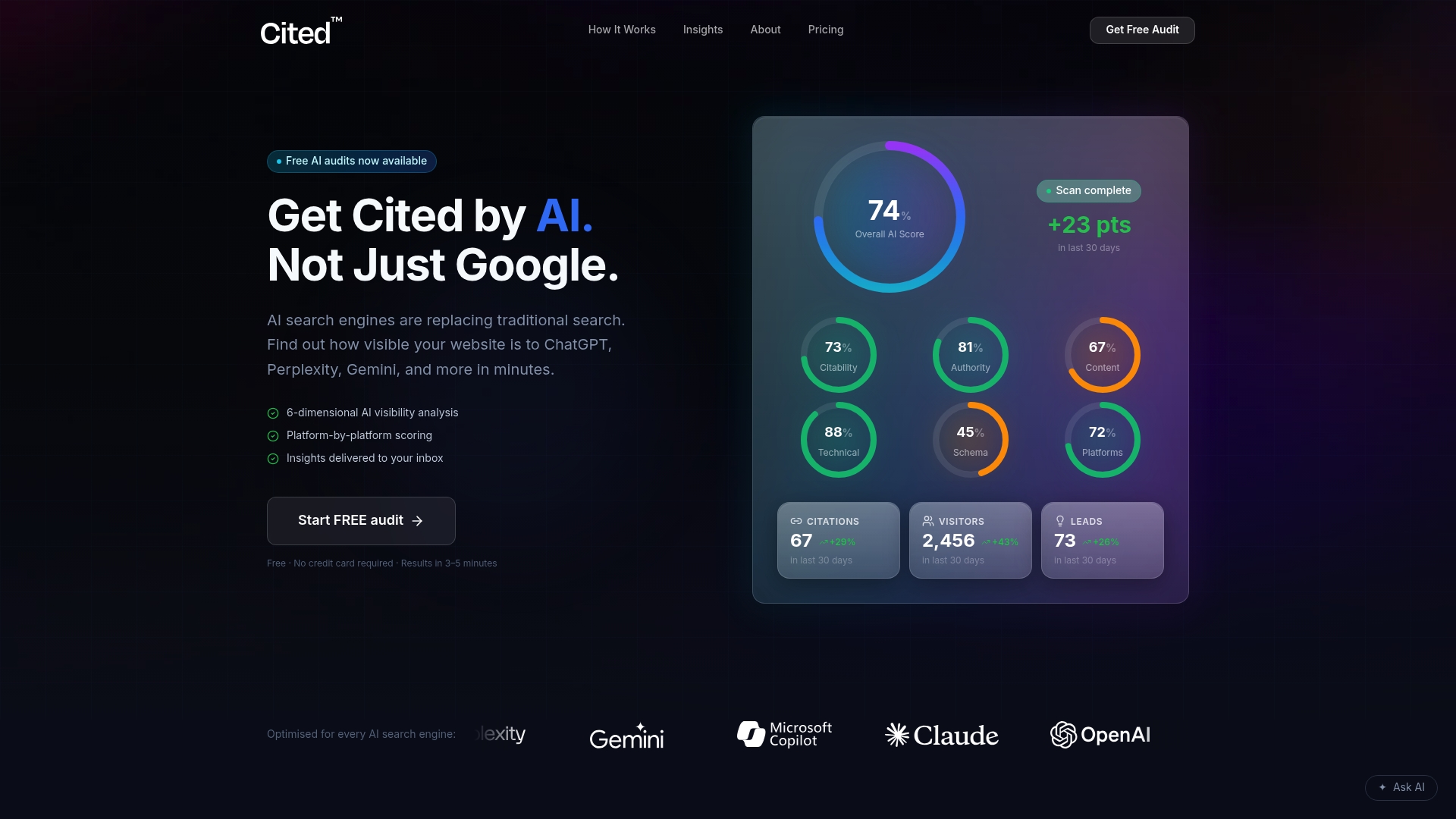
The Free GEO Audit needs no account and no card, and it comes back with a human-reviewed, prioritised action list, not just a raw score. From there, paid work covers whatever the audit actually finds: Technical Fixes from £495 one off for isolated eligibility problems, the AI Optimised plan from £995 per month for ongoing schema, editorial and monitoring work across a growing site, or a custom Enterprise project for larger estates. Every audit records the platform, the prompt and the citation position, following the same methodology detailed on how Cited measures AI visibility, so you can see whether a fix actually moved the needle rather than guessing. If your site currently gets skipped by ChatGPT, Perplexity or Gemini in favour of a competitor, start with the AI Audit and see exactly where it's losing citations.
Sources
- AI features and your website | Google Search Central
- Writing pages that work well for AI search | Surrey County Council
- Google Search Console
- Generative Engine Optimization: How to Dominate AI Search (arXiv)
- What data we expose as schema.org structured data - GOV.UK Developer Documentation
FAQ
What counts as a good AI audit score?
There's no universal passing number, since scores depend on the six dimensions and how a supplier weighs them. What matters more is whether the score comes with a prioritised action list tied to specific pages, because that's what actually changes citation outcomes.
How is an AI audit score calculated?
Most credible methodologies weigh technical eligibility (crawl, index, render) most heavily, since Google's guidance treats AI features as dependent on standard crawl and index systems. Schema accuracy, authority signals, platform coverage and answer quality are layered on top of that eligibility baseline.
Can schema markup alone fix a low AI audit score?
No. Structured data has to match the visible text on the page, and GOV.UK's developer documentation treats schema as a support layer, not a substitute for clear content. A page with excellent markup but a vague or contradictory answer still won't get cited reliably.
How often should you rerun an AI citation audit?
Rerun tests after implementing fixes, allowing for recrawl and reprocessing delays that can run from days to months. A monthly cadence works for most active sites, with an immediate rerun after any major technical change.
Does Cited only offer a free audit, or is there paid support too?
Cited offers a Free GEO Audit as the baseline, then paid implementation through Technical Fixes from £495 one off, the AI Optimised plan from £995 per month, or a custom Enterprise project for larger sites.
Recommended
Ready for your AI score?
See how visible your site is to ChatGPT, Perplexity & Gemini.
Start FREE auditResults in minutes · 100% free