
AI search engines like ChatGPT and Perplexity use third-party profiles on Google Business, LinkedIn, and Companies House as verification sources when deciding whether to cite your website. Keeping your business information consistent across all these platforms—including matching service descriptions and adding machine-readable identity files—significantly increases the chances that AI will trust and cite your site instead of directing users to competitor listings or review aggregators. The fastest wins come from synchronizing your name, address, and service copy everywhere, then publishing Schema.org markup that links these profiles together.
5 Step Checklist: Make Third Party Profiles AI Citable for Tech Teams
Yes, active and consistent third-party profiles materially increase the chance that AI search engines will cite your site. Platforms like Google Business Profile, LinkedIn, and Companies House act as corroborating evidence for AI systems deciding what to trust. The fastest fixes are synchronising your name, address, and service copy everywhere; publishing Schema.org markup with sameAs links; adding AI discovery files; and checking your reviews for integrity. We run a free AI audit that checks all four in minutes.
***
TL;DR: >- Ensuring all external profiles are accurate, consistent, and include live verification files significantly increases the likelihood of AI search engines citing your site.- Prioritizing Google Business Profile, LinkedIn, and Companies House verification improves AI confidence, with alignment across these profiles reducing hedging or omission.- AI systems corroborate claims across independent sources, so mismatched or outdated external data often leads to your site being displaced by third-party listings or reviews.- Publishing identical service descriptions and machine-readable identity files at your website's root helps AI engines reliably match your brand across platforms.- Regularly auditing your discovery files, crawlability, and review patterns prevents common issues that inhibit AI citation and ensures ongoing visibility.
***
Table of Contents
- Which third-party platforms do AI engines use to verify your business?
- How does an AI engine decide what to cite from all this data?
- What is the prioritised checklist for making your profiles AI-citable?
- How do you audit and monitor citation likelihood across engines?
- Where do most businesses go wrong with their AI visibility setup?
- Get your free AI audit and see what needs fixing
- FAQ
- Sources
Which third-party platforms do AI engines use to verify your business?
AI systems treat external profiles as verification nodes rather than marketing afterthoughts. Each platform confirms a different fact about your business, and together they build the kind of corroborated identity that AI re-rankers favour when deciding what to cite.
Google Business Profile confirms your category, location, and live review signal. LinkedIn company pages confirm your workforce size, sector, and leadership claims. Companies House confirms your legal identity and trading status, which matters more for AI trust scoring than most marketers assume. Review platforms and aggregated review counts confirm reputation at scale, while Wikipedia and Wikidata, where they exist for your organisation, confirm notability and structured facts that other engines can cross-reference.
For B2B technology businesses, prioritisation matters because resources are finite:
- Verify and complete Google Business Profile first: it is the most frequently cross-checked node for category and location accuracy; our Local SEO checklist for UK businesses offers practical guidance on synchronising your profile data effectively.
- Fix LinkedIn company page details second: inconsistent employee counts or descriptions are a common source of AI hedging.
- Confirm Companies House details match your public-facing copy, since legal name mismatches undermine corroboration.
- Claim or correct listings on relevant trade and industry directories, since these are often the tie-breaker citation an AI engine chooses over a generic one.
Review platforms and Wikidata entries follow once the above are stable.
How does an AI engine decide what to cite from all this data?
AI engines triangulate claims across independent sources before deciding whether to repeat them with confidence. When your website, your Google Business Profile, and your LinkedIn page all state the same service description, an AI system can corroborate that claim and cite it with fewer caveats. When the three disagree, the system tends to hedge, omit the claim, or cite a third-party directory instead of your own site.
This matters because different AI engines run on different indexes and re-ranking models. AI Visibility's analysis of how AI search works explains that engines triangulate claims across independent sources and apply distinct re-rankers, so coverage that satisfies ChatGPT does not automatically satisfy Perplexity or Claude. A business visible in one engine's index can be invisible in another's simply because its external profile data was built for a single platform.
The practical consequences show up in three ways:
- Hedged answers: the AI engine describes your offer vaguely rather than stating a specific fact it cannot corroborate.
- Omission: your site is dropped from a result set entirely because no external source backs the claim.
- Displacement: the AI engine cites a directory listing or review aggregator about you rather than your own homepage.
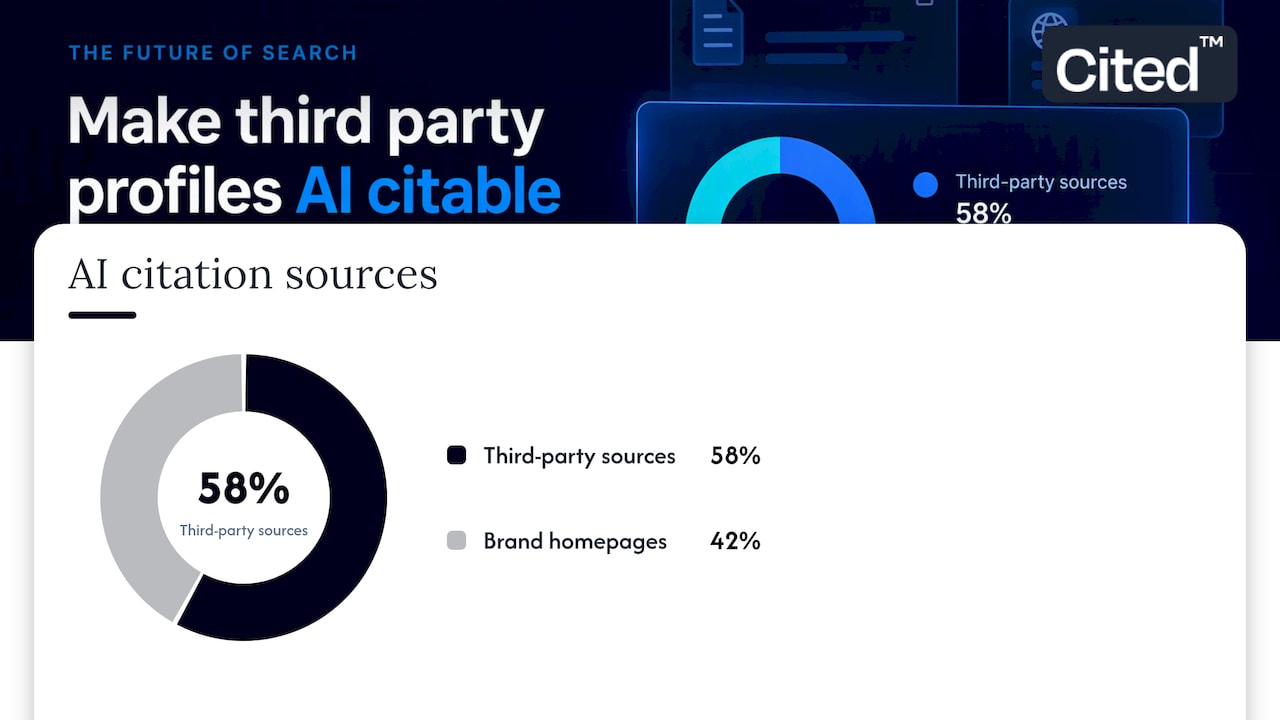
Research on AI citation behaviour shows how often this displacement happens: nearly 58% of content cited by AI systems is informational, comparative, or selection-oriented, meaning engines frequently pull from third-party ecosystems rather than brand homepages. If your own site is not extractable or corroborated, a third party fills the gap.
What is the prioritised checklist for making your profiles AI-citable?
Start with the data a reader or crawler sees first, then move to machine-readable signals, then to access and governance. Working in this order avoids fixing schema while your human-readable copy still contradicts it.
- Write one canonical service description and use it verbatim across your website, your Schema.org markup, and every external profile; identical phrasing in sameAs-linked pages is what lets an AI engine match them with confidence.
- Publish Schema.org Organization or LocalBusiness markup with sameAs links pointing to your verified Google Business Profile, LinkedIn page, and Companies House entry; keep your core identity lines (name, address, service list) in plain HTML, not rendered only by JavaScript, because technical SEO guidance for AI crawlers notes that AI crawlers favour short, factual paragraphs they can extract without executing scripts.
- Publish AI discovery files at your site root: llms.txt, identity.json, and ai.txt. AI Visibility's three-step guide recommends these alongside matching sameAs links as the clearest machine-readable identity signal you can offer. Include attribution terms and crawler permissions directly in ai.txt, and validate the files render correctly once live.
- Confirm crawl access for major AI crawlers: test that GPTBot, ClaudeBot, and PerplexityBot are not blocked by a Cloudflare challenge or a restrictive robots.txt, then log crawler hits in your server logs to confirm fetches are actually happening.
- Govern your reviews: publish a review moderation policy, monitor for suspicious review patterns, and follow CMA guidance on publishing consumer reviews, which recommends automated detection and proportionate removal of fake or misleading reviews.
Pro Tip: Place a single canonical identity paragraph in plain HTML above the fold on your homepage, then run an extraction test; this one change often moves a site from non-extractable to extractable for AI engines.
How do you audit and monitor citation likelihood across engines?
Run a structured audit before touching any copy, so fixes target the actual failure points rather than guesswork. A full pass checks discovery files, crawlability, extraction, schema validity, and review signals in sequence, which is the same order our methodology uses across the six dimensions we score.
- Verify llms.txt, identity.json, and ai.txt are live and correctly formatted at your root domain.
- Run a crawlability check to confirm GPTBot, ClaudeBot, and PerplexityBot can reach your key pages without a challenge page blocking them.
- Test extraction by submitting a key page's URL into each engine and recording whether it quotes your copy or paraphrases from a third party.
- Validate that every sameAs link resolves and that the linked profile's data matches your canonical description.
- Check review platforms for flagged or inconsistent review patterns that could trigger CMA-related removal.
Spot-check each engine directly: ask Perplexity, ChatGPT, Gemini, and Claude a question your business should answer, and record whether it cites your site, a directory, or nothing at all.
Monitoring activity | What it tells you | Suggested cadence |
|---|---|---|
Discovery file validation | Whether llms.txt, identity.json and ai.txt are live and correctly formatted | Monthly |
Crawler fetch logs | Whether GPTBot, ClaudeBot and PerplexityBot are actually reaching your site | Monthly |
Citation appearance tracking | Whether engines cite your domain or a third-party page for key queries | Quarterly |
sameAs and schema validation | Whether external profiles still match your canonical description | Quarterly |
Our guide on measuring AI search visibility sets out how to turn these checks into a repeatable monitoring routine rather than a one-off exercise.
Where do most businesses go wrong with their AI visibility setup?
We see the same failure modes repeatedly. Service descriptions drift apart across the website, LinkedIn, and directory listings within months of being set up, because nobody owns the canonical copy. SameAs links point to outdated or merged profiles. Reviews get flagged for manipulation because nobody is monitoring patterns against CMA guidance. Crawlers get blocked by a security rule nobody remembers adding.
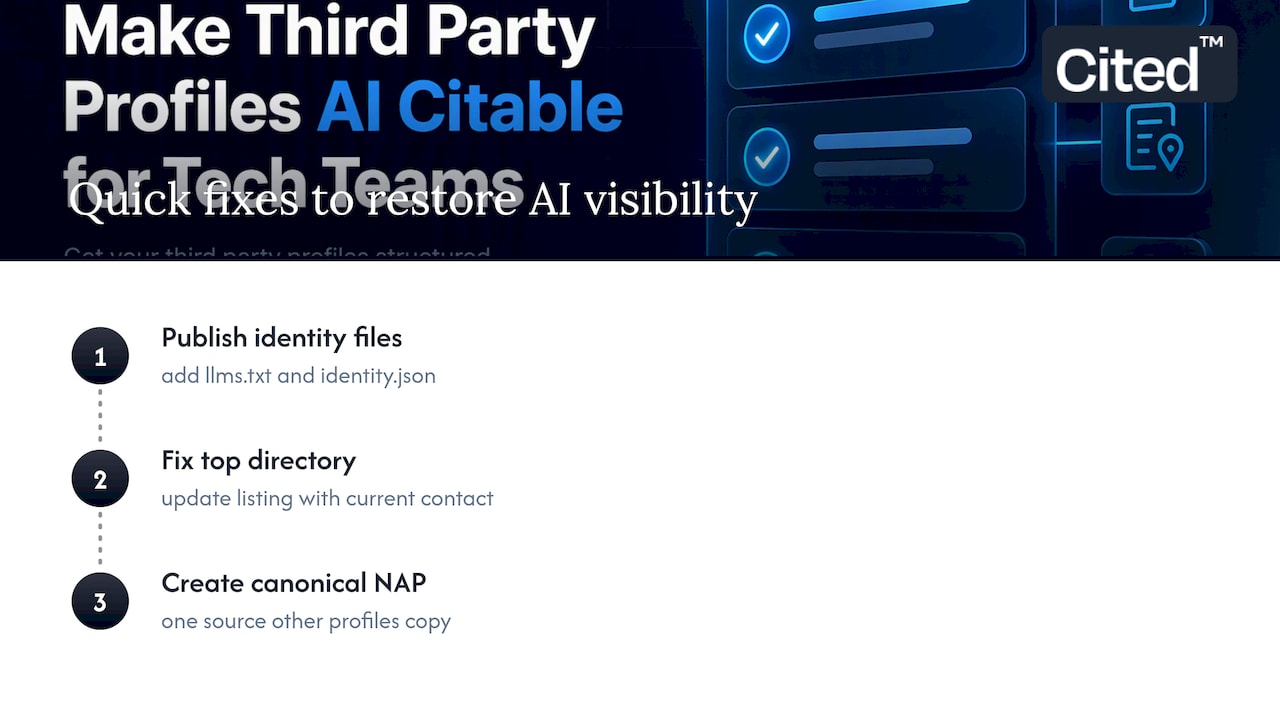
The quickest wins are deliverable within a week: publish llms.txt and identity.json, fix the single highest-traffic directory listing that still shows old contact details, and make one canonical NAP record the source every other profile copies from. These three moves alone resolve most of the hedging and omission we see in early audits.
A one-off technical fix suits a business with a stable profile set and a single sync problem to solve. A managed optimisation subscription suits a business whose listings, schema, and reviews need ongoing attention as platforms change their requirements.
— Tom Heaton
Get your free AI audit and see what needs fixing
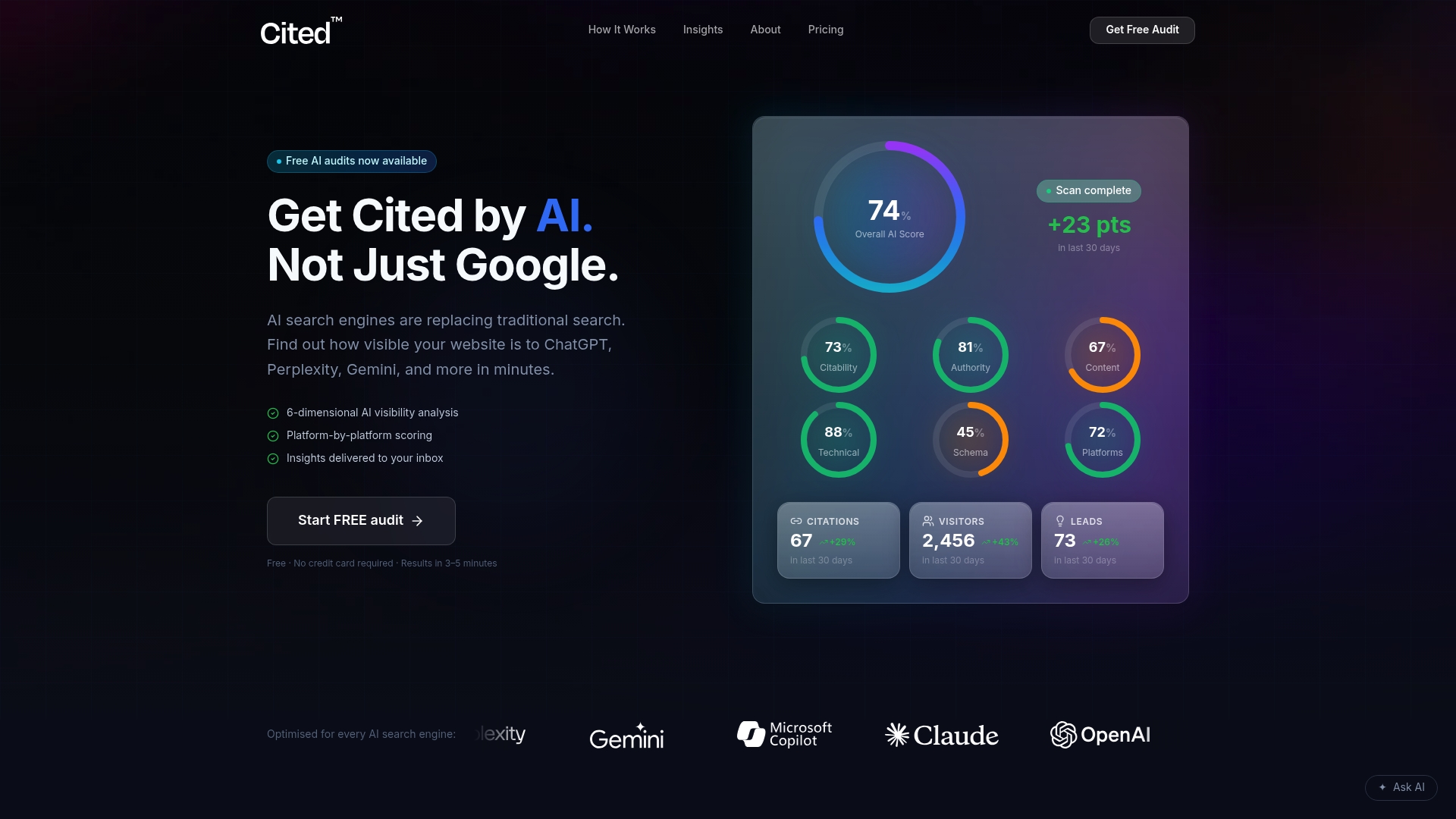
Once you have your results, the path forward depends on what the audit finds:
- A narrow technical gap, such as missing discovery files or broken sameAs links, suits our one-off Technical Fixes service from £495.
- Ongoing drift across multiple profiles and platforms suits our AI Optimised monthly plan from £995 per month.
- Larger organisations with multiple locations or brands can discuss an Enterprise engagement, priced on request.
Book a call once you have your audit results to talk through which option fits your setup.
FAQ
Do third-party reviews affect whether AI engines cite a business?
Yes. Review platforms contribute to the corroboration AI engines look for, and the CMA's guidance for businesses recommends monitoring and removing fake or misleading reviews because manipulated review data undermines that trust signal. Businesses that actively manage review integrity tend to see more consistent citation behaviour than those that ignore flagged patterns.
What is an AI discovery file like llms.txt?
An AI discovery file is a machine-readable document published at your site root that tells AI crawlers how to identify and attribute your content. AI Visibility's guide to appearing in AI search recommends publishing llms.txt and identity.json alongside matching sameAs links as a core identity signal.
How has Google changed its handling of fake reviews?
Google has secured formal undertakings with the CMA to tackle fake reviews, published on 24 January 2025. The undertaking itself sets reporting mechanisms, removal thresholds, and investigation policies for business listing pages.
Why would an AI engine cite a directory listing instead of my website?
This happens when your own site is harder to extract from or less corroborated than the directory entry. Research shows that content cited by AI systems is frequently sourced from third-party ecosystems rather than brand homepages, particularly for comparative or selection-oriented queries.
Sources
- Gov
- How AI search works: ChatGPT, Claude, Gemini, Perplexity | AI Visibility
- Google's undertaking to the CMA - PDF
Recommended
Ready for your AI score?
See how visible your site is to ChatGPT, Perplexity & Gemini.
Start FREE auditResults in minutes · 100% free