
To improve your chances of appearing in Gemini search results, you need to clear three hurdles: make sure your pages are indexed and not excluded from AI features, write answers upfront in your content so retrieval systems can extract them cleanly, and add readable text to images, tables, and videos so they can be cited. Start by checking your indexing status and AI control settings in Search Console before you rewrite anything.
Three fixes that improve your odds of Gemini search optimize success
Three actions move the needle most: make sure the page is indexable and not excluded from Search generative AI features, write answer-first passages that a retrieval system can lift cleanly, and give your images, tables and video real retrievable text. Each one addresses a different failure point. If a page cannot be crawled or is excluded, it never enters the pool Gemini draws from. If the content buries its answer in paragraph four, retrieval systems struggle to extract a clean passage. If your best evidence sits inside an infographic with no surrounding text, it is invisible to a system reading HTML, not pixels.
Before touching content, run two checks:
- Confirm the URL is indexed and not excluded via the Search generative AI control in Search Console.
- Check whether the page already shows impressions in the generative AI performance report.
Key takeaways
Gemini citation depends on clearing indexing and AI-control hurdles first, then writing retrievable answer-first passages backed by real evidence and readable multimodal text.
Point | Details |
|---|---|
Check indexing and AI control | Confirm the URL is indexed and not excluded via the Search generative AI control before rewriting content. |
— | Put the direct answer in the first sentence under each heading so it can be extracted cleanly. |
Cite your own sources | Back claims with inline links to authoritative sources rather than unsupported assertions. |
Make visuals readable | Add descriptive alt text, table captions and transcripts so non-text assets can be cited. |
Get an audit from Cited | Cited's free audit checks all six citability dimensions and maps findings to fixes you can act on immediately. |
Table of Contents
- How do you apply foundational SEO for Gemini search optimize results.
- What makes a passage citation-ready for Gemini?
- Which technical checks confirm a page is eligible for AI features?
- How do you make images, tables and video retrievable for Gemini?
- How do you measure Gemini search visibility and know when to act?
- What are the biggest myths about Gemini search optimization tactics?
- How does Cited apply this checklist to your site?
- Author perspective: prioritise quick wins and measure before scaling
- Get your free Gemini and AI visibility audit
- Sources
- FAQ
How do you apply foundational SEO for Gemini search optimize results.
Google's own guidance on generative AI features is blunt about this: the fundamentals that worked for classic Search still carry the weight. Nothing exotic replaces them. What changes is how precisely you apply them.
- Structure answer-first passages. Put the direct answer in the first sentence or two under each H2 or H3, then expand. A heading like "What does a 404 error mean?" followed immediately by a two-sentence definition gives a retrieval system a clean, quotable unit. Bury that answer under three paragraphs of scene-setting and it becomes harder to extract.
- Consolidate near-duplicate pages. Five thin pages targeting slight keyword variations dilute authority and confuse which URL should be cited. One authoritative page, covering the topic properly, beats five competing for the same query.
- Fix internal linking and canonicalisation. Link from high-traffic pages to the ones you want surfaced, and check canonical tags point to the version you actually want indexed. Well-structured internal links help both crawlers and readers find your best material.
- Add structured data where it's accurate, not as a shortcut. Schema helps machines parse what's already visible on the page. It never substitutes for clear writing.
Pro Tip: Read your own H2 out loud, then read only the next sentence. If that sentence doesn't answer the question in the heading, a retrieval system will skip past it too.
What makes a passage citation-ready for Gemini?
Gemini's grounding process, documented in the Gemini API, generates search queries, executes them, and returns responses with inline citation annotations pointing back to source URLs. That means the passage doing the work needs to stand on its own as evidence, not lean on branding or vague authority claims.
- Byline the author. A name with brief credentials, linked to an author page, signals a real person stands behind the claim.
- Cite your own sources inline. A concise, evidence-backed passage with an outbound link to a primary source (a regulator, a peer-reviewed study, an official standard) reads as more trustworthy than an unsupported assertion, and it gives the grounding process a stronger fact to anchor to.
- Use FAQ format only where it genuinely answers a discrete question. A well-scoped Q&A with FAQPage schema can retrieve cleanly. Stretching one long explanation into ten artificial questions just fragments the argument and adds no value.
Structured content optimisation built around these habits tends to outperform pages stuffed with keywords but light on verifiable substance, largely because it gives a generative system something concrete to quote rather than paraphrase loosely.
Pro Tip: If you can't name the specific source your claim rests on, that's usually a sign the claim needs rewriting, not just a citation bolted on afterwards.
Which technical checks confirm a page is eligible for AI features?
A page has to clear three technical hurdles before content quality matters at all: it must be indexed, it must return a visible snippet, and it must not be blocked in robots.txt.
- Run a URL Inspection in Search Console and check the live test result, not just the last crawl.
- Confirm robots.txt isn't disallowing the path, and that the page returns a 200 status rather than a soft 404.
- Check the Search generative AI control setting for the property. If a site owner has selected "exclude," that page cannot appear in Google's generative AI features, though it remains fully eligible for standard Search results. This is a distinct setting from robots.txt and it is worth checking separately, because the two controls don't overlap.
- After making changes, request indexing and monitor recrawl timing rather than assuming an instant update.
Practical sequence when a page underperforms:
- Verify indexing status first.
- Check the AI control setting second.
- Only then look at content structure and quality.
Skipping straight to a content rewrite when the real problem is an excluded setting wastes a week of effort on the wrong fix.
How do you make images, tables and video retrievable for Gemini?
Gemini reads text, not pixels, so any evidence locked inside a graphic needs a text equivalent sitting next to it. Descriptive alt text that names the actual figures shown, semantic HTML tables with proper captions, and video transcripts all give a generative system something to extract and quote.
- Write alt text that summarises the data point, not just the file name ("Bar chart showing UK conversion rates rising from 2.1% to 3.4% between 2023 and 2025" beats "chart1.png").
- Use
<table>markup with a caption, not an image of a spreadsheet. - Add a 100–200 word plain-text summary directly beneath any infographic, a habit that meaningfully improves citation chances for visual data.
- Embed full transcripts for video, and caption any image used as supporting evidence rather than decoration.
Pro Tip: Treat every chart as if the design will be stripped away and only the surrounding text will survive. Would that text alone still make your point?
How do you measure Gemini search visibility and know when to act?
The generative AI performance report in Search Console is the primary diagnostic tool here. It shows impressions for AI Overviews and AI Mode, and you can filter by page, country and device to see exactly where visibility is building or stalling.
- Pull the report weekly at first, filtered to your priority pages, to establish a baseline.
- Compare impressions against the indexing and AI-control checks from earlier. A page with zero impressions despite being indexed and included usually has a content problem, not a technical one.
- Watch engagement quality on any traffic that does arrive, since Google's own guidance frames quality engagement as the better success signal rather than raw click volume.
Dimension | What it tells you |
|---|---|
Page | Which URLs are generating AI impressions and which are invisible |
Country | Whether visibility varies by market or language |
Device | Whether mobile and desktop AI surfaces treat the page differently |
If a page gets impressions but no clicks, the answer in the AI response may already be satisfying the query fully, worth checking against how you're measuring AI search visibility more broadly. If a page gets no impressions at all, go back to the technical checklist before touching the content.
What are the biggest myths about Gemini search optimization tactics?
The most damaging myth is that opting out of AI features somehow protects your rankings elsewhere. It doesn't work that way, and it doesn't need to.
- Excluding a site from Search generative AI features removes it from those AI surfaces only. It has no effect on standard Search rankings, and Google has never claimed that a high ranking position guarantees a citation in an AI response.
- Mass "mention" campaigns, buying scattered brand references across low-quality sites, do not reliably increase citation likelihood. Grounding relies on retrievable, relevant content, not volume of unrelated mentions.
- Artificially chopping one article into a dozen thin pages to "match chunk size" backfires. It dilutes authority rather than improving retrievability.
- There is no special AI-only file or protocol required to appear in generative AI features. The controls that exist, robots.txt and the Search generative AI setting, are the same ones already documented for standard Search.
How does Cited apply this checklist to your site?
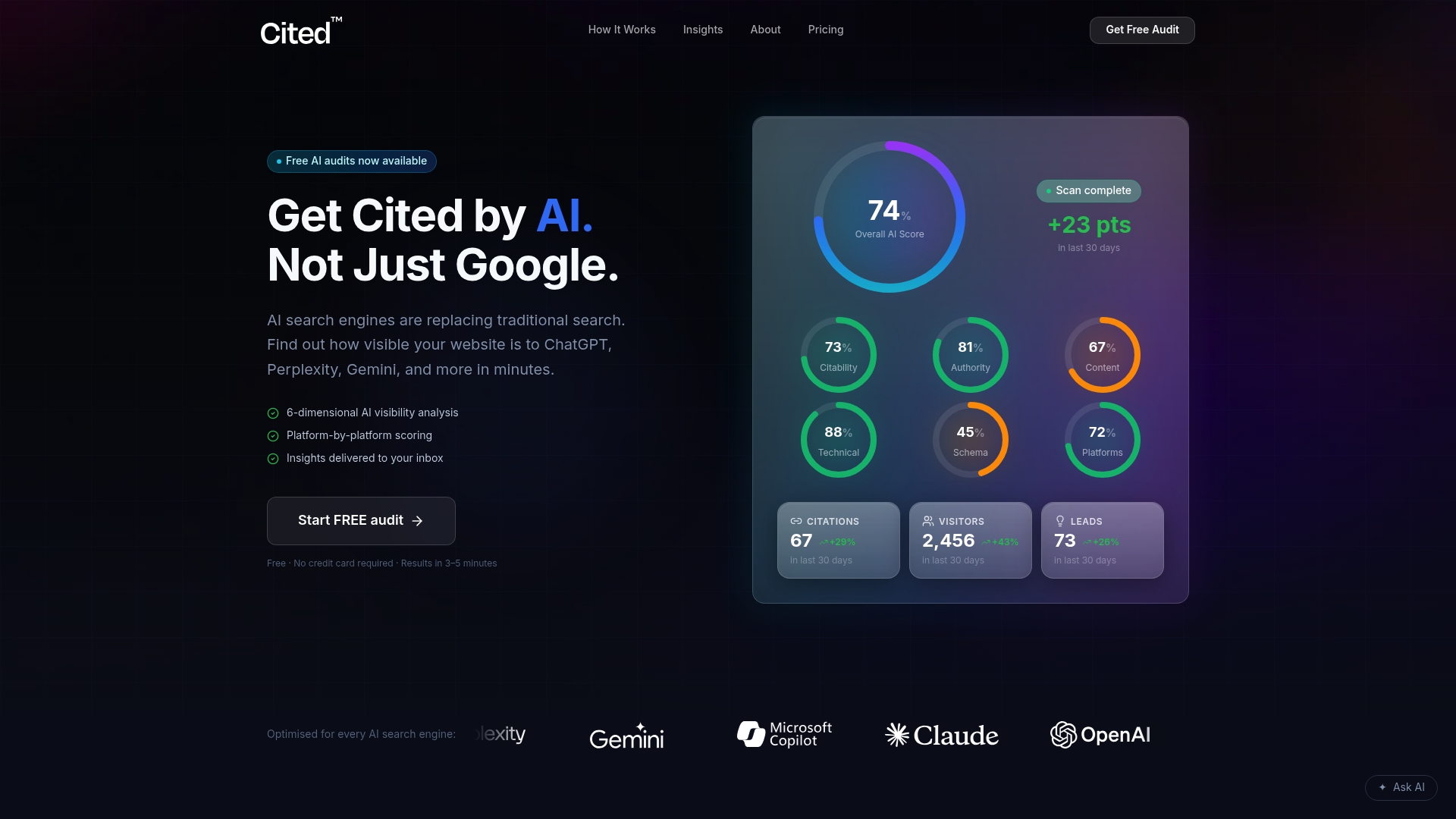
Cited runs a free audit across six dimensions of AI citability: technical health, indexing and AI control settings, structured data accuracy, content quality, authority signals and platform coverage across ChatGPT, Perplexity, Gemini, Claude and Copilot. Each finding maps directly to a task covered above, so you get a specific list rather than a generic score.
- Technical Fixes (£495 one-off) covers indexing, robots.txt, canonicalisation and AI control corrections.
- AI Optimised (£995/month) adds ongoing content and structured data work as the generative AI performance report shifts.
- Enterprise projects are scoped individually for larger sites with multiple properties.
Start with the free audit at cited.best/audit and book a follow-up call once you have the findings in hand.
Author perspective: prioritise quick wins and measure before scaling
The fastest wins in most audits are the boring ones: fixing an accidental robots.txt block, correcting a mis-set AI control, and rewriting the first two sentences under a heading so they actually answer it. In-house teams can usually handle those three alone. Structured data audits and ongoing multimodal rewrites are where outsourcing tends to pay for itself, because they need consistent attention rather than a one-off fix. In audits Cited has run, correcting an excluded AI control setting alone has been enough to move a page from zero to measurable AI impressions within weeks.
— Tom Heaton
Get your free Gemini and AI visibility audit
Hiring an agency to chase AI citations usually means a lengthy discovery phase before anyone touches your site. Cited skips that: the free audit runs across six dimensions of AI citability, technical health, schema accuracy, authority signals and platform coverage, and hands you a findings list within days, not weeks.
If the audit turns up an excluded AI control setting or a blocked path in robots.txt, that alone can be worth fixing before anything else on this page. From there, Technical Fixes at £495 one-off handles the structural corrections, while AI Optimised at £995 a month keeps content and structured data aligned as Google's generative AI features evolve. Larger sites with multiple properties can scope an Enterprise project instead.
Run the free AI visibility audit now, then book a call to walk through the findings and decide what needs fixing first.
Sources
- Optimizing your website for generative AI features on Google Search — Google Search Central
- Search generative AI control — Google Search Console Help
- Grounding with Google Search — Gemini API docs
FAQ
How do you optimise for AI search generally?
Confirm the page is indexed and not excluded from AI features, write answer-first passages with clear evidence, and make images, tables and video readable as text. These three steps address the most common reasons pages get overlooked by generative systems.
What counts as good search engine optimisation today?
Good SEO still means crawlable pages, clear structure, and genuinely useful content backed by credible sources. That foundation, confirmed directly by Google's own generative AI guidance, hasn't been replaced by AI search, it's been extended by it.
Can you use Gemini as a search engine?
Gemini can generate search queries and return grounded responses with inline citations when it uses grounding with Google Search, though not every response includes sources. It functions more as an answer layer over search than a direct search engine replacement.
What replaced Google Optimize?
Google Optimize, the A/B testing tool, was sunset and is unrelated to Gemini search optimisation or AI citation work. If you're looking for tools to measure AI search visibility specifically, the generative AI performance report in Search Console is the relevant successor concept for this context, not a direct product replacement.
Does excluding my site from AI features hurt my rankings?
No. The Search generative AI control only affects whether your pages appear in AI-powered features. Standard Search rankings are unaffected either way, according to Google's own documentation on the setting.
Recommended
Ready for your AI score?
See how visible your site is to ChatGPT, Perplexity & Gemini.
Start FREE auditResults in minutes · 100% free