

Brand monitoring in 2026 means tracking whether AI engines like ChatGPT and Perplexity are actually citing your website, not just monitoring social media mentions. Traditional social listening tools can't tell you if AI systems are using your content, which is what determines your visibility in AI search results. Start by checking whether AI crawlers can access your pages, then ensure your content has proper structure and schema markup so AI engines can extract and cite it.
Best brand monitoring tools for UK businesses in 2026
The best brand monitoring tools for UK businesses in 2026 are AI citation trackers: services that detect when ChatGPT, Perplexity, Gemini, and Google AI Overviews include your site in their generated answers. Social listening tools track mentions across news and social feeds, but they cannot tell you whether an AI engine is citing your pages or ignoring them. That distinction is what determines your visibility in AI search.
Start with a free AI visibility audit from Cited. The audit returns a diagnostic score and a prioritised fix list within days. The first checks it runs are:
- Crawler access: whether OAI-SearchBot, PerplexityBot, and Bingbot can reach your pages
- Schema markup: Article, FAQ, and Organisation structured data
- FAQ structure: machine-readable question-and-answer blocks that AI engines can extract
- Indexability: canonical URLs, sitemap submission, and server-side HTML rendering
***
Table of Contents
- How do you measure whether AI engines are citing your site?
- What technical fixes increase the chance AI models cite your pages?
- What does a practical AI citation audit include?
- How does Cited help UK businesses improve AI citations?
- Key takeaways
- The gap between monitoring and actually getting cited
- Get your free AI citation audit from Cited
- Useful sources
- FAQ
How do you measure whether AI engines are citing your site?
Measure both referral traffic and citation presence. Analytics alone will undercount citations significantly, because many AI-generated answers cite sources without producing a click.
- Open Google Search Console and review the Performance report filtered to the Web search type. Google counts AI Overviews and AI Mode interactions under this type, so impression and click data there reflects AI feature exposure.
- Add a citation tracker. Dedicated AEO tools log citation frequency, benchmark share of voice, and provide prompt monitoring, which is necessary because many citations do not create referral clicks. Tools in this category include HubSpot's AEO tool, Xfunnel, and GenAI Lens.
Combining analytics referral filters with dedicated citation trackers and manual checks builds the most complete picture. Referral data tells you about clicks; citation trackers tell you about visibility; manual checks validate both.
***
What technical fixes increase the chance AI models cite your pages?
Fix accessibility and structure first, then content clarity and entity signals. A page that retrieval crawlers cannot reach will never be cited, regardless of how well it is written.
Priority checklist:
- Allow OAI-SearchBot, PerplexityBot, and Bingbot in your
robots.txt. Blocking OAI-SearchBot removes your site from ChatGPT's retrieval consideration entirely, whereas blocking GPTBot only prevents training-data use. Many UK businesses block both by mistake. - Confirm pages render as HTML on the server. Client-side JavaScript rendering means retrieval crawlers often see a blank page.
- Submit your sitemap to Google Search Console, Bing Webmaster Tools, and use IndexNow to notify Bing and its partners of new or updated pages promptly.
- Publish an
llms.txtfile at your domain root to guide AI engines towards your most citable pages. - Add Article, FAQPage, and Organisation schema. A FAQPage schema block pairs each
Questionwith anacceptedAnswer, giving the model a clean, extractable unit. Schema and clean HTML structure improve the chance of being eligible for citation. - Check canonicalisation: every page should have a single canonical URL, and duplicate or near-duplicate pages should be consolidated.
For a quick robots.txt allow rule, the relevant directive is:
```
User-agent: OAI-SearchBot
Allow: /
```
A developer can audit robots.txt, server firewall rules (including Cloudflare bot-fight settings), sitemap submission status, and server-side rendering in 30–90 minutes. These checks alone often surface the single fix that restores citation eligibility. Cited's Insights piece on making sure AI bots can access your website covers the server-log verification step in detail.
Pro Tip: Blocking GPTBot and blocking OAI-SearchBot are not the same action. GPTBot governs training data; OAI-SearchBot governs live retrieval. Check both directives separately in your robots.txt before assuming ChatGPT can reach your pages.
***
What does a practical AI citation audit include?
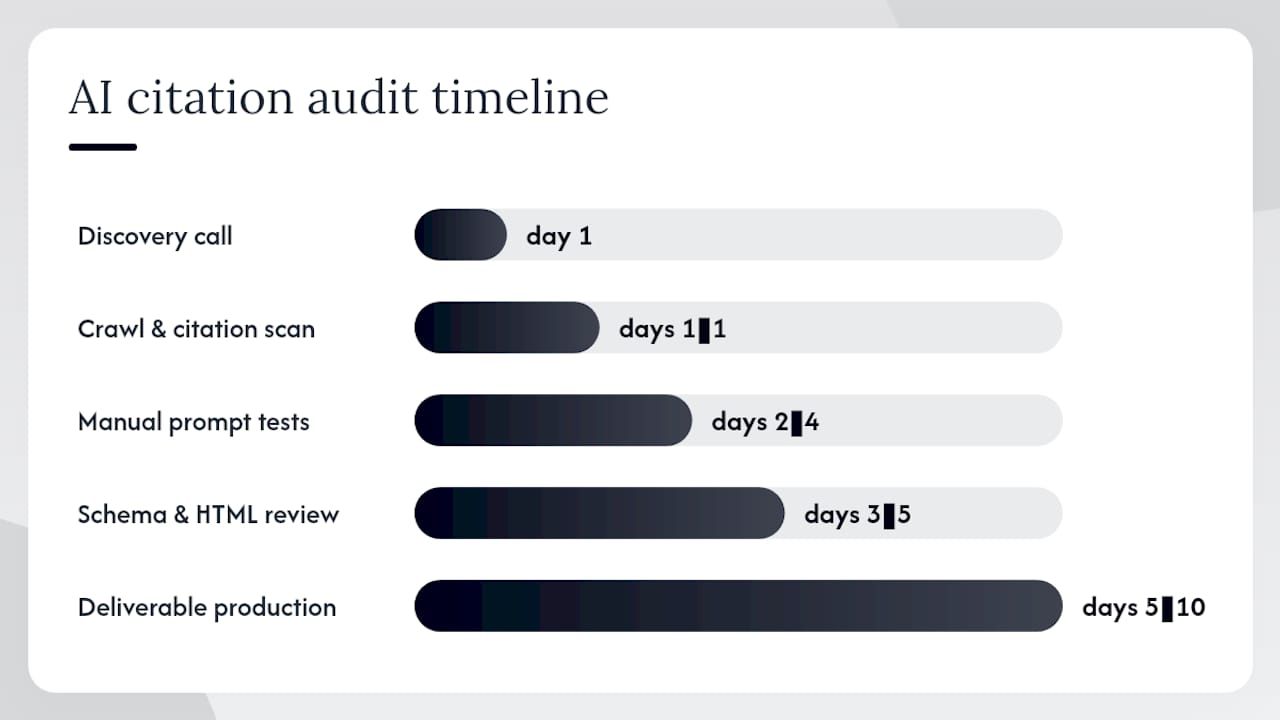
A good audit runs technical checks, citation discovery, content mapping, and a prioritised fix list. The process typically takes 3–10 working days for a small business site.
- Discovery call (day 1): scope the site, agree target queries, and identify priority pages.
- Automated crawl and citation scan (days 1–3): check crawler access, HTML rendering, schema, canonicalisation, and run citation queries across engines.
- Manual prompt tests (days 2–4): query ChatGPT, Perplexity, and Gemini with target questions and record which pages are cited, if any.
- Schema and HTML review (days 3–5): validate structured data, check FAQPage and Article markup, and flag missing or malformed blocks.
- Deliverable production (days 5–10): compile findings into a diagnostic report.
Deliverables from a complete audit:
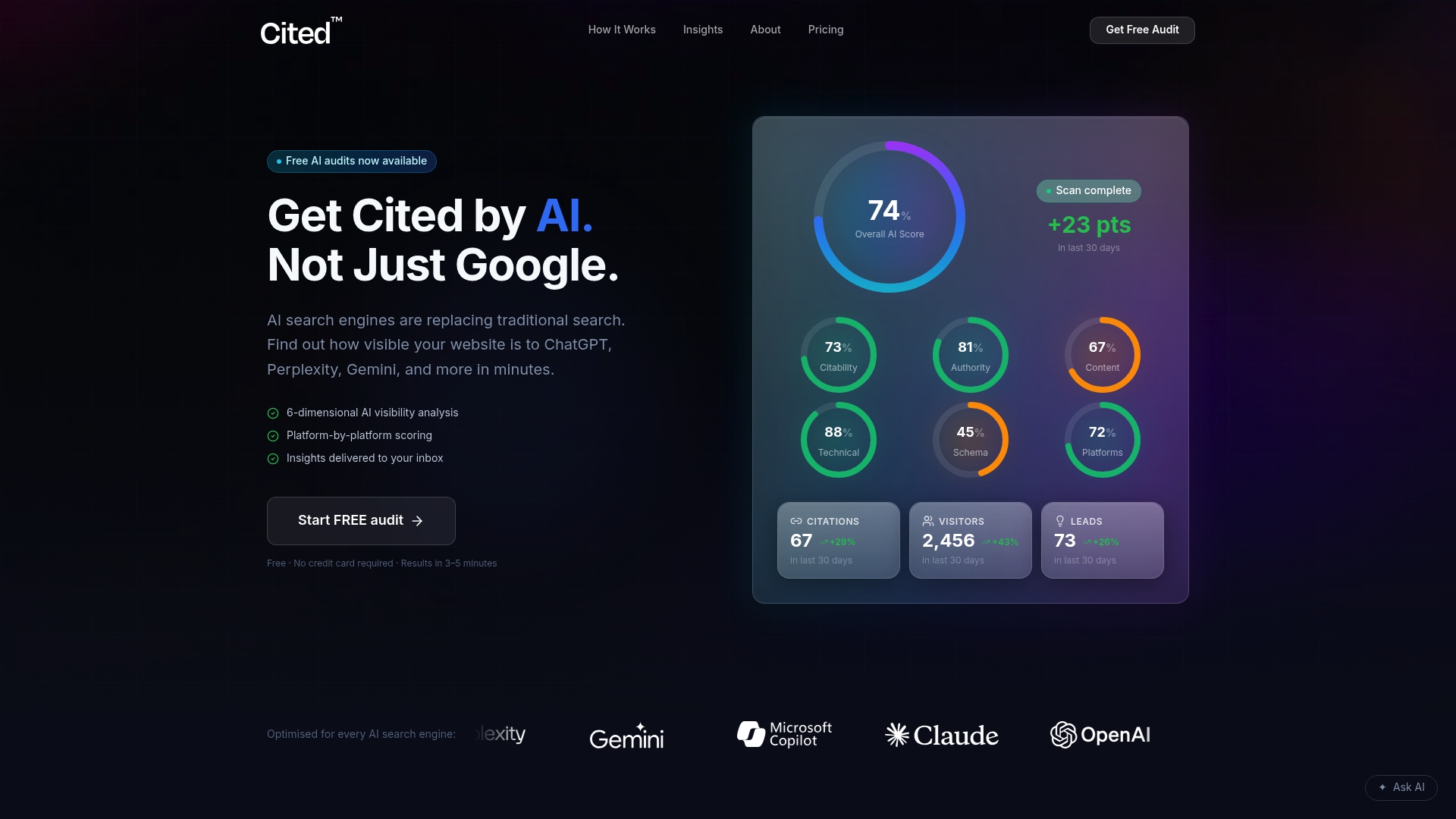
- Diagnostic report with a citability score across six dimensions
- Prioritised fix list with effort and impact ratings
- Implementation tickets ready for a developer
- Sample prompts that cited your site (or confirmed it was absent)
- Follow-up measurement plan
A common example issue: a site's robots.txt blocks OAI-SearchBot via a wildcard Disallow: / rule applied to all bots. ChatGPT's retrieval pipeline cannot index the site, so it never appears in citations, even for queries where the site is the most relevant source. The audit surfaces this in the crawl phase and flags it as a critical fix.
***
How does Cited help UK businesses improve AI citations?
Cited runs the free audit, lists priority fixes, and offers implementation for a fixed fee or an ongoing managed service. The six-dimension AI citability methodology covers technical health, schema markup, content structure, entity signals, authority, and platform coverage across ChatGPT, Perplexity, Gemini, Claude, and Copilot.
The service maps directly to outcomes: the audit identifies which of the six dimensions is limiting your citation rate, the Technical Fixes package resolves the highest-impact issues in a single sprint, and the AI Optimised plan maintains and extends citation coverage month by month.
Run your free AI visibility audit at cited.best/audit. The audit returns a diagnostic score and a prioritised fix list. From there, you choose:
Package | Price | What it covers |
|---|---|---|
Technical Fixes | £495 one-off | Implementation of priority fixes from the audit |
AI Optimised | £995/month | Ongoing optimisation, monitoring, and reporting |
Enterprise | Custom | Bespoke projects for complex or multi-site requirements |
Pro Tip: The audit score alone is useful, but the priority fix list is where the value sits. Each item is ranked by estimated citation impact, so you can decide whether to implement fixes yourself or hand them to Cited.
***
Key takeaways
AI citation tracking tools, combined with technical fixes to crawler access and structured data, are the most direct route to improving your brand's visibility in AI-generated answers.
Point | Details |
|---|---|
Check crawler access first | Confirm OAI-SearchBot, PerplexityBot, and Bingbot are allowed in |
Add machine-readable FAQs and schema | FAQPage and Article schema give AI engines clean, extractable units that improve citation likelihood. |
Track citations with a dedicated tool | Analytics referral data undercounts citations; use an AEO tool to capture visibility without clicks. |
Run the free Cited audit | Cited's free audit at cited.best/audit returns a diagnostic score and prioritised fix list within days. |
Match the service to your resource | Technical Fixes at £495 suits a one-off sprint; AI Optimised with ongoing monthly optimisation and reporting suits ongoing optimisation. |
***
The gap between monitoring and actually getting cited
Most businesses that ask about AI citation tracking have the same underlying problem: they want to know whether AI engines are citing them, but they have not yet checked whether AI engines can even reach their pages. The monitoring question is secondary to the access question.
The single most common, fixable cause of missing citations is a robots.txt rule that blocks retrieval crawlers, often introduced accidentally when a developer copied a blanket bot-blocking rule from a staging environment. The second most common is JavaScript-only rendering, where the page looks correct in a browser but delivers an empty document to a crawler. Both issues are invisible to the site owner until an audit surfaces them.
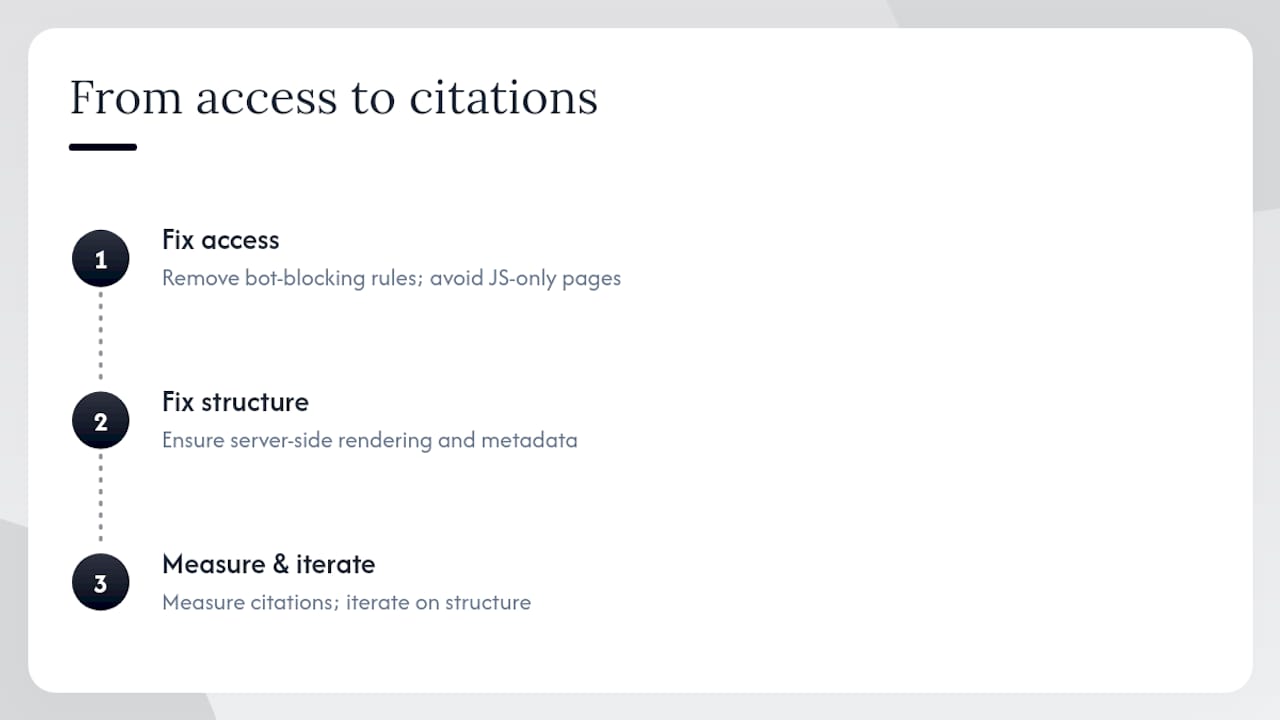
Monitoring tools are genuinely useful once access is confirmed and structure is in place. Before that point, they report absence rather than opportunity. The sequence that produces results is: fix access, fix structure, then measure and iterate. Cited's content optimisation guidance covers the structure side in detail, and the free audit handles the access and technical checks in a single pass.
***
Get your free AI citation audit from Cited
Cited gives UK businesses a clear picture of why AI engines are not citing their site, and then fixes it. The free audit covers all six citability dimensions and returns a scored report with a prioritised fix list, typically within 3–10 working days.
Next steps are straightforward. Run the free audit at cited.best, review the priority fix list, then choose Technical Fixes at a moderate one-off fee for a single implementation sprint, or AI Optimised with ongoing monthly optimisation and reporting for continuous optimisation and reporting. Enterprise pricing is available for complex or multi-site projects.
Ready to move from audit to implementation? Book a call with the Cited team to discuss your fix list and agree a timeline.
***
Useful sources
Source | What it covers |
|---|---|
How AI citation extraction works and the role of structured content and llms.txt | |
UK-specific guidance on crawler access, schema, and the citation-readiness sequence | |
How Google reports AI Overviews and AI Mode in Search Console performance data | |
Overview of dedicated AEO dashboards, citation frequency logging, and share-of-voice benchmarking | |
The RAG pipeline explained, with the signals rerankers use to select cited sources | |
The GPTBot vs OAI-SearchBot distinction and IndexNow for fast retrieval indexing | |
Referral traffic filters, citation tracker recommendations, and combined measurement approach |
***
FAQ
What are the best brand monitoring tools for AI citations?
The most effective tools for AI citation tracking are dedicated AEO platforms such as HubSpot's AEO tool, Xfunnel, and GenAI Lens, combined with Google Search Console for AI Overviews data. For UK businesses that also need technical fixes implemented, Cited's free audit and managed service covers both monitoring and remediation.
How do I know if ChatGPT is citing my website?
Check Google Analytics 4 for referral sessions from chat.openai.com, then run manual prompt tests in ChatGPT using your target queries. A dedicated citation tracker will capture citations that do not produce a click, which analytics alone will miss.
What is the difference between GPTBot and OAI-SearchBot?
GPTBot crawls pages for training data; blocking it does not affect live citations. OAI-SearchBot handles retrieval for ChatGPT's live answers, so blocking it removes your site from citation consideration entirely.
How long does an AI citation audit take?
A typical small business audit takes 3–10 working days from discovery call to final deliverables, covering crawler access, schema, HTML rendering, manual prompt tests, and a prioritised fix list.
How much does it cost to fix AI citation issues?
Cited charges £495 as a one-off fee for Technical Fixes, covering implementation of the priority issues the free audit identifies. The AI Optimised managed service is £995 per month for ongoing optimisation and reporting. Enterprise pricing is available on request.
Recommended
Ready for your AI score?
See how visible your site is to ChatGPT, Perplexity & Gemini.
Start FREE auditResults in minutes · 100% free